A figure stands alone in the desert, cradling his infant son. His followers, his brother, and his sons are now dead, except for his eldest who lies in their ragged tent, deathly ill. He has not had a sip of water in three days, since the tyrant Yazid ordered his family to be starved or slain.
He cries out, holding his son aloft, "Do none of you have children of your own? If you show mercy to my son, and give him but one sip of water, I will guarantee your place in Paradise!" The response is an arrow that pierces the infant's neck.
Ashura is the story of Imam Hussain AS, who was martyred by the forces of Yazid on the plains of Karbala in what is modern-day Iraq. The word "Ashura" literally means "10th" since it falls on the 10th of Muharram in the Islamic calendar. The story of Imam Hussain AS is one of sacrifice, and inspiration, in order to defy tyranny and preserve the ethos and values of the Islamic faith from corruption. The hedonistic caliph Yazid, ruling from Damascus, sought to force Hussain AS to swear fealty to him, in order to gain legitimacy for his claim of spiritual and political authority.
Hussain AS was the grandson of the Prophet SAW, the son of the fourth caliph Ali ibn Talib SA. (The abbreviation AS stands for "alayhis salam" which is a customary honorific applied to the name of important figures in Islam. The acronym SAW is a similar acronym reserved for the Prophet Muhammad alone, which translates to "upon him be peace.") Yazid knew that his rule depended on securing Hussain's AS allegiance. Hussain AS did not seek political power for himself or to replace Yazid. Hussain AS only sought to assert his spiritual authority and guide muslims in the faith. But his spiritual authority was perceived as a political threat by Yazid, and his refusal to submit an act of defiance. The significance of Ashura to Shiite muslims is in mourning the martyrdom of Hussain AS, but also in inspiration for doing what is right for the greater good. Hussain's AS sacrifice reminds us that we must not accomodate forces that seek to coopt religion for political gain, that we must not abandon our values and our beliefs.
Ashura is not a sectarian doctrine but a timeless message that resonates in every era. Muslims today (Shiite and non-Shiite alike) can draw inpsiration from Hussain AS in many ways, such as choosing to retain their so-called "muslim garb" (of Juan Williams' consternation) despite the unwanted attention it may bring them. Likewise, in Yazid we can see the face of other tyrants and self-styled authorities, such as Anwar al Awlaki or Osama bin Laden, who invoke and corrupt religion to further their nakedly political ambitions.
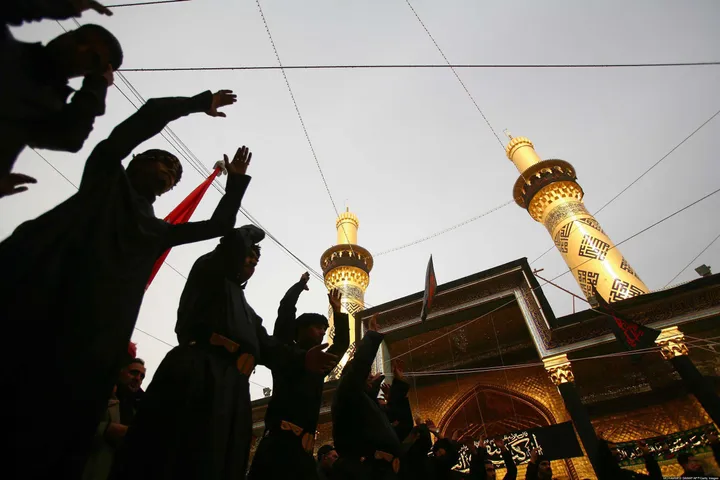
But central to Ashura must be sorrow. There is a great tragedy in the martyrdom of a saint, and Hussain AS was a prince among saints. Shiite muslims mark the occassion of Ashura by reciting marathiya, rhythmic liturgies that recount the story of Karbala. We also symbolically express our grief with matam, a symbolic beating of our breast with our open palm. These rituals are performed in majlis, a gathering at mosques or other centers, on the days leading up to Ashura and on the day of Ashura itself. Thus, Shiite Muslims have observed and remembered the sacrifice of Hussain for centuries. In our sorrow is our responsibility to fulfill the uncompleted trust laid upon us by Imam Hussain AS.
Hussain AS lay against the tree, beaten and bloodied, pierced by arrows and swords. The wicked Shimr came to him and shoved him roughly to the ground. Shimr sat upon Hussain's AS chest and tried to cut his neck with a blunted knife, but Hussain AS cried out, "Shimr, arise! Your knife will not cut here, for this is where the Prophet SAW kissed me often as a child."
With sudden strength, Hussain AS threw Shimr off, and then performed one final sajda (prostration). In that last fleeting moment, before Shimr lowered his sword, Hussain AS prayed for Islam, for muslims and the world. YA HUSSAIN!
There is no god, there is no heaven or hell or even purgatory, Dead is dead. There is no life after death. How can there be? We are not the cause of our existence, we are the result of our environment. Remember the Spanish discourse on whether Indians had souls or were just animals. Animals don’t have souls? For that matter, all animal life, insects, plants, bacteria, viruses? 230,826,365,trillion ants exist on earth. They are all life, they all eat, defecate and reproduce, all have some sentience, what makes us better than them?
We cannot fathom just how infinitesimal we are. All 106,million, million, million of us since the beginning. We think we are the be all and the end all. How stupid.
But we are less than nothing. Our essence is contained in the neurons and synapses in our brains, but there are about 70 thousand billlion stars that we can see, 10 times more than all sand grains on all the world's beaches - some think it is infinite. Most stars probably have planets, and some probably have life:
Our Milky Way galaxy contains about 300 billion stars, of which about 30 billion are like our Sun, and at least 1.5 billion theoretically have orbiting planets the size of Jupiter, and there are 125 billion galaxies in the universe.
There are more than one hundred thousand million sparrows. If his eye is really on the sparrow, then he doesn’t have time for the rest of us.
In any event, the irony of finding this article is that certain people of the Bohra community who were supposed to have taught me something about ashura stayed silent, leaving it to me to learn through osmosis, google or wikipedia. In my google search, I came across this article written by a Bohra. Gives me the distinct impression "outsiders" are not welcome. I believe we all end up in the same place, even if the Bohra believe they possess all the secrets. No one has designated them the "chosen ones" except for themselves.
Hussein is a great companion much beloved my every Muslim in the world, yet he is not different than the many other great men and women who were murdered and killed. If Islam was about crying for pious people...its would be 365 days of mourning, plus every hour, for the thousands of innocent and righteous ppl killed.
Omar, Uthman, and Ali and many countless other companions were murdered, and as Muslims it should not be about sadness or vengeance. We should rather be thankful for their hardwork, and continue where they left off...sadly some took the opportunity to cause more division.
This political tension that comes along with this story and history is one that should be put to rest. Hussein was murdered, so where Prophets, do you see ppl running around and causing harm to their bodies because of fate. It was meant to be, and I can honestly say that Hussein would be more disappointed to see the Muslim world divided because of his situation, when it was supposed to bring us closer and more united.
Sorrow has no place in Islam, as Ashura is the day we celebrate the freedom of the oppressed! The Israelites
Ashura as Prophet Muhammad stated was a day to celebrated Moses...I mean he couldn't possibly mean Hussein who lived years after him...
The first Shia person I met was in KSA ( never knew or heard of them before) and sadly she was cursing Omar for all things bad...funny how it was right in front of the Prophets grave..to my shock, I walked away...when I asked other about them (usually point them out because they are mostly Iranian or Lebs) and they said forget them...
First impression really does matter, and the woman really impressed me...the wrong way
As for history...sure sure, Hassan, Hussein would be SOO proud of Iraq today, SO proud...
However, religion is a belief, it is not a truth. If religious people would acknowledge that, it would lead to peace in the world. It is the concept religion as truth that leads to conflict. There are a billion Christians, a billion Muslims, almost a billion Hindus and Buddhists.
Since Christians, Muslims and Jews all claim Abraham as the father of humanity and Abraham's God is the God of Christians, Jews and Muslims then all these people should be respectful and joyous for each other since they all have one God. If God was the truth it would be so.
Unfortunately, they are constantly fighting each other because they each believe that their path is the truth and therefore the others are not truth.
This is the fundamental problem with religion, the desire to preach that it is the truth.
Truly religious people can do charitable work without preaching their beliefs, they should only offer their views when requested and speak about their personal experience knowing and acknowledging that it is personal to themselves.
All religious organizations have gained enormous wealth and political power fom their communities. The Pope is a fine example. The catholic church has enormous collections of art, property, and jewels. The Aga Khan, the leader of a branch of the Muslim faith lives a lavish life with race horses and obligation.
the fast is not required... it si what we cal a "nafil"... even i am observing fast today and did so yesterday as well...
The obvious heresy by some is shown on HP's Ashura photos of 100s of bloody men committing self flagellation as if THAT is the way to recognize Ashura.
From http://tribune.com.pk/story/91024/violence-in-muharram/
"Why has Muharram become such a season of tragedies for us? The people of Pakistan are not fired by sectarian hatred. Wherever there is no clerical or terrorist coercion, they coexist happily and, not so far back in the past, used to intermarry as well. Scholars who have investigated the closing of the Pakistani mind agree that Pakistan’s sectarian war is a relocated conflict and is a radiation from the fire that was lit in the Middle East and the Gulf when Arab leadership passed from secular leaders to religious ones, and Iran arose as the champion of the scattered Shia communities in the region."
Even the most horrid stories underlying Judaism and Christianity have been worked up over the ages by most mainstream streams to teach a lesson more important than the bloodiness and brutality of the original primitive narrative of hatred, violence, retaliation and oaths to retaliate for eternity.
Please, let me know.
The "bloody, brutal story" signifies the hardships faced by Hazrat Hussein and his companions... but they did not succumb and fought till their last for their faith, their religion, their values and their beleifs..
Most mainstream lessons from the Chanukah and Massada stories play down the fundamentalism and death-worship for a message to stand up for your values, preserve your heritage and that this applies to everyone. Chanukah can then be an opportunity not only for Jews to remember sacrifices made to preserve their homeland and to battle against assimilation, but also to think about whether they respect "others" the same way. You can see how it can be a moral reminder of how to treat the Palestinians as well.
All of this can be done without focusing on the guts and blood.
Muslims need to re-tailor the messages in a more peaceful way. Just because life wasn't peaceful then doesn't mean we can't put a peaceful spin on it now.
Just a thought.
http://www.nytimes.com/2010/12/16/opinion/16kristof.html?_r=2&ref=opinion
You don't have to look at the Talibans, look at the so called Royals in the Muslim countries, they buy toilets made of gold as their fellow Muslims starve.
And there is no Kingship in Islam
how to achieve victory while being oppressed.”
Charles Dickens (English novelist): “If Husain had fought to quench his
worldly desires…then I do not understand why his sister, wife, and children
accompanied him. It stands to reason therefore, that he sacrificed purely for
Islam.”
Charles Dickens (English novelist): “If Husain had fought to quench his
worldly desires…then I do not understand why his sister, wife, and children
accompanied him. It stands to reason therefore, that he sacrificed purely for
Islam.”
Mahatma Gandhi
“My faith is that the progress of Islam does not depend on the use of sword by its believers, but the result of the supreme sacrifice of Hussain (A.S.), the great saint.”