iPhone app iPad app Android phone app Android tablet app More

Featuring fresh takes and real-time analysis from HuffPost's signature lineup of contributors
Benyamin Cohen

Benyamin Cohen

Posted: March 8, 2010 11:19 AM

I know what it's like to be a Jew jonesing for Jesus -- at least for the purposes of a memoir. I spent a year going to 52 different churches each Sunday. So I was quite happy to find out I was not alone. Gina Welch's new book, In the Land of Believers: An Outsider's Extraordinary Journey into the Heart of the Evangelical Church, takes the reader into the heart of the religious right as Welch goes undercover at the megachurch in Lynchburg, Virginia founded by Jerry Falwell (and now run by his son.)

In the end, she came out -- as we all should -- more understanding of our religious neighbors. Her book is a great example of how those on any side of the religious, political, or cultural divide can retire our preconceived notions by walking a mile in someone else's shoes and come out a more tolerant and well-rounded individual because of it. In that sense, we should all try to emulate Welch's open-mindedness.
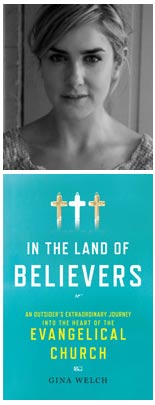
2010-03-07-ginahuffpo.jpgI caught up with Welch as she embarked on her book tour to find out what motivated her to go on this journey and what she learned from the experience.

What made a self-proclaimed liberal atheist Jew decide to go to church?

My Sundays needed structure. No, I think my attraction to the church grew out of repulsion. I grew up thinking of myself as a born atheist, bristling at public expressions of faith, at being shoehorned "under God" by the Pledge of Allegiance. Berkeley was very accommodating of that attitude. For the most part, I didn't have to deal with religion if I didn't feel like it. And so from the vantage point of my little sliver of experience, I thought of our country as a pretty secular place.

The violent realization I had when I moved to Virginia for graduate school was that this is a very Christian country, with around a quarter of Americans self-identifying as evangelical. And in spite of my smug self-conception as a tolerant person, I had this calcified, unrecognized prejudice against evangelical Christians. Their politics angered me, their culture seemed silly. Most of all their vocal efforts to see the world converted to their views made me, frankly, afraid of them.

Around the time I was reckoning with this stuff, George W. Bush got re-elected, an event that was flat out unthinkable to me. The polls showed that an organized, mobilized block of evangelicals played an instrumental role in helping him secure that victory, and following the election there was an avalanche of media coverage about this scary, militaristic zombie-force of evangelicals bent on hijacking government.

So this made me feel entitled to answers: If evangelicals believed they not only had a right to meddle in what I believed, but also in how my government operated, I thought I had a right to know who they were.

There was a complicating element: I knew a handful of evangelical Christians in Virginia, and they didn't align neatly with my conception of what evangelicals were like. So I was drawn to the navigation of those inconsistencies, and to challenge my own prejudices by experiencing firsthand the tactile reality of evangelical life.

Why undercover? Why not pose as yourself -- a journalist with questions?

Before I began attending Thomas Road Baptist Church, I dimly believed that I'd attract suspicion if I presented myself truthfully. That dim sense was affirmed by my early interactions: although I didn't tell anyone I was working on the book, during the first months I spent at church I told people I wasn't a Christian, that I'd gone to Yale, that I was "curious" about Christianity. And I was greeted as the gawking outsider I was. The church members I met witnessed to me, directed me to passages from the Bible, spoke to me in guarded, prepackaged narratives.

I understood their suspicion. There's a widespread impression among evangelicals that secular progressives would like to see them flushed out of the culture. Look at the strange currency of the war on Christmas, an annual pageant of outrage that from my point of view seems like goofy satire. Many evangelical Christians buy into it because in them resides a potent fear of endangerment, for which there's plenty of real-world evidence: a lot of secular progressives treat evangelicals with derision, the media feeds a public appetite for exposes on their churches, and we celebrate when their leaders are disgraced, humiliated, or revealed as enjoying the same behaviors they built careers on decrying as sin.

So the notion that they'd trust a liberal, atheist writer to fairly represent their stories, or that they'd act naturally around me, knowing the filter through which I was viewing them, was just unrealistic.

For any undercover book, I think the only possible redemption for the methodology -- for the betrayals woven into it, for winning trust on false pretenses, for the narrative theft -- resides in the value of the result. Do the merits of the work justify the means by which it was obtained? In my case, I'd like to think the value of a detailed, humanizing portrait of evangelicals from a secular perspective, deepened by the story about how its creation changed me, meets a real deficit in cross-cultural understanding. Could it have been written any other way? No. The intimacy of my experience, which is really the hinge on which the book swings, would have been impossible had I presented myself truthfully.

Ultimately, I can't be the arbiter of whether or not my deceptions were justified. They're justified if the book connects with readers.

What was the biggest surprise you found during your journey?

The biggest surprise for me was the individual reflectiveness of church members. I think I'd had this stereotype of evangelicals as blisteringly arrogant dogmatists. But I observed instead humility and a kind of obsessive self-reflection, enacted through prayer. They call it listening to God's voice, but from it seemed to me like a constant internal pat-down of conscience, which really resulted in care with choices, and a movingly ample capacity for selflessness and generosity. I learned a lot by their example.

A secondary surprise was that I felt implicated in the ignorance I observed -- relating to gay rights, to the environment, to feminism. I started to believe that their reactionary attitudes on these subjects were a result of profound insularity, which itself seemed the legacy of a culture that rejected them: mine. Why would they open themselves up to influence from a culture that made no space for their beliefs?

Who is the target audience for your book? More specifically, do you think evangelicals -- and Christians as a whole -- will enjoy your book?

The book's appeal for secular progressives, I hope, is implicit. I think we like to think of ourselves as very tolerant, but we're comfortable being nasty to evangelical Christians. I think Internet culture has really exacerbated this attitude. It allows for hostility that would be unacceptable in life, where interacting with flesh and blood people counteracts any budding impulse to reduce someone to a disgusting cartoon. So I want this book to restore some humanity.

I'd hope that evangelicals would be interested in reading the book to see how their ideas and culture translate to a person working very hard to take them seriously, who nonetheless doesn't share their central beliefs.

Since the book has now been published, and you've been "outed", have any of the people you wrote about contacted you? If so, what was their reaction?

Well, I actually outed myself long before the book came out. I thought it was important to do my best to emotionally prepare the people to whom I'd lied, and to be available to them for questions. So I went back to Lynchburg last year to talk to some people I'd been close to, to reveal to them who I truly was and what I'd done.

Their initial reaction was shock, of course. They were understandably wounded. I hadn't known this, but they thought something terrible had happened to me. So to find out that not only was I doing just fine, but also that I'd had this agency, that I'd done something to them, that I'd been secretly recording the events of their lives and that I'd stolen them for use in this book -- I think that was deeply disturbing news. Worse, not only had I lied about being a Christian, but I was an atheist, someone who -- from their perspective -- had no moral center at all. I've tried to understand what it must have felt like to assimilate that news, but it's something I'll never fully be able to imagine.

So they were hurt, and immediately suspected I'd written a jeremiad. They wanted to know if I'd set out to embarrass people.

After long conversations about what I did and why I did it, something incredible happened: they each extended me acceptance, affection, and forgiveness. I never could have asked for that. I don't have the right to impose expectations on anyone's reaction. But they've been generous and lovely with me. I'm still in touch with a close friend from church, and with one of the pastors. I believe if it weren't for the geographical distance, I'd be in better touch with everyone.

Any ideas yet on what your next book will be?

Right now I'm working on a project based on letters my grandfather sent to my grandmother during World War II, which lushly detail his Zelig-like experiences on the European front -- on the beaches of Normandy, in Paris, in the Hurtgen Forest, at Dachau. My grandfather destroyed my grandmother's letters as he received them, so part of the work of my project is restoring her narrative as a young Communist living with her mother in Brighton Beach. My grandparents were also persecuted for their politics at the start of the McCarthy Era, so I'm working to get my arms around the scalding disappointment of that experience, to have sacrifice rewarded with vilification and ostracism.

So, you know, another light, easily accessible subject. Sometimes I wish someone would come along and force me to write some short, breezy essays.

---
Benyamin Cohen is the author of "My Jesus Year: A Rabbi's Son Wanders the Bible Belt in Search of His Own Faith" and is the content director for the Mother Nature Network.


Follow Benyamin Cohen on Twitter: www.twitter.com/myjesusyear

I know what it's like to be a Jew jonesing for Jesus -- at least for the purposes of a memoir. I spent a year going to 52 different churches each Sunday. So I was quite happy to find out I was not alo...
 
 
  • Comments
  • 1,686
  • Pending Comments
  • 0
  • View FAQ
Comments are closed for this entry
View All
Favorites
Recency  | 
Popularity
Page: 1 2 3 4 5  Next ›  Last »  (24 total)
photo
HUFFPOST SUPER USER
skatoolaki
Passionate, fiery walking contradiction.
07:56 PM on 03/26/2010
Fascinating interview - I love Ms. Welch's manner of expression; she is obviously very intelligent, compassionate, and expresses herself with such candid sophistication. I cannot wait to get my hands on her book.

As a fellow progressive, though not an atheist (but definitely not a Christian), I am quite intrigued and want to delve deeper into Gina Welch's experiment and see what she learned from it; a fresh perspective does us all wonders from time to time and I will admit to having some of the same fears and reserves about evangelicals that Ms. Welch expressed having before embarking on this journey.

I am especially interested in reading about how she found some of her own long-held myths being debunked and coming to realize that - for all she thought Christian evangelicals were intolerant - she held some prejudices of her own against them.

All in all, I think this book will be delightfully enlightening and inspirational, with something to learn for individuals on both sides of the fence - and those in between. As well, her forthcoming book about her grandparents sounds positively engrossing; Ms. Welch is an author I intend to keep my eye on from here on out.
photo
ThankGodhesgone
Always Progressive and loving the CONs meltdown.
11:08 PM on 03/16/2010
Magick1 - I can't reply to your post to me, but I agree with you and fanned you.

Love your Avatar - Great movie.
photo
HUFFPOST SUPER USER
wandering girl
grownup
05:36 PM on 03/16/2010
"Why would they open themselves up to influence from a culture that made no space for their beliefs?"

I was raised in an evangelical, conservative environment and believe you got this backwards: they *live* in the same world I do, but they *reject* any culture that does not reflect and endorse their beliefs. they don't want to be included; they really, really want to convert everyone to their own viewpoint.
FaceReality2
Democracy in the U.S. is an illusion
06:35 PM on 03/28/2010
"they 'reject' any culture that does not reflect and endorse their beliefs"

Bingo, wandering girl.
photo
HUFFPOST SUPER USER
Ale
Unorthodox Progressive
08:54 PM on 03/15/2010
Despite having Christian friends and family that I care deeply about it is always hard for me to think of evangelical Christians as people or as thoughtful in any way.
Christianity to me has always been a religion that has no real moral center or ethical balance.
The article helped humanize a group I rarely consider as human quite honestly.
photo
HUFFPOST SUPER USER
skatoolaki
Passionate, fiery walking contradiction.
07:59 PM on 03/26/2010
Agreed.

Over the years, my view of Christians and especially evangelicals, has hardened considerably - to the point that I'd say it now, sometimes, harbors on intolerant. This, of course, makes me no better than that which I condemn in them.

I think, therefore, this would be a very good book for me to read and gain some perspective; to not become that which I despise and to remember to always be as accepting, tolerant, and compassionate of others as I expect them to be of me and the rest of the world.
12:55 AM on 04/08/2010
No moral center or ethical balance? Such thoughts can only come from someone who speaks without seriously studying Christianity, someone who read a book on the Inquisition and decided to throw out the baby with that bathwater.

For your own sake --- what would I gain if you did change your mind? --- read Augustine, or Aquinas, or Chesterton. Even C.S. Lewis or Graham Greene, if you want, but they're more readable than deep. Give faith a chance.
04:05 AM on 03/15/2010
Seems that there is a lot of backpedaling going on here. Or maybe it's just an attempt at creating the illusion of one.

Considering the definition of an atheist and the definition of a Jew, an atheist Jew is an impossible combination.
04:09 PM on 03/16/2010
I'm an agnostic Jew and only I can define what my beliefs are, so stuff it.
05:54 PM on 03/17/2010
I'm an agnostic Protestant. But then that's a non sequitur. To be Protestant implies that you believe in their god and dogma. Although I don't think about religion unless it gets in my way, most people associate being Jewish with a religious context. I guess you're free to redefine things in your own mind.
HUFFPOST SUPER USER
bklynsparrow
creating reality from unreal things
04:30 PM on 03/16/2010
Actually you can be an theist Jew, or an Agnostic Jew. Judaism is not only a cultural identity but Judaism is also a system of ethics and morality. It doesn't demand you believe in G-d- to get to Heaven your good deeds must outweigh the bad. In other words, believing in G-d won't get you into Heaven (if you are a religious Jew), only if you do good deeds. Unlike Christian theology which demands a belief in Christ or else.
FaceReality2
Democracy in the U.S. is an illusion
05:58 PM on 03/28/2010
How do the laws in Leviticus fit into the Jewish system of ethics and morality? Are they (at least the most extreme ones--like stoning adulterers, etc) rejected by all but the Orthodox?
03:33 PM on 03/14/2010
Jesus is not head over any of theses man made churches. Jesus is High Priest over God's church period, which will come and rule over all on the day of God's wrath.
This user has chosen to opt out of the Badges program
c-tom
Badges we don't need no stinking badges
05:53 PM on 03/15/2010
To a Christian Jesus is God. He is not a priest, a demi-god, or a good example. He simply is God - Father, Son and Spirit. Now don't ask me to explain how one can be three, just accept that it is.
FaceReality2
Democracy in the U.S. is an illusion
06:01 PM on 03/28/2010
Christianity is the best religion for golfers. With the Christian god, you immediately have a foursome.
FaceReality2
Democracy in the U.S. is an illusion
06:30 PM on 03/28/2010
And don't ask anyone to explain all the other inconsistencies and nonsense in the Bible. Just void your mind and accept everything whether it makes sense or not, and above all don't question anything.

These are the basic lessons of religion. Great lessons for kids, aren't they?
photo
HUFFPOST SUPER USER
Magick1
Dark fire shall not avail you. You shall not pass
02:28 PM on 03/16/2010
Does he have to?
01:38 PM on 03/14/2010
Has anyone been following the continuing saga of abuse accusations that are being leveled within the Catholic Church?

How is it that church is able to conduct their own private investigations and administer their own punishments outside of the reach of secular law?

What would the world be like without religion? There would be no need for atheists or agnostics for sure.
01:01 PM on 03/13/2010
You know the joke about the Irishman who says he is an atheist, "what kind of atheist are you", a friend asks, "Protestant or Catholic."

Mr. Cohen asks Ms Welch "What made a self-proclaimed liberal atheist Jew decide to go to church?"

It seems to me that Ms Welch is a bit confused.

If one is born into a religion, be it Islam, Christianity or Judaism (the big Monos) and let's face it religion is passed on to little children through a process of inculcation, then when and if one is able to free oneself from that inculcation, it is almost always begun by questioning that religion and trying to apply reason to one's observable existence. It begins as an anti status quo process.

This is often called atheism, because it is in effect a stance against the religion of our upbringing. But in reality, the important element is the process of reason and the desire for truth and understanding.

So I try to call myself a rationalist, not an atheist. Rationalism is fluid, it acknowledges the existence of uncertainty, but uncertainty that can be overcome eventually through knowledge.

When Ms Welch describes herself as an atheist Jew, is she saying I don't really believe in god, except when he created me a Jew. I think if she wishes to enter the public debate as a self defined "atheist", she needs to be less ambiguous.
photo
ThankGodhesgone
Always Progressive and loving the CONs meltdown.
10:02 PM on 03/13/2010
So I try to call myself a rationalist, not an atheist. Rationalism is fluid, it acknowledges the existence of uncertainty, but uncertainty that can be overcome eventually through knowledge.

I love that description. Co-signed and fanned.
04:38 PM on 03/14/2010
"but uncertainty that can be overcome eventually through knowledge."

... that knowledge that you will eventually get (that you demand before you will believe) unfortunately won't be gotten until after you die, and then it will be too late. We are not going to get an explanation to our existence in this life.. our existence is illogical... it's beyond our comprehension, if nothing else is obvious, that is. You are kidding yourself.
photo
ThankGodhesgone
Always Progressive and loving the CONs meltdown.
03:20 AM on 03/13/2010
What a crock, young lady. In your own words:

"There's a widespread impression among evangelicals that secular progressives would like to see them flushed out of the culture. Look at the strange currency of the war on Christmas, an annual pageant of outrage that from my point of view seems like goofy satire. Many evangelical Christians buy into it because in them resides a potent fear of endangerment, for which there's plenty of real-world evidence: a lot of secular progressives treat evangelicals with derision, the media feeds a public appetite for exposes on their churches, and we celebrate when their leaders are disgraced, humiliated, or revealed as enjoying the same behaviors they built careers on decrying as sin."

In your story you also said that there were many more believers than none believers, so why are non believers such a threat?

As for Christmas, you do realize that this was once a pagan holiday regarding the winter solstice and was taken over by the Christian church as 'the celebration of Jesus' birth? So too was Easter. It originally was a pagan holiday to celebrate fertility.

The goddess celebrated in April was known as Eostre.

See the link below of the history.

http://englishheathenism.homestead.com/eostre.html
11:08 AM on 03/13/2010
"In your story you also said that there were many more believers than none believers, so why are non believers such a threat?"

The numbers argument makes doesn't really apply. Welch discussed the state of antagonism that exists between many evangelicals and 'liberals'. That isn't related to numbers. What it is related to, as she mentioned, is media discourse.

What did you think of the main point of her story? Would you be willing to challenge some of the deeply held impressions you have of another group of people, and really get to know some of them on an intimately personal level?
11:31 AM on 03/13/2010
lol "makes doesn't really apply"

editing in mid-sentence fail!
photo
ThankGodhesgone
Always Progressive and loving the CONs meltdown.
09:59 PM on 03/13/2010
Regarding your last para. I already do. I have 3 uncles who are pentecostal ministers, as wll as Aunts and cousins. I don't judge people by their beliefs, only by their actions.
photo
HUFFPOST SUPER USER
skatoolaki
Passionate, fiery walking contradiction.
08:19 PM on 03/26/2010
I think everyone is more than well aware at this point that Christmas and Easter both are Pagan in origin; much more so than even Halloween.

Here are the histories - and Pagan origins - of both of these "religious" holidays:
http://bit.ly/2HqpT8
This user has chosen to opt out of the Badges program
MJinCanada
Safe from zombies until my 2nd cup of coffee
01:46 AM on 03/13/2010
I'll believe that the congregation comprises a large number of very nice people.

However, the church and political leaders who dupe them and use them as uninformed voters are quite another matter.

I'm not trying to be mean or hoity toity, but when people put too much emphasis on faith it can keep them from thinking. And there are always wolves who prey upon sheep in such a situation. A friend of mine got into a new church with a "God will provide" frame of mind and it took a nasty brush with hypothermia to realize that she had the wits, power and responsibility to prepare and look after herself, instead of trusting completely to the mercy and miracles of God. Another woman I know went through a nasty divorce: she innocently chose a lawyer and a counsellor from her church and both of them took advantage of her as much as her ex did. That hurt her a lot emotionally.
12:40 AM on 03/13/2010
The author should join the Unitarian Universalist church - they support spiritual growth and believe in respecting others religious beliefs - no matter how silly they are. I spent some time with them several years ago and they are admirable in many ways and brighter and better informed than most Evangelicals - most having had to actually put some serious mental effort into finding there way from mainstream churches, usually through several churches to the UUs.

Unfortunately, the part about respecting others belief systems never came off as intellectually honest or logical to me. Why would I respect ignorance, or misinformation, or mythology as fact? Why would I respect someones beliefs - no matter what crap they might believe, no matter how ignorant it may be in the face of factual evidence to the contrary? What would we do if a bunch of religious cannibals joined the church? This idea that all information regardless of its quality and basis deserves equal respect - caused me to leave the UUs and all other churches beside the road on the way where to a place where logic and critical thinking are respected and lesser processes are not.
photo
Chase Stowell
Interested Citizen
08:18 PM on 03/12/2010
I appreciate Welch's effort to humanize the Evangelical community, they aren't a bunch of mentally ill psychos. But ultimately, as a recovering believer, I still argue that faith is a dangerous tool. The cultural acceptance of believing claims with no evidence condemns mankind to forever dwell in darkness. Still her book is worthwhile by painting a picture of evangelicals beyond stereotypes. Portraying them as human beings just makes me want to "save" them from their ignorance even more.
09:14 PM on 03/12/2010
I disagree. They are a bunch of mentally ill psychos and need to be reminded of that constantly. Patience hasn't worked with these chromosome deficient, self righteous fools. It's time we actually counter their aggressive tactics, by speaking out.
11:16 AM on 03/13/2010
It must be quite convenient to have such a bipolar view of people.
This user has chosen to opt out of the Badges program
photo
11:09 PM on 03/12/2010
"The cultural acceptance of believing claims with no evidence condemns mankind to forever dwell in darkness."

That's dramatic (it has a brimstone quality to it). Yet now you're an atheist, which is to say you believe in something that also lacks evidence. You have simply chosen the contrary position.
12:56 AM on 03/13/2010
Typical of most religious thinking. Atheism isn't a contrary position - its no position. The atheist is simply waiting to have the necessary evidence to have a basis for belief. Get it - its the absence of credible evidence to reach a position.

I don't believe in the gods of any known religion because those religions have yet to present any evidence (in the same way would be necessary to believe in any kind of product's efficacy or not) that would make me decide to. If someday someone presents any kind of credible evidence for some god, I'll be open to it. In the mean time I'll consider all organized religion as a self serving scam, that I personally consider criminal - as much of religious history so well illustrates.
03:02 PM on 03/12/2010
If you subject yourself to propaganda of any type for long enough you will find yourself believing it.
This user has chosen to opt out of the Badges program
photo
03:12 PM on 03/12/2010
True. And if you believed any of it before you decided that five years wasn't too long to spend with evangelicals (five minutes is too long for me), what then?

*ka-ching*
HUFFPOST SUPER USER
haval2
what to say?
02:51 PM on 03/12/2010
Before you try to drum up sympathy for the evangelicals and their so called persecuted status you might want to check into your own history...you may have chosen to be an atheist but I am sure as Jews your family through the ages suffered a lot more than evangelicals in a country such as the US.
photo
HUFFPOST SUPER USER
MyHeartSpits
Be kind, for everyone is fighting a hard battle
02:18 PM on 03/12/2010
Also, lack of belief is not belief. If the lack of something proves its opposite, then all things in all dreamworlds might as well exist.
This user has chosen to opt out of the Badges program
photo
03:14 PM on 03/12/2010
Do you believe god or gods exist?
photo
HUFFPOST SUPER USER
MyHeartSpits
Be kind, for everyone is fighting a hard battle
03:58 PM on 03/12/2010
You're ignoring the logic of my statement. If lack of belief is belief, then believing and not believing are the same, and god and not god is the same, and dreams and reality are the same.
photo
HUFFPOST SUPER USER
MyHeartSpits
Be kind, for everyone is fighting a hard battle
04:33 PM on 03/12/2010
Someone is murdered and there is no evidence to point to any suspect, but John Doe lives in the town where the murder took place. Your logic requires that I either believe he's a murderer or innocent, when there is evidence of neither and I know nothing of John Doe. Where should the conviction come from?
01:02 AM on 04/08/2010
Fanned to the OP.