
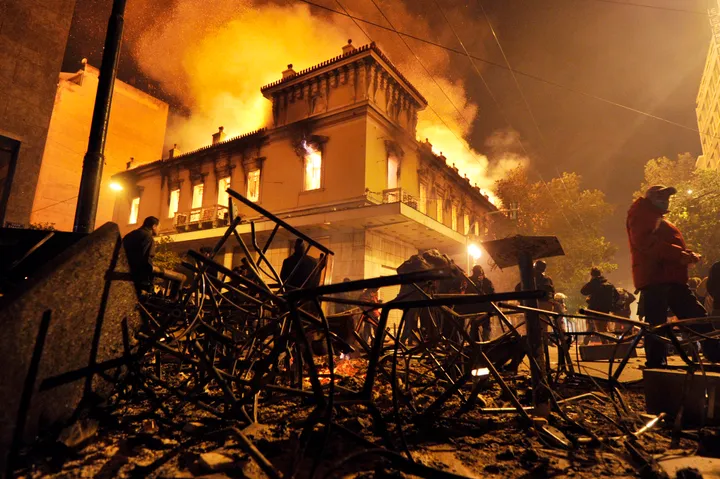
The Greek Parlement's vote, during the night of Sunday to Monday, on the austerity plan the European Union demanded as a prerequisite to the release of a new installment of financial assistance was inevitable. Clearly, the alternative to the austerity plan was, in the short term, exclusion from the eurozone, leading to bankruptcy and the consequent plunge into a state of poverty even more unbearable than what the country faces today. And one finally understands that the negligence of successive governments in Athens for the past 30 years -- their demagoguery, their clientelism, their bad faith, and their short-sighted policies -- have forced their partners to raise their voices.
Nonetheless.
In an affair like this one, which is political as much as economic, and where the highly inflammable matter being toyed with is a people, their pride, their memory, their revolt, their survival, one would like to have seen things handled more deftly.
In such a declaration by German or French leaders, a tone free of contempt, less like a diktat, would have been appreciated. One would have preferred that they not contemplate the replacement of the Greek finance minister by a European commission, the very idea of which could only be perceived as a useless form of humiliation. More importantly, one would have wished that the bureaucrats responsible for the plan not throw health expenditures in with the indispensable and just measures for drastic reduction, placing them on the same level as the wasteful spending of a state given to excess. In other words, we would like to be sure that those charged with evaluating the country to save it from bankruptcy had no other choice but to make cuts blindly, reducing the budget for the most essential public services, those upon which the bio-political survival of its citizens depend, as much as, say, defense.
At the same time, we should be certain that these evaluators are themselves adequately informed of the diabolically complex mechanism that they are implementing by compelling Greece to reimburse its new debt while facing the growth that this new bludgeoning will automatically cause to contract, and that its effect will not be to bring the country to the level of debt in 2020 that it faced in 2009, before the "bailout."
In any event, it is regrettable that this crisis is not the occasion, not only in Greece but throughout Europe, for a vast democratic debate, whose results might be: 1) an actual auditing of this debt, so that the electorate has the right to know its history and how it spiralled (incidentally, isn't this the only way to make them a part of the implementation of the plan that, for the moment, is imposed upon them?); 2) a division of responsibility among governments (socialist as well as conservative), bankers (including those who have been recycled to head international institutions and who, all of a sudden, are wagging their fingers at the Greeks), and local social categories (who have turned fiscal fraud into an art form, and continue to do so); or 3) the vision not of the choice but of the choices that were available and remain so to this society gripped in a stranglehold (choice, yes, this deliberation by citizens among a variety of possibilities, even if reduced, that is the essence of democracy as invented, precisely, by the Greeks, and from which no state of emergency can exempt those who govern).
All that is not a question of style but of substance, and even of destiny, first of all because the images transmitted from Athens are not those of simple demonstrations but of a social tie that is disintegrating, exploding, dissolving -- and it's like the end of a world; and then because, if the people are not always right, one is never right when against the people -- except in resignation to its hurling itself into one or another form of this naked abhorrence, with neither words nor faith, this strange, suicidal whirling of passions that are dead and, paradoxically, all the more virulent, which is the eternal refuge of worn-out societies indifferent to the form of chaos they choose or, in reaction to chaos, to that of their chosen tyranny; and finally because the entire continent finds itself confronting this politically, morally, and metaphysically unbearable perspective. Europe had, among other virtues (including peace and prosperity), that of reconciling with the practice of freedom peoples, both to the south and to the east, who had been more or less deprived of it for a long while. And now the same institutions, the same community rules, the same currency -- in short, the same Europe -- would have the inverse effect, because it would plunge a member country into anarchy, or into forced order, a dictatorship, even fascism -- which amounts to the same thing.
This would be a failure whose shock waves, really, would far surpass those of the simple rupture of an economic and monetary union. And for the "good Europeans" whom Nietzsche predicted would be the only ones to hold back the flood of nihilism, when the time came, this would be a nearly unimaginable yet very real irony of History. But the worst is never certain. And there is still a little time to save, together, the dream of our illustrious pioneers.