
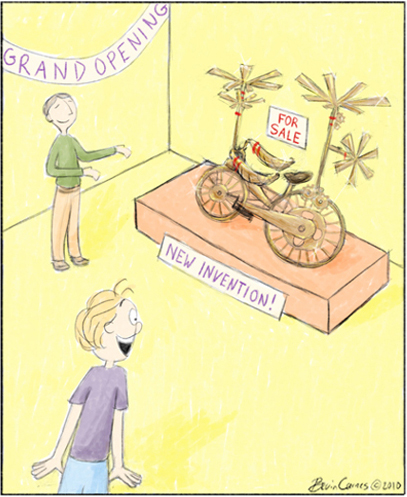
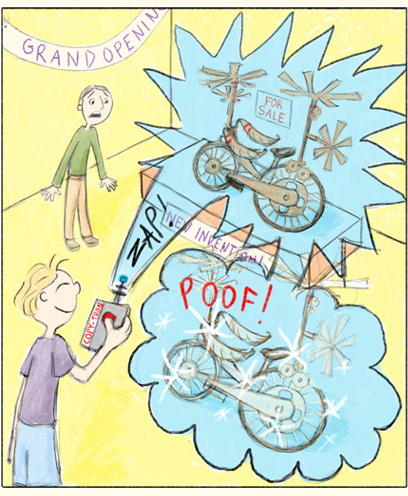
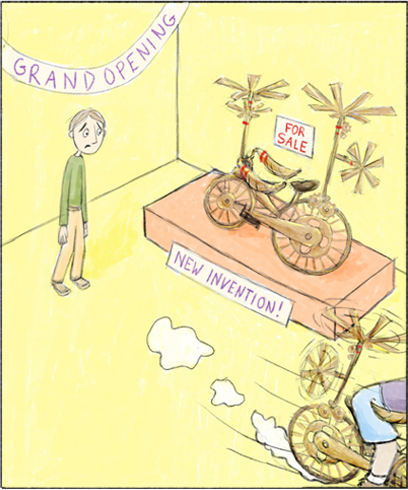


There seems to be an awful lot of confusion surrounding the ethics of illegal downloading these days. Most people have a general sense that it's probably wrong, but they'll keep doing it anyway, because they doubt that anyone will really get hurt as a result of their actions.
This attitude is further exacerbated by a number of misleading rationalizations (many cooked up by those who profit from piracy) out there waiting to sway people in favor of illegal downloading.
One such justification supposes that if ideas were physical things, like bicycles, it would be easy to see how making a copy would be harmless. If you have a bicycle, and I steal it from you, then you no longer have a bicycle, and that's why it's stealing, because you get hurt. But if you have a bicycle, and I copy it, we both have a bicycle. So in other words, copying can't be stealing because no one is harmed. Now we can both ride happily off into the sunset on our identical bikes, and seemingly nobody gets hurt. That seems pretty cool, right?
But like all things that appear too good to be true, there's a catch. Someone had to make that original bicycle -- a team of people designed it, figured out how to manufacture it, safety tested it, and another group of people- perhaps the owners of a mom and pop store in your neighborhood sold it to you. When you give your friend a copy of your bike, those are the people that get hurt. Those are the people that get put out of business. Then when you and your friend's bikes get old and you want newer, cooler ones, there won't be any, because you've destroyed the business model that produced the original version. Sure, you and your friend could then create "user-generated" bikes that might work okay for awhile. But since you and your friend aren't in the business of creating bikes, you probably won't have much time for that, since you have to spend most of your time doing whatever it is you do to make a living. As a result, the bikes you build might not be very good, or even safe. Without a dedicated business model in place for the production of bikes, the quality of the product would go down.
Your actions have now caused a chain reaction that has robbed good people of their dream of producing good work that you can enjoy in the future. Also, those who were training to go into the business of designing and building bikes will now see that there is no business model in place that will allow them to make a living doing what they love, and so they will be forced to go into a different business.
So, what on the surface may have seemed harmless to you as you were making that copy, has now hurt absolutely everyone, including you and your friend, because the quality product that you liked and wanted to copy in the first place can no longer be produced.
Sadly, this scenario is exactly what is now happening in the world of intellectual property creation. People are "sharing" movies and music with the thought that no one is getting hurt in the transaction. They don't realize how many people were involved in the process of creating those original films and songs and that when these creators are deprived of compensation for the use of their work they go out of business.
Also, the economic implications of the theft of intellectual property could be even further-reaching than the theft of physical property. Over the past few decades, America has become a culture that increasingly produces and exports innovation and ideas more so than physical products. If, as a society, we propagate the concept that ideas and innovations have no monetary value, we destroy the basis for our future economic system in America. We kill the American jobs of the future.
When you really take the time to consider all the ramifications of the "copying isn't theft" scenario, you discover that not only is illegal copying (ie. copyright infringement) a form of stealing, it's stealing from yourself and from your own children's future.
Each time someone thoughtlessly copies someone else's intellectual property and gives it away for free they cast a single vote against a future that would most benefit themselves and others. Eventually, all those single, thoughtless votes could change everyone's future for the worse. What we're asking from each and every person is very simple -- cast your vote in favor of the future you want by doing what you know is right.
Follow Bevin Carnes on Twitter: www.twitter.com/bevincarnes
The people who are profiting from piracy simply care more about their own welfare than yours. They see a chance to better themselves and they take. You will never change the minds of these people with your moral screeds. They see your greed as immoral. You will need to figure out how succeed in spite of them. And if they means you stop creating, then thats just the way it is.
Not ever copy is a lost sale. When people share something only when it is good. Each act of sharing what is good is a vote cast towards buying something that is scarce.
There's always the possibility of concurrent ideation (two people having the same idea at the same time.) And then, where does one draw the line? If I copy your ten-line piece of software, and change five lines, is that a violation? What if I change just half a line? What about, nine lines? What about translating your ten lines to a different language (extract some of the HTML and render it to HTML plus CSS)? There's simply not enough humans in the world to watch all the websites in the world to watch all the websites in the world to detect copying.
The best might be, to place a Creative Commons or Copyleft notice on the website which states that the author acknowledges the possibility of copying, but reserves the right to modify the original for the author's own benefit, without incurring royalties to or violating copy infringements of the copier(s).
From the article...
"Then when you and your friend's bikes get old and you want newer, cooler ones, there won't be any, because you've destroyed the business model that produced the original
version."
Agreed to the part that the business model is destroyed! But just because the business model is destroyed, it does not follow that their will be no more bicycles produced. Bicycles may just become open source. Because of a technological change the existing business model no longer works. And if the industry is to survive - then a new business model is needed.
If the topic of the thinly veiled discussion is music recording the revenue stream can no longer be sought in the selling of recordings of the music. But rather in the selling of live performances, and other associated merchandise. Perhaps if the industry is stubborn recorded music can still be sold. But the packaging will have to be the enticing factor - not the music.
If the industry is software, then the software industry will also have to change their business model to generate revenue from a source other than the sale of the software. Perhaps the support site for the software can be advertising driven. Perhaps the software industry should die, and be replaced by open source creators who are happy to give away their product for free, or for donation by altruistic adopters.
Who knows at this point! Several industries are in flux. But just because the dust has not settled from this revolution, does not excuse the promulgation of such gloom and doom fear mongering. All that is clear is that no amount of preaching to the population at large, nor threatening them with legal action, is going to modify their behavior and convert them back into purchasers once again. To do so is akin to trying to take an omelet and turn it back into an egg.
The sense of entitlement of the recording industry is amazing. Not only do they think they should be able to violate every law of economics as we know it by ascribing an artificial monetary value to something that isn't scarce (digital data), but they apparently live in a dream world where everybody gets paid for having hobbies, no matter if there's a market or not.
I'm sure the carriage makers enjoyed their jobs before the automobile put them out of business. Markets change, jobs come and go. You can no more willfully stop that than you can willfully trigger it. It happens naturally.
They steal your website data and sell it to others or use it to sell their advertising. Google has a business model that is primarily built upon the theft of other peoples' data.
If we could copy a bike, we could copy a house. Which is more important, that a few people make a lot of money or that all people get to have shelter?
And art is an expression of creativity. Art inherently seeks to be shared, to be seen and heard. It's not as good unless someone appreciates it.
I think it would be great if everyone got a bike, because my grandchildren's grandchildren better not be going to work in a bike factory all their lives just because people didn't copy music.
*sarcasm aside*
Life is much easier without copyrights in area you can get it.
There are many ways to monitise your ip that does not involve selling it directly, you just have to be willing to think outside the box.
Ucentric.org
BTW, can you list me any examples of a copyrighted bicycle? You'd have a patent on a bicycle, not a copyright. How long would such patent protection run for a bicycle? Life + 70 years? Nope. But, as soon as Disney starts actually manufacturing bicycles, I'm sure we'll see a push for that too.
http://www.slyck.com/story2055_ACS_Law_Website_Remains_Down
Bullying of File Sharers Lands Solicitor in the Dock:
http://www.thinq.co.uk/2010/8/24/file-share-bullying-lands-lawyer-court/
Anti-Piracy Bully Banned by Swiss Court:
http://www.thinq.co.uk/2010/9/9/anti-piracy-bully-banned-collecting-ips/
Finally, I salute 4chan for the havoc they are causing these morons. Keep up the good work, kids! I've got more popcorn ready to go!
Uh, actually, this would be perfectly legal because you would have to build/acquire and assemble parts yourself. What kind of bike it resembles is immaterial as long as you don't position it as a factory made model in trying to sell it.
Moreover, this article continues to display the legacy of its onetime bigwig, Hilary Rosen, a onetime chief lobbyist for the RIAA.
Moreover, by continuing to issues these kind of lame articles, the MPAA and the RIAA, both of which are trying to dictate to consumers how they use legally bought product and eliminate the fair use doctrine, actually make it cool to steal. And that is before you get to the fact that the RIAA's members regularly reduce their artists to a kind of sharecropping through things such as cross collateralization and abusive accounting practices. And now they want artists to sign 360 deals, which would further inhibit artist income. Only suckers would fall for that.
Look, if those industries want to inhibit torrent sites then what they need to do is become more collaborative with music and movie audiences rather than talking town do them and telling us how we should use what we bought.
I’m pretty tired of hearing about how people are stealing because they believe our industry is evil and they should take it down, and the music/movies aren’t any good so they have a right to steal all they want. My answer is this: prove that you have the courage to stand behind your word.
If you really believe that what you’re doing is right, then what you should do is send the RIAA and the MPAA a list of every song and movie you’ve stolen, and tell them that you’re proud of what you did and you have no intention of paying. Then when they sue you, go to court with them, prove your point, and get the law changed if that’s really what you want to see happen.
Piracy is a crime of convenience. Most people will keep downloading without paying because it’s easy and they believe they won’t get caught, but it would take real courage for someone to volunteer to identify himself and stand up for himself in court. I personally won’t take people seriously who aren’t willing to stand up for themselves in an arena where they know they’ll be held responsible for their actions.
What this does is tell the public that our entertainment overlords are unable to adapt to new marketplace realities and they are technophobic. The approach you guys are taking is akin to tailors organizing to have sewing machines outlawed except when they are used by big apparel enterprises.
So either find ways to exploit the net and these technologies to a public that no longer wants to be talked down to but wants to be collaborated with or consign yourselves to the ashcan of history. Yeah, you may not like it, but it isn't up to members of the public to hold your hand and protect and indulge your whims like you're a four year old.