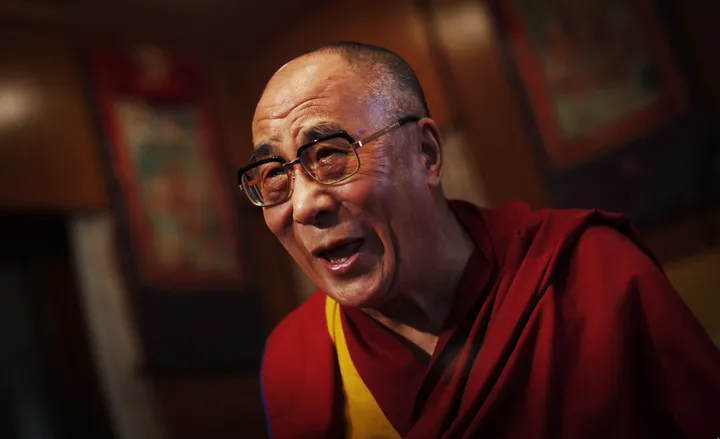
On July 6, 2010 His Holiness the Dalai Lama turns 75, according to the Western calendar.
This is a good time to talk about what the Dalai Lama means to the world. Oftentimes, as part of my work here at the International Campaign for Tibet, I have come across people from, and working on, conflict areas similar to Tibet who want to know the reason why the Dalai Lama and the Tibetans seem to strike a chord among the American public. Part of the reason for this, I feel, lies with the Dalai Lama's personality.
There is the traditional Tibetan perspective of His Holiness that is shared by followers of Tibetan Buddhism along the Himalayas, including in Mongolia, the Russian Federation, Nepal, Bhutan, etc. This perspective regards His Holiness as the manifestation of Chenresig (Avalokiteshvara), the Bodhisattva of Compassion. He is someone who has the capacity to be fully enlightened but has chosen to come back to this human world for the sake of sentient beings.
Prior to 1959, an average Tibetan could only hope to meet someone who may have been fortunate to get a glimpse of His Holiness from a distance. At best this glimpse may have been at a religious teaching or when the Dalai Lama undertook his irregular travels in Tibet. It would be rare to meet someone who had an audience with His Holiness. The structure of the Tibetan society in independent Tibet was such that there was very limited access to His Holiness. Elaborate protocol was the rule of the game. To Tibetans, the Dalai Lama was the focus of their daily prayers. Nobody even dreamt of any close encounters with him.
But in the post-1959 period, following the flight of His Holiness into exile forced by Chinese incursion into Tibet, the institution of the Dalai Lama underwent a dramatic transformation, much to the delight of the young 14th incarnation. Aided by circumstances, the institution became less protocol-heavy, more accessible to the public and more practical. Over a period of time, this led to a close interaction between His Holiness and the Tibetan people, a historical development of sort. The most obvious indication of this metamorphosis is the increase in the number of Tibetans with the first name Tenzin. Almost every other Tibetan who is born in exile and under the age of 40 may have this first name. Tenzin is the name that His Holiness gives when followers of Tibetan Buddhism resort to the convention of approaching a lama for providing a name to their child. Prior to 1959 only a privileged few Tibetan children may have had the opportunity to get their names from His Holiness.
Life in exile has also led to His Holiness' interaction with the outside world, mainly through his visits throughout the world. This has provided the Tibetans with a new side of the Dalai Lama. While most of the Tibetans still hold strong to their Buddhist faith and thus subscribe to the traditional perspective of the Dalai Lama, they have also been able to see his human side. Accordingly, His Holiness has become the role model for the young Tibetans.
I belong to the generation of Tibetans who grew up in exile, a generation which had to be the spokesman for our people without having the direct experience of life in Tibet. This change in our situation, however, has given me a fresh insight into the Dalai Lama and has provided people like me with the opportunity unimaginable by my parent's generation.
Growing up in India, I did not dream even for a minute that one day I would be in the same room as the Dalai Lama, leave alone being able to strike a conversation with him. But that day arrived in the late 1980s and is fresh in my memory even to this day. I was accompanying an Indian photojournalist to the residence of His Holiness in Dharamsala as part of my work at the Tibetan Department of Information and International Relations. Between photo sessions, His Holiness looked toward me, just a newcomer to the Tibetan civil service, and asked me from which part of Tibet I was. That one ordinary-sounding question altered the course of Tibetan social history, to me at least. The Dalai Lama had spoken to me, an ordinary Tibetan, and had acknowledged my presence. Since then I have been privileged to interact with His Holiness on quite a few occasions in the course of my work.
My interaction with His Holiness is in a way symbolic of the transformation of the institution of the Dalai Lama that the 14th incarnation, Tenzin Gyatso, has brought about. The significance of the transformation can be comprehended only when one has looked at the history of modern Tibet, as well as that of the 14th Dalai Lama. To be objective the course of modern Tibetan history dictated certain changes in the institution as well as in the Tibetan society as a whole.
However, things may not have changed as rapidly as it did had the 14th Dalai Lama not complemented historical development with his own liberal outlook and foresight. My fascination (if I even dare use this term) with His Holiness is more to do with his social activism and less with his religious role. While His Holiness' outreach to the international community in the field of religion and spirituality, as well as in drawing attention to the plight of the Tibetan people, is acknowledged internationally, not many know much about his influence in the social thinking of the Tibetan people and his other followers.
The establishment of a system of universal modern education for young Tibetans, mainly with the assistance of the Indian government, in the wake of his flight to India in 1959 was the most important factor in changing the Tibetan society in exile. That one act by the Dalai Lama not only provided a level playing field for Tibetans at all levels of society in terms of educational opportunity, but the blend of modern and traditional education that was part of the curriculum resulted in a new generation of Tibetans, modern in outlook and also having knowledge of our cultural heritage.
His Holiness is a social reformer and an iconoclast. Relying on his moral authority and the well-founded justification of Buddhism as a rational religion, His Holiness has altered those theological perceptions of Tibetan Buddhists that did not conform to scientific reality. This included asking the monk community to accept the earth as round instead of flat, which is contrary to Buddhist scriptures, and removing the mystery behind the institution of the Dalai Lama, thereby forcing the very many lama institutions to follow suit. He has encouraged doing away with irrelevant monastic rituals and political protocols. He has transformed Tibetan Buddhism from being ritualistic to being a practice relevant to any individual interested in it.
His Holiness has been able to make effective use of his coveted position to change the social system not only of the Tibetans but also of communities that share the same cultural values as Tibetans. For example, although people living in the Tibetan cultural environment do not have a caste system, people following certain professions are looked down upon.
There is a story of how a simple act by His Holiness changed the outlook of the Ladakhi people (an ethnic Tibetan community that resides in the Indian state of Jammu and Kashmir that borders Tibet) towards the musicians in their society. It is said that a community of musicians is traditionally looked down upon in the Ladakhi society. During one of his visits to Ladakh, His Holiness interacted with one such musician, took the drum sticks from his hand, and beat the traditional drum himself a couple of times. This sent a strong message to the Ladakhi people.
One issue that has personally affected me is His Holiness' contribution to changing the dietary habit of the Tibetan people. Tibetan Buddhists traditionally consume meat, and the reasoning goes that Tibet in the past did not have adequate non-meat products. Since 1959, the Tibetan society has changed greatly. Today, Tibetans, whether living in exile or inside Tibet, do have access to vegetarian food. However, meat continues to be an integral part of the Tibetan diet even now, much to the consternation and confusion of outside observers who tend to equate Buddhism with vegetarianism.
Many people do not comprehend the significant role His Holiness has been playing in promoting vegetarianism. Through his personal example (he became total vegetarian for some years, but then had to resume some non-vegetarian diet on the advice of his physicians) and consistent advocacy using his coveted position, His Holiness has started leading the meat-eating Tibetan society along the path of vegetarianism. In the Tibetan community he has encouraged food workshops promoting vegetarianism. A meat-eating society has overnight started taking gradual steps towards vegetarianism. This is a significant development. There are increasing numbers of Tibetans like myself who have become vegetarians, and our encouragement has come from His Holiness.
His Holiness is also a role model for a balanced approach to life. He can adjust easily to royalty and heads of state as well as to a simple monk in a meditation cave. Several years back, I overheard one Swiss tourist exclaim "Sehr einfach!" -- very simple -- when he found that he was traveling in the same tram car as His Holiness. He can be very solemn in a ritual-filled Buddhist ceremony or be jovial among schoolchildren in a Tibetan settlement.
During the Dalai Lama's May visit to the United States that included trips to Indiana, Minnesota, Wisconsin, Iowa and New York, I was struck by his categorical assertion that the world is becoming more gentle and positive. This is quite contrary to popular feeling of the world becoming more violent and crisis-ridden. It has certainly provided much food for thought to students of the developing society.
His Holiness was adamantly clear during his lectures, his brief appearance on NBC's The Today Show, and during his meetings with the press in general that the world is becoming more positive. The indicators of his world view were the broader human concern for man-made or natural calamities worldwide (shown in the aftermath of the Asian tsunami and the earthquakes in Haiti, Chile and Tibet), the existence of peace movements throughout the world (which was visible prior to the United States' war in Iraq, for example); the emergence of an environmental movement (there was no such movement in the beginning of the previous century); and the increased interaction between science and religion (science is showing interest in not just external matters but also in the study of mind). In short, through a comparison between the 20th century and the 21st century so far, the Dalai Lama feels the world is becoming more positive.
The Dalai Lama feels that much of the blame for the popular view of the world becoming worse should be placed on the media, which tends to always highlight the negative (even though it involves only a miniscule amount of the world's total population) while taking the positive for granted.
The Dalai Lama has also been talking about his three commitments in this life. In addition to finding a solution to the Tibetan issue, he also embraces two fundamental commitments to promoting human values and religious harmony.
He refers to the "oneness" of all religions in that they all convey the same messages in attempting to make us better human beings. He thinks that at one level there is philosophical difference, which is a reality. At another level, he says all religions preach the message of compassion, love and tolerance, etc. The Dalai Lama feels we need to prioritize by treating the philosophical differences as secondary to the more important common messages. This is a worldview that would certainly make all religious practitioners rethink their approach to spirituality.
Similarly, in terms of human values, the Dalai Lama feels that differences in caste, creed, color, etc. should be placed at a secondary level to the more fundamental thinking of the sameness of human beings, who want happiness and shun suffering. This is a simple message, but placed in the context of the Dalai Lama's worldview, it certainly gets a greater resonance.
Generally, Tibetans believe in the ability of the Dalai Lama to liberate them from the suffering of this material world. That is a spiritual and subjective belief that only people subscribing to Tibetan Buddhist principles may comprehend. But the new perspective of His Holiness as a role model is one that may be shared by Tibetans and non-Tibetans alike.