
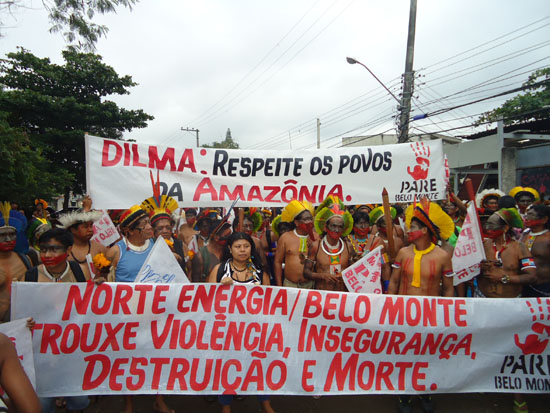
Belo Monte protest, Rio. The sign reads: Norte Energia, Belo Monte causes violence insecurity and death.
Rio+20
Twenty years ago at the first Earth Summit in Rio, Severn Suzuki a twelve year old girl, made an impassioned plea at the conference. She had come to Rio with the Environmental Children's Organization (ECO), a group of 12 and 13 year olds. 'We've raised all the money to come here ourselves,' she said, 'to come 5,000 miles to tell you adults you must change your ways. Coming up here today, I have no hidden agenda. I am fighting for my future... I am only a child, yet I know if all the money spent on war was spent on finding environmental answers ending poverty and in finding treaties, what a wonderful place this earth would be.' She was pleading for the rights of her generation and of generations to come.
I was at that first Earth Summit in 1992. I was calling for a paradigm shift in our global environmental policies: for a new model of development incorporating respect for human rights, good governance, social and economic justice, environmental protection and respect for the rights of indigenous and tribal people. I was campaigning for governments and corporations to be held accountable for their actions.
Twenty years later I am still calling for the same changes, and for corporations to be held accountable for crimes against present and future generations. Why have we made so little progress on these issues? Global carbon emissions have increased by around 50 percent since the first conference. If you had told us at the 1992 Earth Summit that this would be the case, we would have been horrified.
Rio+20 finished with little fanfare and no concrete outcomes. Attended by more than 45, 000 people, including 130 heads of state, 1,500 CEOs from 60 nations, with over 500 side events, Rio+20 was the biggest UN sustainability conference in a decade, and has been described by the UN as 'an historic opportunity to define pathways to a safer, more equitable, cleaner, greener and more prosperous world for all.'
Why was this opportunity so shamefully squandered?
While the 1992 Earth Summit was three weeks of consistent close negotiations, Rio+20 was just three days long. Many world leaders did not attend. President Barack Obama, Chancellor Merkel and President Vladimir Putin were absent. UK Prime Minister David Cameron did not attend despite the Summit being rearranged to avoid clashing with the Queen's Diamond Jubilee and his pledges two years ago, upon becoming Prime Minister, to lead the 'greenest government ever.' There was an indefensible lack of political will to address the most pressing issues of our time.
Chinese Premier Hu Jintao was there as was the French President Francois Hollande, Secretary of State Hilary Clinton represented the US, and Deputy Prime Minister Nick Clegg represented Great Britain. And of course President Dilma Rousseff of Brazil was hosting the conference.
From the start the mood of Rio+20 was not optimistic. By the finish, emotions were running high. Former Costa Rican president Jose Maria Figueres addressed the conference's secretary general, Sha Zukang, at a press conference on June 22nd:
"One thousand five hundred CEOs from 60 nations, global NGOs from all over the world, have come to your conference and committed to action," he said. "Those who have failed you, Mr. Sha, are the governments. Those are the ones that have failed you, sir."
'The Future We Want'
The outcome document 'adopted' at Rio+20, 'The Future We Want' is a miserable failure; 283 paragraphs of platitudes and unenforceable commitments which will not take us into the 'Future We Want.' Once again politicians have abdicated responsibility for our future, and that of our children and grandchildren.
'The document is not legally binding. It is at best, a roadmap containing broad 'Sustainable Development Goals' or SDGs, which echo the Millennium Development Goals. These SDGs have been agreed only in principle. There is no detail, and no targets. Even these are voluntary national commitments. 'The Future We Want' 'affirms,' 'recognizes,' 'underscores,' 'urges,' 'acknowledges' and 'expresses concern' over a wide range of issues. The word "reaffirm" is used 60 times.
Connie Hedegaard, the EU's Commissioner for Climate Action, took to Twitter to express her dissatisfaction on the 19th of June. "Nobody in that room adopting the text was happy,' she said. 'That's how weak it is. And they all knew. Disappointing."
The text of 'The Future We Want' was, already, at the beginning of June, a compromise. It contained little that was not on the table at the 1992 Earth Summit. Have they been able to accomplish anything these 20 years, except political grandstanding?
Severn Suzuki, speaking to Democracy Now on the 21st of June, 2012, said: 'This is showing that the world's leaders are not able to come together and lead for the sake of humanity. What does it mean when the world's elected leaders do not represent the good of the people that they're supposed to care for?'
Twenty years later, and world leaders still aren't listening to her.
By the 21st of June, when 'The Future We Want' was submitted to leaders, it had been diluted even further. 'The Future We Want' has glaring and serious omissions.
Fossil Fuel Subsidies
The text announces its objective as a 'green economy.' It 'reaffirms support for... greater reliance on advanced energy technologies including cleaner fossil fuel technologies and the sustainable use of traditional energy resources.'
'The Future we Want' 'reaffirms' the intention to "phase out harmful and inefficient fossil fuel subsidies that encourage wasteful consumption.' However, this is not a commitment. It is not even a new promise. The G20 agreed to this in 2009. And we have seen no results.
Initially, fossil fuel subsidies were not even on the agenda at Rio +20: rightly causing public outcry.
350.org with the global campaign group Avaaz launched a 'twitterstorm' on June 18th, calling on leaders to use Rio+20 as the opportunity to act: to set deadlines, and devise implementation to end nearly $1 trillion in fossil fuel subsidies, to 'turn one triillion green.' I joined and supported the Twitterstorm. Avaaz also took out advertisements in Friday's Financial Times calling on Brazil's President Rousseff to demand a timeline for ending subsidies. Ending subsidies for fossil fuels became a rallying cry for Rio+20. #endfossilfuelsubsidies trended on Twitter at number two in the world. It was this worldwide protest that forced fossil fuel subsidies onto the agenda on the evening of June 18th.
Even after the 2011 Fukushima Daiichi nuclear disaster, which forced 150, 000 people to flee their homes due to radiation, leaving large parts of Japan still contaminated, the document fails to question or even mention nuclear energy.
The document fails to discuss the shift to renewable energy: the most urgent and necessary transition of our time.
Let me be clear. By once again delaying these tough decisions, world leaders may well be condemning the planet to death.
Business
We welcomed the commitments of business and corporations at Rio+20. We need sustainable, ethical businesses to fully participate in creating the future we want. As Sharan Burrow, General Secretary of the International Trade Union Confederation told the Guardian newspaper, 'The economic transformation that shifts the production base to greener and cleaner production is an imperative if we are to live within planetary boundaries.'
The fingerprints of corporate interest, however, were all over Rio+20 and are all over the text of 'The Future We Want.' The US succeeded in striking a reference to "unsustainable consumption and production patterns from the outcome text."
On Friday June 22nd, Nnimmo Bassey, Chair of Friends of the Earth International delivered a statement, 'End Corporate Capture of the UN,' to UN Secretary General Ban Ki-Moon, condemning the influence oil companies like ExxonMobil, Rio Tinto, Anglo American and Shell, all of which are involved in human rights violations and the destruction of the environment, and large multinational corporations like Dow and Coca Cola exert over the United Nations. 400 organizations representing millions of members of civil society around the world signed the statement.
These companies have no place in a UN dialogue. Oil companies have perpetrated some of the most appalling human rights and environmental crimes in our history. Dow owns Union Carbide, which has been responsible for one of the most egregious corporate human rights violations the world has ever seen, the Bhopal disaster. They have caused untold suffering to hundreds of thousands of people.
Some countries seemed to be using Rio+20 as a get together, an opportunity to strike deals. On June 22nd Brazil and China announced a $30 billion bilateral trade deal at the Summit, which includes Chinese investment to build oil drilling platforms in Brazil.
This is what President Dilma Rousseff was doing to tackle climate change.
I was very encouraged by the UN Women Leader's Summit on the 21st of June, chaired by former President of Chile and current UN Women's Executive Director Michelle Bachelet. The Summit called on governments to prioritise gender equality and opened up the dialogue regarding women in development.
Climate change, economic crisis, fuel shortage; all these issues affect women differently and disproportionately to men, due to traditional roles and gender stereotypes.
Current and former heads of state such as Brazilian President Dilma Rousseff, Helle Thorning-Schmidt, Prime Minister of Denmark, Laura Chinchilla Miranda, President of Costa Rica, Dalia Grybauskaitė, President of Lithuania, Eveline Widmer-Schlumpf, President of the Swiss Confederation, Portia Simpson Miller, Prime Minister of Jamaica, Julia Gillard, Prime Minister of Australia, and Mary Robinson, former President of Ireland, among others participated, as well as Christine Lagarde, Managing Director of the International Monetary Fund (IMF).
But, disappointingly, none of their concerns made their way into the text of 'The Future We Want.' Strong wording on reproductive health programs and improved access to free contraception were quashed, leading to a protest at Rio Centro on June 19th. The text shamefully ignores women's reproductive rights.
The language on forests in the outcome document is inexcusably weak. Countries need only 'commit' to "reaffirm" previously made commitments and "highlight" uncontroversial needs. How many pieces of paper were needed to orchestrate this conference? How many trees were lost in the process of drafting 'The Future We Want?'
There is no mention of military spending or disarmament in the document. In 2011 global military spending on jets, tanks, ships, bombs, missiles, landmines and nuclear weapons amounted to $1740 trillion. Meanwhile 1 billion people suffer from chronic hunger and more do not have access to safe water or adequate health care and education. Even in the developed world millions are without work. The Millennium Development Goals cannot be realized while the world invests such a large proportion of its wealth on military equipment.
The connection between peace and sustainable development has been ignored for too long. An appeal, 'Disarmament for Development,' was issued by laureates of the 'Right Livelihood Award' (otherwise known as the alternative Nobel Prize), including myself, in advance of Rio+20.
The right to freedom of expression was not included in any draft of the outcome document. Reference to the rights of "freedom of speech and association" were included in the zero draft, but struck out in late night negotiations. Savio Carvalho, of Amnesty International said, the 'move took just minutes. I was shocked to watch as it happened with little or no resistance from other negotiators... It felt like human rights had once again been relegated to a mere bargaining chip amid the horse-trading for a final text.'
Do we want a future where our basic human rights are swept under the carpet? I am outraged, to put it mildly.
All the while, three thousand kilometres north, and unbeknownst to most participants at Rio +20, the Brazilian government is carrying out an objectionable project: a series of dams in the heart of the Amazon rainforest.
If construction is allowed to continue, Belo Monte will be the 3rd largest dam in the world. It will divert 80% of the flow of the Xingu river, displacing at least 20, 000 people. It will flood indigenous settlements and a quarter of the city of Altamira, and have devastating consequences on the environment in the region. Belo Monte is in flagrant violation of communities and indigenous people's rights, and an environmental crime.
On the 16th of June 2012, protesters stormed the construction site of the Belo Monte Dam. They dug a channel through the earth coffer dam, chanting 'Free the Xingu.' They lay on the dam, their bodies spelling out the words 'Pare Belo Monte:' Stop Belo Monte.
Protests are ongoing.
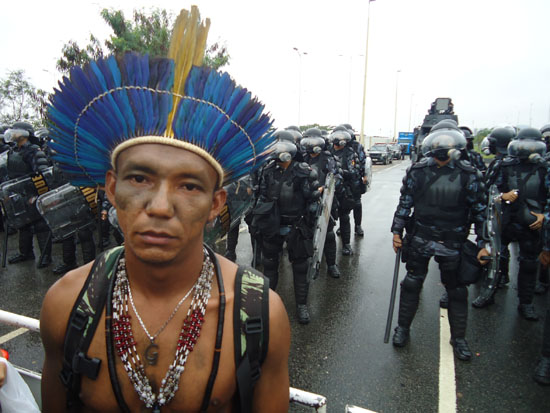
Indigenous protester and armed Brazilian police.
Warriors from the Xikrin and Juruna indigenous groups have occupied the coffer dam since Thursday June 21st, to protest the violation of their rights and the dam building consortium's non-compliance with socio-environmental mitigation measures. The groups are demanding a meeting with the Norte Energia (NESA) dam-building consortium and the Brazilian government.
I have written a full report on this abysmal project, 'The Belo Monte Dam, An Environmental Crime,' which is a result of eight months of research and a fact finding mission to the Brazilian states of Para, and Rondonia. It is available on the Huffington Post.
Please read it, and support their cause. The people of the Xingu desperately need our help.
Climate Change
'The Future We Want' 'urges Parties to the UNFCCC and Parties to the Kyoto Protocol to fully implement their commitments, as well as decisions adopted under those agreements. In this regard, we will build upon the progress achieved including at the most recent COP-17/CMP 7 in Durban.'
All that was accomplished in Durban was that world leaders agreed to postpone a legally binding climate agreement until 2020. How can you build on a lack of progress?
The Kyoto Protocol is the only legally binding international mechanism that requires industrialized nations to curb greenhouse gas (GHG) emissions. It expires in December 2012.
To date, world leaders have failed to agree a legally binding Kyoto Plus. A new international framework urgently needs to be negotiated and ratified that can deliver stringent emission reductions.
Waiting until 2015 or worse until 2020 as suggested at COP17 could be fatal. It is not an option.
At COP15 in Copenhagen, US$30 billion dollars was committed to developing countries, with balanced support for both mitigation and adaptation. This funding was crucial for developing countries that will be first and hardest hit by the effects of rapid climate change. 'The text of 'The Future We Want' failed to stipulate funding figures to achieve these goals.
What we urgently need is a critical, constitutional moment to avert catastrophic climate change and redefine our models of development. What we got at Rio +20 was a document with no teeth. And we are running out of time.
In the past decade the earth experienced the two warmest years on record, in 2005, and 2010 - the latter was the warmest year in recorded history. The earth is perilously close to dramatic climate change that threatens to spiral way out of control.
At the end of May 2012 monitors in the Arctic showed the highest ever recorded levels of Co2, at 400 ppm. The rest of the planet will soon follow suit, unless concrete action is taken. We have already reached the stage of dangerous climate change. The task now is to prevent irreversible climate chaos.
Today the planet has concentrations of around 392 ppm.
Global climate expert Professor James Hansen, head of the NASA Goddard Institute for Space Studies, is emphatic that the safe upper limit of CO2 levels is 350 ppm.
Economist Lord Nicholas Stern, author of the Stern Report, the definitive investigation into the costs of climate change, said on June 22nd of this year, "...the [Rio+20] conference has failed to acknowledge the compelling evidence about the scale and urgency of action required."
Are our leaders so divorced from reality that they fail to see the danger they have placed us and the planet in with their prevarication?
The UN Process
Since the Earth Summit in 1992 I have attended many UN climate and sustainability conferences. I often leave feeling that yet another critical opportunity was wasted. COP 15 should have been one of the most important climate negotiations of our time. We arrived with our expectations high, hoping that the negotiations would effect real change. We left with nothing accomplished. COP17 was yet another let down. But after each COP and Earth Summit we see politicians and UN officials congratulating one another, slapping backs and shaking hands. If one didn't know better it might appear as if each one had been a great success.
What has been achieved in the twenty years since Severn Suzuki asked for us to 'change our ways?' Do our leaders really believe that the Rio+20 document will help us achieve the future we want?
Year after year these meetings deliver roadmap after roadmap, with no binding commitments. We have been waiting in the departure lounge for 20 years. When will we get moving? When will we get the critical action we need to prevent catastrophic climate change?
Not all is lost. There are things we can do. There have been some positive initiatives, some of them outside the official Summit.
Progress
The Zero Hunger Project
Ban ki-Moon's five point initiative, unveiled on June 19th at Rio+20, aims to:
-Ensure 100% access to food for all, all year round
-an end to stunting among children under two because of a lack of nutrients during pregnancy and in the early days of life
-ensuring food systems are sustainable (although there is no reference to how this could be achieved)
-double smallholder productivity and income
-reduce food waste at the farmer level through lack of suitable storage and among consumers.
There is some vagueness about how these aims will be implemented. But the Zero Hunger project delivers sound objectives, and Great Britain has vowed to allocate 150 million pounds from the International Climate Fund, primarily to farmers in Niger and Ethiopia, who are experiencing food shortages.
I hope it materialises. The success of the Brazilian 'Fome Zero Programme,' launched in 2004, and on which the Zero Challenge is based, suggests that it is achievable.
Plant a Pledge
I was recently appointed Ambassador to the International Union for the Conservation of Nature (IUCN) Plant a Pledge Campaign to support the Bonn Challenge target, to restore 150 million hectares of degraded and deforested land by 2020. This is the largest restoration initiative the world has ever seen. On the 12th of June 2012 I launched Plant a Pledge in London, UK.
The Bonn Challenge target was set last year in Bonn, Germany, by representatives of governments and the private sector as well as indigenous and non-governmental organizations.
The Global Partnership on Forest Landscape Restoration (GPFLR) has mapped two billion hectares of deforested and degraded land across the globe - an area the size of South America - with potential for restoration.
Over half of the planet's original forest cover has been lost in the past 200 years. Today forests continue to be destroyed at an alarming rate. Every year approximately 13 million hectares - an area the size of New York State - is lost.
On the 18th of June the GPFLR, the IUCN and myself held a press conference at Rio +20 where we announced landmark restoration commitments totalling 18 million hectares. The United States Department of Agriculture Forest Service pledged 15 million hectares, the government of Rwanda 2 million hectares, and the Mata Atlantica Forest Restoration Pact of Brazil, a coalition of government agencies, NGOs and private sector partners 1 million hectares.
We also welcomed the commitment to the Bonn Challenge of the Mesoamerican Alliance of Peoples and Forests, a forum of indigenous peoples and forest communities who together have legal rights over more than 50 million hectares of territorial forest in Mexico, Guatemala, Honduras, Nicaragua, Costa Rica and Panama. We look forward to receiving their specific pledge of hectares.
It is very encouraging that countries and landowners are signing up to restore degraded and deforested land by 2020; in great contrast to the lack of progress at the Rio+20 negotiations. The pledges of more than 18 million hectares take us over 10 per cent closer to achieving the Bonn Challenge target of 150 million hectares by 2020. But this is only the beginning. We still need to put pressure on governments around the world to achieve this unprecedented initiative.
In the lead up to the Rio +20 summit, more than 1 million people voted online in the Rio +20 Dialogues to identify the most important recommendations to transmit to heads of state at the summit. The results, announced on the 17th of June, clearly demonstrate that restoration should be at the top of the political agenda: the public voted the restoration of 150 million hectares of degraded and deforested lands the number one proposal on forests, and number two overall.
Global deforestation is threatening our future, and that of the planet. The removal of trees is causing damage to habitats, biodiversity loss and species extinction; forests host 80 per cent of the diversity of all life on Earth. Deforestation causes serious soil erosion, aridity and desertification. As forests vanish the carbon being added to the atmosphere - some 15 per cent of total greenhouse emissions - is accelerating climate change.
Environmental destruction goes hand-in-hand with human rights. They are interconnected. Forests sustain our most basic needs. They are vital for clean air, food, three-quarters of the world's fresh water, shelter, health and economic development. 1.6 billion people - almost a quarter of the world's population - depend on forests for their livelihood. 300 million people call forests their home.
Damage to our forests and ecosystems could reduce global GDP by about 7 per cent and halve living standards for the world's poorest communities by 2050.
We urgently need to put public pressure on governments and others who own or manage land to contribute to the Bonn Challenge target.
The Plant a Pledge campaign, devised by the IUCN and sponsored by Airbus, aims to do just that. Each pledge at www.plantapledge.com supports a global petition directed at world leaders, which I will personally deliver, in my capacity as IUCN Plant a Pledge Campaign Ambassador, to the UN climate change talks, COP18, in Qatar this year. We can ensure that governments put pen to paper on the specifics - 'where, when and how?' - to achieve the Bonn Challenge, and inspire others to do the same.
Restoration of degraded and deforested lands - as called for by the Bonn Challenge - is not simply about planting trees. Achieving the target will bring about transformative, measurable change. With restoration we will repair the damage not only to ecosystems, but, crucially, to human lives. We will put people and communities first, transforming barren or degraded areas of land into healthy, fertile working landscapes. Restored land can be put to a mosaic of uses such as agriculture, protected wildlife reserves, ecological corridors, regenerated forests, managed plantations, agroforestry systems and river or lakeside plantings to protect waterways.
With global climate negotiations foundering, it is through initiatives like Plant a Pledge that we can effect change. Through restoration we can help lift millions of people out of poverty and inject more than US$80 billion per annum into local and global economies while reducing the gap between the carbon emissions reductions governments have promised and what is needed to avoid dangerous climate change by 11 to 17 per cent. We can make the world a more sustainable place - for everyone. And we will see these benefits not only in our lifetime, but in years to come.
I urge everyone in the across the world to play their part. Go to www.plantapledge.com, and click to sign our petition. This is a unique opportunity to renew our forest landscapes now.
Beyond Rio+20
Politicians at Rio+20 should have taken note. They should remember that their decisions, or lack thereof, will affect everyone across the world now and in the future.
What Rio+20 has demonstrated is that we can no longer stand by and wait for world leaders to provide solutions to prevent us from reaching the tipping point, or point of no return.
As Kumi Naidoo, Executive Director of GreenPeace said at the close of the conference, 'The only outcome of this summit is justifiable anger, an anger that we must turn into action.'
What the protests of the last few days have shown us, what the phenomenon known as the Arab Spring has shown us is that together we have great collective power. We don't have to let Rio+20 be the end of our hopes. The future of the planet lies not only with governments and politicians, but in grassroots movements, NGOs, protesters, the responsible business community. We must not give up. What is at stake is our future and that of future generations. These are global objectives which require global collective action.
As Winston Churchill said on the eve of the Second World War: 'The era of procrastination, of half-measures, of soothing and baffling expedients, of delays, is coming to its close. In its place we are entering a period of consequences.'
I hope that, at the very least, we have acquired a sense of urgency from Rio+20 and a consciousness of the consequences of inaction. There is no room and no time for political squabbling, or point scoring. At this critical juncture in history we will either stand or fall together.
Bianca Jagger
Ambassador, IUCN Plant a Pledge Campaign and Chair of the Bianca Jagger Human Rights Foundation
Twitter: @BiancaJagger
Plant a Pledge is an IUCN campaign sponsored by Airbus.
Photos courtesy of Xingu Vivo: Mitch Anderson, Verena Glass and Atossa Soltani
www.xinguvivo.org.br