
On a recent visit to Pennsylvania, I saw signs of a natural gas boom on the wane.
Googling "Pennsylvania 'natural gas rush'" this morning got me 356,000 hits. Some may call it a gas boom instead of a rush, but, regardless, it seems to be a happening thing.
The development of the technology that combines horizontal drilling with hydraulic fracturing (or fracking) along with the trillions of cubic feet of natural gas that lie in the Marcellus shale formations (from less than 2,000 feet to more than 11,000 feet [pdf] beneath the surface) has lured the gas industry to the Keystone State.
A New Energy Ball Game for the Nation
This animation by the U.S. Energy Information Administration shows how horizontal drilling in Pennsylvania has increased since 2005, helping the state's gas production more than quadruple. The black diamonds represent conventional vertical wells, and the red diamonds horizontal wells.
That "fracking" rush, along with similar ones in Texas to exploit the Barnett shale and elsewhere (some 20 states in all), has ushered in a sea change in America's energy outlook. So much so that we have a good chance of becoming a net energy importer to exporter.
Natural gas prices have declined so much that natural gas power plants are now edging out coal-fired power plants on economic considerations, and threaten to put the kibosh on market penetration by wind and solar.
A Dollar Bonanza for Pennsylvania
It goes without saying that a resource-extraction boom often makes for an economic boom, and fracking has done that for Pennsylvania. At a meeting of the Pennsylvania State Association of Township Supervisors in May 2012, Lieutenant Governor Jim Cawley reported that drilling companies had added $1.6 billion to the commonwealth's tax coffers since 2006. He pointed with pride to "the neighbor, the brother, the aunt, the friend, who's been unemployed for two and three and four years, finally having a family-sustaining wage."
An Environmental Outcry
In addition to dollars, resource extraction can bring to a community environmental issues -- sometimes nightmares that can last for generations after the extraction has shuttered.
A case in point: pollution of streams from acid mine drainage. And fracking has definitely raised the hackles of folks concerned about water quality. With mounting evidence that at least some families have had their well water contaminated, there is a fairly loud chorus of people calling for a moratorium (here and here) or at least a slowdown of drilling in the Marcellus shale.
A moratorium seems pretty unlikely, but there are suggestions that a slowdown is in the cards -- not because of environmental concerns, but a slowdown nevertheless.
When Comes the Bust?
If there is one word that is commonly associated with boom, it is probably bust. Booms don't last forever; the resource gets mined out and/or prices decline because of oversupply, and the boom goes bust. The mining companies pull out, and the mining community is left with the legacy. Did I hear someone say ghost town?
Which brings me to Pennsylvania. I had heard from colleagues who had been to Pennsylvania that the fracking-related truck traffic in towns like Williamsport and Montrose was overwhelming -- clogging thoroughfares and making what should have been a five-minute jaunt to the local grocery store into a 30-minute crawl.
But when I visited those towns in June, trucks certainly barreled through them, but not nearly enough to disrupt traffic. I asked some local residents about it, and they allowed that things had definitely slowed down recently.
That piqued my interest, so I did a little surfing and found this data on drilling in Pennsylvania from Baker Hughes, an oil-field services and shale gas company.
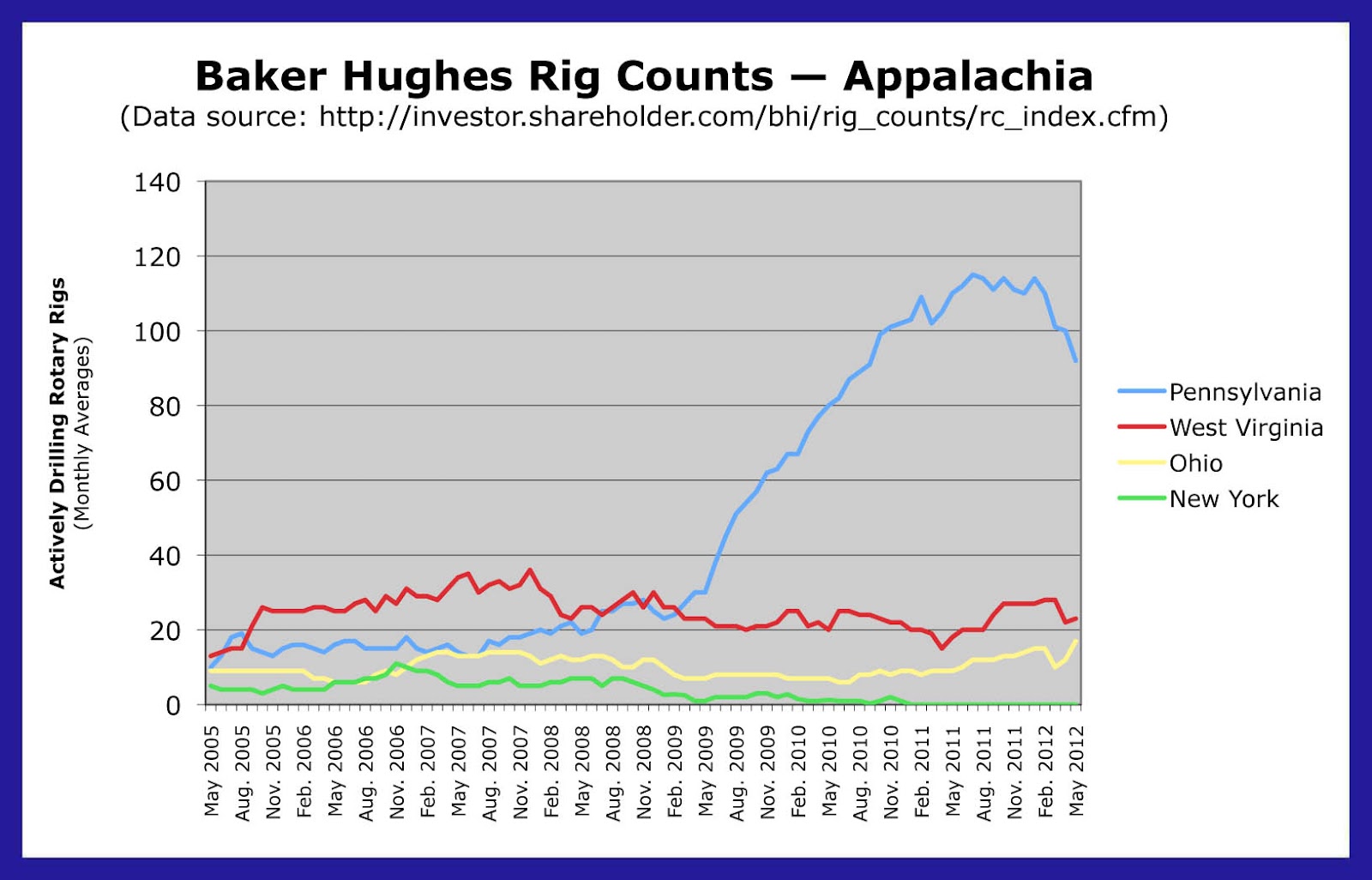
Starting in early 2009, the number of active rigs (those that are drilling) skyrocketed from about 20 to a peak of almost 120 in August 2011. But in late 2011 that number began to decline, falling below 100 in February 2012. As of the end of May, according to the Akron Beacon Journal Online, the number of active drilling rigs was down to 95. In January 2012, Chesapeake Energy, the largest driller in the state, announced plans to cut its drilling rigs from about 75 to 24.
Note: This is not to say that production from Pennsylvania will fall off anytime soon. The thousands of wells that are in production will remain so for quite some time, and there are also reportedly some 2,000 wells that have been drilled but not completed. What it does suggest is that drilling of new wells is on the wane in Pennsylvania.
Why Fewer Rigs?
What is the explanation for the slowdown? Economics are certainly part of the answer. I have been told by folks who work in the energy business that fracking for the dry gas that one gets out of the Marcellus is only profitable if the price of natural gas is above $4 per thousand cubic feet. According to the U.S. Energy Information Administration, natural gas prices at the wellhead (pdf) in the United States fell below the $4-threshold around August 2011. Is it a coincidence that that is the same time we began to see a decline in new drilling rigs in Pennsylvania? Probably not.
What does the future hold? Will we see natural gas prices spike, bringing a new rush back to Pennsylvania to frack new wells? Or, given all the wells already in production, will prices remain depressed for some time and the apparent slowdown in new well drilling continue? I can't say. But depending upon how things go, environmentalists could get a bit of what they have been asking for: a slowdown in new fracking and some time to assess the environmental impacts more thoroughly.