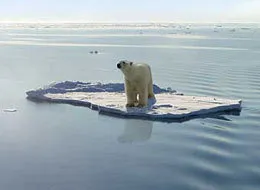
Scientists call it DAI -- "dangerous anthropogenic interference" with the climate system. The United States along with 191 other countries pledged to prevent DAI in 1994. However, little has happened to address the problem since, and now some scientists think it may be too late.
The vast majority of scientists now agree that:
- Global warming is occurring, in large part because of emissions of carbon dioxide (CO) and other greenhouse gases, and
- Failure to stem future pollution will lead to serious, even disastrous consequences.
So what should we do about it?
The most obvious solution is to reverse the warming -- go back to the way it was in the 1800s when CO concentrations were only 280 parts per million, instead of today's 386. Great idea, but not practical. Once CO gets into the atmosphere it stays there for hundreds of years and there is no easy way to take it out. In short we're stuck with it.
OK, you might say, if we can't reverse the warming, let's just stop it. Sorry, but even that is not possible. Because of inertia in the climate system, even if we stopped emitting CO today, the atmosphere would continue to warm for another 30 years or so.
Goal: Keep Global Temperatures Below Critical Threshold
Avoiding DAI in the climate is the only option left. This entails implementing a strategy for reducing greenhouse gas emissions that will avoid irreversible and, for many of us, unacceptable climate disruption. Identifying specific events that would constitute DAI and determining the global warming threshold that would trigger DAI are difficult and fraught with subjective judgments.
The general consensus is that global temperatures must not exceed pre-industrial levels by more than 3.5 degrees Fahrenheit. The consequences of exceeding this threshold include melting the Greenland ice sheet and increasing sea level 20 feet. Presently global temperatures are about 1.5 degrees Fahrenheit above pre-industrial temperatures. (More on global temperatures here and here and the Greeland ice sheet here.)
The climate bills being considered in Congress and the ongoing international negotiations designed to take hold when the Kyoto Protocol expires in 2012 generally focus on implementing emission reductions to hold the line against a 3.5 degrees Fahrenheit temperature increase.
The Perverse Effect of Reducing Air Pollution: Climate Change Accelerated
But in a recent paper published in the online edition of the Proceedings of the National Academy of Sciences (PNAS), V. Ramanathan and Y. Feng of the Scripps Institute of Oceanography argue that it may be too late. Their model simulations suggest that even if all CO emissions were stopped, global temperatures may exceed 3.5 degrees Fahrenheit above pre-industrial levels. Why? It has to do with another kind of air pollution from fossil-fuel burning -- tiny particles or aerosols that are suspended in the atmosphere. Because aerosols reflect sunlight, they act to cool the Earth and thus counteract the warming effects of greenhouse gases. (See our earlier post for a fuller discussion of aerosols.}
Unfortunately, the very same aerosols that cool the planet sicken and even kill people who breathe them in. For the sake of people's health we need to get those particles out of the atmosphere. And so, governments are putting regulations in place to eliminate particle pollution. The problem is that while CO stays in the atmosphere for hundreds of years, aerosols fall out of the atmosphere in a week or so. Ramanathan and Feng show that if we simultaneously halted all emissions of CO and aerosols, the aerosol cooling would disappear much faster than the greenhouse warming and global temperatures would rise more than 4 degrees Fahrenheit above pre-industrial levels and thus well above the critical threshold.
Another Temperature Scenario: What Goes Up Could Come Down (If We Act Quickly Enough)
In an online commentary in PNAS last week, Hans Schellnhuber of the Pottsdam Institute of Climate Impact Research paints a less depressing picture (subscription required). He agrees that the elimination of particle pollution would push global temperatures above the 3.5 degree Fahrenheit threshold. But his model simulations indicate that as long as CO emissions were rapidly curtailed and brought to zero by the end of the century, temperatures would fall back down below the 3.5 degrees Fahrenheit threshold after about 70 years. Climate scientists refer to situations where temperatures first rise above 3.5 degrees Fahrenheit and then fall below as "overshoot scenarios."
Even if Schellnhuber is correct, there is no guarantee that his overshoot scenario will be sufficient to avert DAI. The critical question is: How long do temperatures have to be above the 3.5 degrees Fahrenheit threshold before the loss of the Greenland ice sheet becomes unstoppable? Is it more or less than 70 years? We don't know.
So maybe we still have time and maybe we don't. But even if we can't save the Greenland ice sheet, there's still the Amazon rain forest, and the Antarctic ice sheet and on and on and on. So my vote, if anyone's asking, is that we get started on cutting back on greenhouse gas emissions right away.
Dr. Bill Chameides is a member of the National Academy of Sciences and the dean of Duke University's Nicholas School of the Environment. He blogs regularly at The Green Grok