
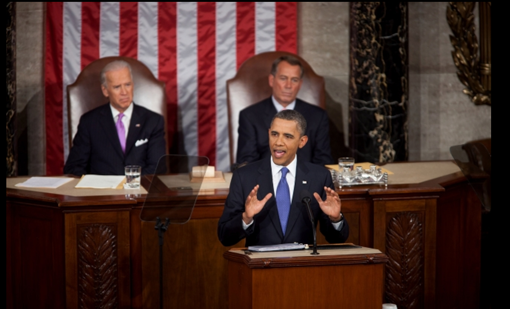
Official White House Photo by Chuck Kennedy
What does the Obama administration plan for our energy future? To find out, we'll let the words tell the story.
How do Obama's words on energy compare to Team Romney's?
Last week, while the Republicans were celebrating the Romney-Ryan ticket in Tampa, Florida, we posted a count-the-words analysis of their energy plan. The plan's overall aim is to achieve energy independence for North America. The numbers told us the path to independence for the Romney team is strong on oil and gas, but not much on renewables; and climate was totally absent.
This week the Democrats are doing their thing in Charlotte, North Carolina, so we figured we’d give the Obama administration's energy policy the same treatment.
For the Romney-Ryan analysis we used a document released days before our post. No such luxury for Obama; as best as we can tell, his most recent vision for America's energy future is the 44-page “BLUEPRINT FOR A SECURE ENERGY FUTURE” [pdf] from March 2011. Certainly not as fresh, but that's what we've got.
In the Clouds with President Obama
Obama's blueprint targets three broad strategies for our energy future:
- Developing and securing America's energy supplies,
- Providing consumers with choices to reduce costs and save energy, and
- Innovating our way to a clean energy future.
But as usual (and as with the Romney plan), the devil is in the details.
So what are the details of Obama’s plan?
OK, so just like the Romney word cloud, "energy" is front and center. No big surprise there.
There are some striking differences. In the Romney-Ryan cloud, "U.S." showed up among the most cited (biggest) words; in the Obama plan it's there, but you've got to look for it. And whereas the word "Obama" is prominently featured in the Romney-Ryan plan -- and not in a favorable light -- it's small potatoes, so to speak, in the Obama plan.
The other striking difference is in the emphases placed on energy sources. In the Romney-Ryan cloud "oil" and "gas" are king. In Obama's, "oil" and "gas" are prominent but so are "clean" and "efficiency."
In terms of energy sources, "oil" grabs the top spot for the Obama plan, followed by "clean energy," "gas" and "efficiency." "Renewable" is visible, but individual renewable energy sources are harder to find.
Greater Role for Efficiency and Clean Energy in Obama Plan
Want to be a little more quantitative? After "energy," "oil" and "clean energy" are in a virtual dead heat with slightly more than 100 appearances each. "Gas" (appearing 88 times) and "efficiency" (83 times) aren't far behind. (Team Romney's top three were "oil," "energy" and "gas," with everything else way back in the pack.)
Obama's emphasis on "clean energy" should no doubt make many enviros happy, as should his greater emphasis on "pollution," but be careful -- one person's clean energy is another's dirty polluter. Here's how Obama defines it:
"cleaner sources of electricity, including renewables like wind and solar, as well as clean coal, natural gas, and nuclear power."
I suspect that the inclusion of clean coal and nuclear will mean a bit of heartburn for some green leaners, and others won't welcome natural gas either.
The Race for the Environment Crown
It's interesting (and perhaps surprising) to note that "environment" appears a bit more frequently in the Romney-Ryan plan than in Obama's. Does that suggest that the Republicans have a legitimate claim for the green vote? I don't think so. There's an interesting juxtaposition in the two parties' approach to the environment. On the one hand, Romney-Ryan tend to place energy needs above environmental concerns and thus talk of streamlining and reforming environmental regulations to allow more rapid drilling, as in the following:
"Modernizing America's complex environmental statutes, regulations, and permitting processes is crucial to ensuring that the nation can develop its resources safely and efficiently."
"Regulations should be carefully crafted to support rather than impede development."
Obama's focus, on the other hand, is on developing appropriate environmental regulations so that oil and gas resources can be extracted safely. Two examples:
"environmental regulations that permit the beneficial development of this [gas] resource."
and
"working with local communities, state regulators, industry, and other Federal agencies to build a clean energy future by permitting environmentally responsible development of renewable energy on public lands."
Energy Independence vs. Energy Security
Interestingly, while the Romney-Ryan plan's fundamental and prominently stated goal is achieving energy independence, the Obama blueprint doesn't even mention it. Instead, Obama places emphasis on energy security, hence the report’s title (“Blueprint for a Secure Energy Future”) and the plan's stated objective to:
"secure America's energy future by producing more oil at home and reducing our dependence on oil by leveraging cleaner, alternative fuels and greater efficiency."
Note that though both plans propose to increase domestic oil production, Obama's additionally proposes to decrease America's dependence on oil by focusing on alternate energy sources and efficiency. Such a two-pronged approach is not evident in the Romney-Ryan plan -- the emphasis is clearly placed on increasing production, not decreasing demand or oil dependence.
Obama's Energy Plan by the Numbers
* no derivatives
** averaged over the length of the document.
Climate by Any Other Name
With Romney-Ryan's "climate" scorecard showing a big goose egg, Obama's plan wins by a hair -- with a single mention in a list of three goals:
"These important investments are helping to develop cutting-edge technologies with real world applications that can tackle our nation's toughest energy challenges, address global climate change and advance a clean energy economy."
On the other hand, "greenhouse gas" comes up nine times in Obama's plan, each in the context of steps being taken to reduce emissions. The Romney-Ryan plan does mention "greenhouse gas," but the one reference is in the context of criticizing the Obama administration's proposed rules limiting emissions from new power plants.
Contrasts in Plans Reveal Very Different Paths Toward Energy Future
Viewed through their numbers, the two plans appear to offer a stark contrast. The Romney-Ryan plan aspires to achieve energy independence for North America by aggressively boosting oil and natural gas extraction, while environmental concerns associated with such activity do not figure prominently, nor do efforts to conserve and become more efficient.
The Obama plan, which seems to be a good deal more diversified, does not aspire to energy independence, but instead emphasizes energy security (that is, being less susceptible to swings in oil prices caused by political instabilities in foreign countries by reducing our dependence on oil). And this naturally translates into a greater focus on developing other forms of energy and becoming more efficient.
There also appears to be a fundamentally different vision for the future. The Obama plan talks of a “clean energy future” and therefore investing in innovative, clean energy technologies, arguing that "targeted and sustained investments in clean energy research and development [like alternative transportation fuels, advanced batteries] that can jumpstart private sector innovation are critical to our long term economic growth, energy security, and international competitiveness."
The Romney plan favors "not picking winners" and focusing "government investment on research across the full spectrum of energy-related technologies."
So there you have it; those are the two plans. Now what are the chances that we'll see a thoughtful debate between the candidates on the energy issue?
_______________
Note from my couch
Like many of you, I tuned in for much of Tuesday night's opening of the Democratic National Convention. Energy was certainly not the loudest or the most mentioned among the many issues and policy solutions alluded to last night, but there were at least several mentions (here and here, for example). And we've got two more nights left.
Crossposted with TheGreenGrok. | Follow us on Facebook.