
Crossposted with TheGreenGrok.com.
The spin on this one is enough to make your head spin.
On October 20 a group of scientists announced big news: The globe really has warmed and at a rate more or less consistent with what climate scientists have been saying all along.
For an announcement that confirmed what we've known for quite some time, it created quite a dustup with folks from all sides of the climate controversy weighing in -- even the Wall Street Journal published three pieces on the subject (four if you count a blog post).
Not to be left out, we had a post on these pages as well.
Why all the attention? Because this announcement came from the Berkeley Earth Surface Temperature (BEST) team, a group of self-identified skeptics whose research aimed "to do a new analysis of the surface temperature record in a rigorous manner that addresses" criticisms of the temperature record.
Now that the dust is beginning to settle on this chapter of the climate controversy, let's take a spin down memory lane and see how it all played out.
Spinning Role Reversals With the BEST
The BEST project, the brainchild of Richard Muller and his daughter, Elizabeth Muller, was launched in 2010. But things didn't heat up until March 2011 when Muller was asked to testify in front of the House Committee on Science, Space, and Technology. In anticipation of that testimony, the battle lines began to be drawn with skeptics on one side and accepters on the other -- just not in the way we've become accustomed to.
Many of BEST's skeptics were not among the ranks of climate skeptics but among climate scientists. While parts of the climate science community welcomed the study, there were those who argued that it couldn't be trusted in part at least because one of its biggest funders was the right-leaning, climate-change-denying Charles G. Koch Charitable Foundation. (See group's main funders.)
On the other side of the schism, that belonging to the "traditional" climate skeptics, came anything but skepticism. A paraphrase of the reaction at the time might go like this: At last, an analysis by independent scientists, untethered to the climate science cabal. Anthony Watts, an outspoken skeptic, went so far as to say, "I'm prepared to accept whatever result they produce, even if it proves my premise wrong."
Of course that all changed once the results were announced (in preliminary form in Congressional testimony [pdf] on March 31, 2011, and through the release [pdf] of four yet-to-be-peer-reviewed papers two weeks ago). Some in the climate change camp formerly critical of the BEST study now embraced it -- finding it ironic that the Koch money machine had supported the research.
Many in the climate skeptic camp also changed their tune (see here, here and here), choosing to dismiss the study they had earlier embraced. Even Watts trashed the study, bailing on his earlier pledge. And then there was the coverage by the Wall Street Journal.
Muller Gets His Say in the WSJ
It's not often that a non-denial position gets expressed on the WSJ's opinion pages, but the BEST project results provided a rare exception. A day after the study results went public, the journal published an op-ed by BEST's lead scientist. In "The Case Against Global Warming Skepticism" Muller states unequivocally (dare I use that word) that "global warming is real." (He did, however, equivocate on the question of humans' role in the warming.)
So kudos to the Wall Street Journal for printing a piece debunking global warming skepticism, right? Well, yes and no. The op-ed appeared not in the paper's U.S. edition but in its European edition. Not quite important enough to make the cut for an American audience.
WSJ Spins the Other Way With the Denier's Side
After Muller's op-ed, outspoken climate denier Fred Singer, an atmospheric physicist, was given the opportunity to respond with his own op-ed, "Why I Remain a Global Warming Skeptic."
One of Singer's key criticisms is that the BEST team only looked at data from land-based meteorological stations. Far more reliable data, Singer maintains, come from satellites and weather balloons (radiosondes), and he states that those data show no warming between 1978 and 1997. What this really shows is that Singer can cherry-pick with the best of them. Temperature records from satellites and balloons clearly show long-term increases (see graphic below).
(Source: NCDC/NASA)
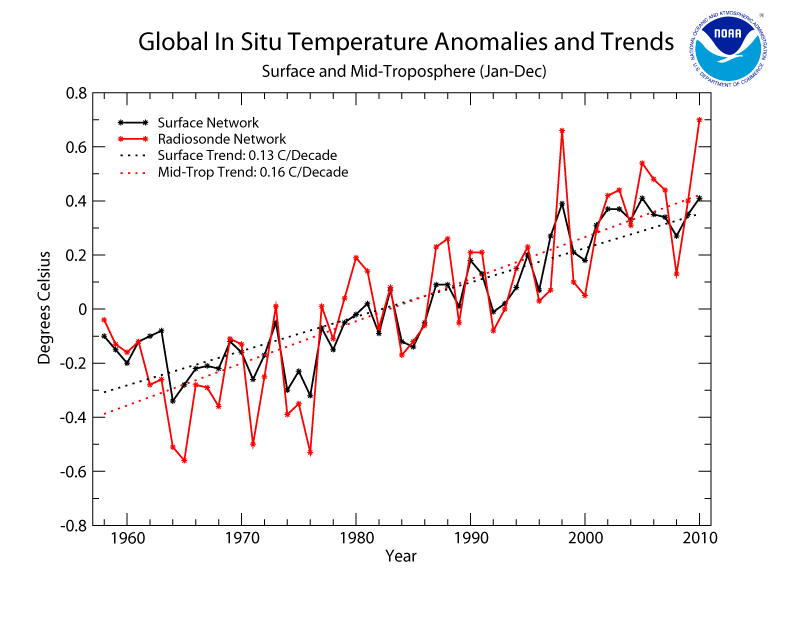
Then There Was the 'Numbers Guy' Spin
On Saturday, some 16 days after the BEST results were announced, Carl Bialik dedicated his "Numbers Guy" column to the study. For a piece supposedly covering a study that found that "global warming is real," it's pretty remarkable.
I always thought good journalism demands that an article's most important facts come via the "lede" -- the headline and opening paragraph. So in this case I'd expect at least one of those to note the BEST project's conclusions. But no, in "Global Temperatures: All Over the Map," (!) the first five paragraphs discuss the problems with the global temperature database. It's not until the sixth paragraph that you find: The study "concluded that the Earth's land has warmed." What follows are 11 paragraphs citing negative critiques of the study.
And the Pièce de Résistance: Heating Gets Spinned Into Cooling (Sort of)
OK, so two op-eds and a column. Surely the Journal also covered the BEST story with a strictly factual news story, you know the stuff serious newspapers are supposed to do?
After much searching I found one. Well, not exactly an article, a blog post by Bialik, our Numbers Guy. But it did start with the facts of the BEST study ... in a strange kind of way.
"My print column examines an announcement last month," Bialik's lede reads, "that a new effort to compile historical global temperature numbers has confirmed the earth has been cooling warming in the past century," which is then followed by a footnote: "Correction. ... This blog
post initially said the effort had shown the earth has been cooling."
Perhaps a Freudian spin? Or wishful spinning? Spinning a web of deceit and obfuscation? Who knows, just help me find my painted pony.