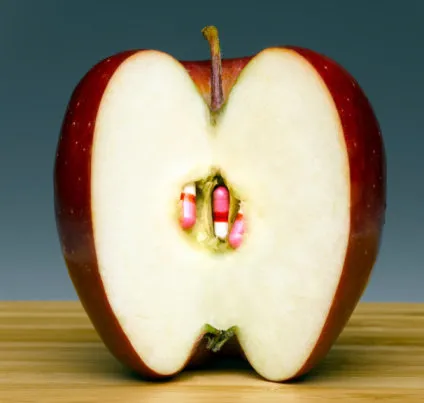
President Obama is addicted to nicotine. Rush Limbaugh got hooked on OxyContin. Glenn Beck is a recovering alcoholic, as is Elton John, Eric Clapton, Anthony Hopkins, Robin Williams, Judy Collins, Mel Gibson, and many more. Tiger Woods is a sex addict - it's likely that Warren Beatty and Wilt Chamberlain were, too. William Bennett's gambling habit was all over the news. Oprah acknowledges she's a carbohydrate addict. Julia Cameron was hooked on alcohol and drugs, as were McKenzie Phillips and Carrie Fisher. The list of famous addicts grows ever-longer and we begin to wonder: Do the pressures of fame and fortune drive people to addictive substances and activities ... or is everyone an addict?
In her book, When Society Becomes an Addict, Anne Wilson Schaef asserts that life in the U.S. is so stressful that it is impossible not to become addicted to something. She says that we live in a society that not only encourages addiction, but almost demands it. Schaef points out that some addictions, such as workaholism, are actually applauded in our culture - while others, such as nicotine, TV, internet porn, gambling, and sex addiction, are simply tolerated. But nobody grows up in our country without becoming addicted to something.
Can this be true? Has America become a junkie nation?
Buddhist nun Pema Chodron, author of Start Where You Are, agrees with Anne Wilson Schaef - we all are addicted to something. But she doesn't blame it on American culture; she says it's simply part and parcel of our human nature. Chodron explains that we are restless, irritable, and discontent - we find it impossible to just sit still and BE. So we distract ourselves with activity and entertainment: cell phones, texting, video games, iPods, TV, movies, magazines, non-stop busyness to keep us looking everywhere but inside ourselves. We mood-alter with substances (sugar, alcohol, drugs, nicotine, caffeine, etc.) and activities (shopping, gambling, sex, work, viewing porn, etc.) Chodron says that we are unable to simply be awake and present to life - so we medicate our existential anxiety.
Are Schaef and Chodron onto something? What do other experts say? What does research tell us?
~ Fourteen million Americans abuse alcohol or are addicted to it; three million American teens between ages 14 and 17 are problem drinkers. (www.alcoholics-info.com)
~ The National Institute of Drug Abuse reports that marijuana is the most commonly used illicit drug in the U.S. Over 14 million Americans aged 12 or older used marijuana at least once in the past month; 6,000 people a day try marijuana for the first time; sixty-two percent of them are under age 18.
~ Conservative estimates indicate that there are about two million cocaine addicts, 1.4 million regular methamphetamine users, and 800,000 hardcore heroin addicts. (addictionnomore.com and pbs.org/frontline),
~ Fifteen million Americans display signs of gambling addiction. Researchers call gambling the fastest-growing teenage addiction: 42 percent of 14-year-olds, 49 percent of 15-year-olds, 63 percent of 16-year-olds, and 76 percent of 18-year-olds. (overcominggambling.com/facts.html)
~ Forty million adults in the United States regularly visit pornography sites; ten percent of them (four million) admit to having a sexual addiction to pornography. (reliableanswers.com)
~ In 2007, 60 million Americans (24.2 percent of the population) were current cigarette smokers, 13.3 million smoked cigars, 8.1 million used smokeless tobacco, and two million smoked tobacco in pipes. (drugabuser.gov/infofacts/tobacco)
~ It is estimated that eight million Americans suffer from eating disorders; 90 percent are women. One in 200 women are anorexic; 2 or 3 in every hundred women are bulimic. (South Carolina Department of Mental Health)
~ While it is difficult to obtain accurate numbers of workaholics, compulsive spenders, TV and video game addicts, and other less well-known addictions, we can be certain that they are legion.
Psychiatrist M. Scott Peck, a self-confessed nicotine addict and author of The Road Less Traveled, offered his perspective in a 1991 lecture, "Addiction: The Sacred Disease." Dr. Peck's thesis:
At birth, humans become separated from God. Everyone is aware of this separation, but some people are more attuned to it than others. They report feeling an emptiness, a longing, what many refer to as "a hole in their soul." They sense that something is missing, but don't know what it is.
At some point in their lives (often quite young) these sensitive souls stumble across something that makes them feel better. For some it's alcohol; for others it's sugar, drugs, shopping, sex, work, gambling, or some other substance or activity that hits the spot. "Ahh," they sigh, "I've found what's been missing. This is the answer to my problems." They have discovered a new best friend -- their drug of choice.
Peck pointed out that the alcoholic is really thirsty for Spirit, but he settles for spirits. Alcohol is simply a form of cheap grace, as are all addictive substances. What we humans really long for is a connection to God ... alignment with the Holy ... re-union with the Divine. It is a deeply spiritual hunger -- a longing to go home again, back to Source.
But we're confused about what we're really hungry for, so we go looking for love in all the wrong places: a bottle of booze, pills, a cookie jar, a casino, shopping malls, a pack of smokes, the Internet, or the bed of a new hottie. We reach for anything to take the edge off, to smooth out life's rough spots, to help us make it through the night.
Anne Wilson Schaef says that addiction is a pandemic American disease driven by our high-stress culture. Chodron and Peck say that addiction is a human dis-ease driven by our existential angst.
Perhaps it doesn't really matter who's right. If you're addicted to something, or your loved one is an addict, all you want to know is how to get free from the grip of addiction.
Stay tuned: Next week we'll explore different approaches to kicking a habit and learning to look for love in all the right places.