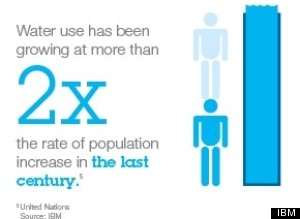
With a population expected to exceed nine billion by mid-century and a fixed water supply, the world's demand for water is quickly outpacing its supply.
We rely on steady seasonal rainfall to restore our ground water sources, but droughts are becoming more frequent, often forcing communities to enforce stringent water restrictions.
Nearly half of the world's 6 billion people live in water stressed areas. Eighty countries already have water shortages, and the World Bank warns that the demand for water doubles every 21 years. Thirty countries already get more than one-third of their water from other regions. And treating the water we do have to make it safe for consumption requires great amounts of energy and generates as much carbon emissions as a passenger jet.
Growing the food we eat consumes 70 percent of our freshwater supply. And much of the remaining amount is used extravagantly at home. A family of four typically uses 260 gallons of water a day, mostly in the bathroom. Flushing toilets, using faucets, and taking showers or baths account for 75 percent of the total.
At the Desert Mountain golf community, we are partnering with the City of Scottsdale and the State of Arizona to utilize treated effluent, or reclaimed water, to reduce our water footprint. To further reduce our footprint, we are using a deeper level of analytic insight that also saves energy and cuts operating costs. More importantly, everything that's done at Desert Mountain is done with the indigenous plant life and wildlife of the community in mind.
For many years now, Arizona has been in a drought. In fact, we're supposed to average 12 inches of rain annually, but we haven't had that amount in many years. So at Desert Mountain we're implementing a water conservation program that will help us become even more efficient and better prepared to meet water shortages and environmental changes.
The information we collect from underneath the ground and from weather stations helps us make better decisions on how much watering to do. The less water we use, the more energy and costs we save on treating and transporting water. We are not only making our business more efficient, but we are also playing a role in conserving a precious natural resource.
To date, we've saved eight to 10 million gallons of water by understanding the data we're getting from the sensors in the ground that tells us when moisture levels are low or when there is water leak. And we can react faster to that leak.
If you look at the people who live here, you'll see that Desert Mountain is a community of leaders. We are taking a proactive stance to become better stewards of the land and in becoming educators on the role we all can play in protecting our natural resources. That's the goal we've set for ourselves going into the future.