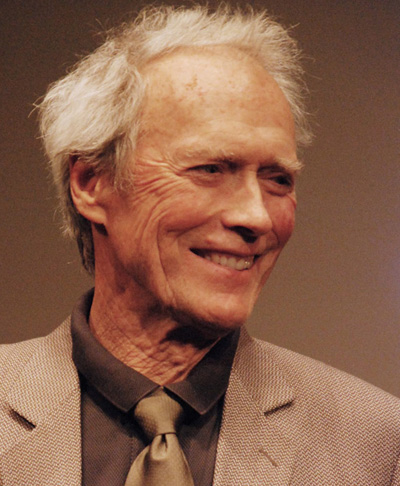
An avowed Republican in Hollywood is nearly as rare as the giant Komodo Dragon -- and with the spiteful bite of one as well. But with Barack Obama's victory, they've made themselves pretty scarce since election day.
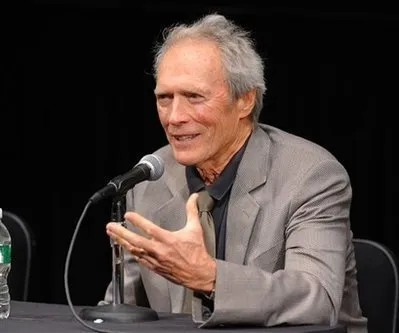
Hell, even a straight-shooting, no bullshitter like actor/director Clint Eastwood -- long known as a registered Republican who supported Richard Nixon in 1968, and who has made other forays into politics (he won a term as mayor of Carmel in 1986; was on the the California State Park and Recreation Commission from 2001 to 2008 and is on the California Film Commission) -- distanced himself from the Republicans before this election. At a recent press conference that Eastwood gave at this year's New York Film Festival -- where Changeling, his latest directorial effort premiered -- it was uncanny how even he wanted to clarify his position away from them.
Of course, that wasn't the only interesting thing he had to say about himself and his film, so with a little juggling and a few delays, here are the comments from this 78-year-old grand master -- the man who defined so many cinematic archetypes from the hard-boiled, hardened cop (Dirty Harry) to the laconic gunslinger with a heart (the Man With No Name from Sergio Leone westerns). This Oscar-winning director (Unforgiven) and longtime actor is also a jazz musician and composer as well.
Given that Changeling deals with out-of-control authorities drunk on their own power -- the film has a very current political tenor. Starring Angelina Jolie as a mother searching for her nine-year son Walter, she is given the wrong kid by corrupt L.A. police officials; she is then carted off to the looney bin when she protests. Once freed by a crusading minister after it's revealed that a serial killer may have abducted her son, she succeeds in bringing down the authorities who have done her wrong. So it makes Eastwood's remarks particularly telling.
Q: As a noted Republican, former elected official, and supporter of John McCain, what are your thoughts on the election?
CE: My mortgage just went down the tube [laughs]. I haven't been very active in politics. Yes, I started out as a Republican in 1951, when I was a young 21-year-old in the army, and I wanted to vote for Dwight Eisenhower, because he, like all politicians, was promising something, and he promised to go to Korea and end the Korean War.
But the Republican Party, as [with] the Democratic Party, have changed dramatically since the 1950s, and so I've drifted towards a more libertarian point of view. It never really got going as a party, but just the idea of, "Let's leave everybody alone, and not over-regulate," was very appealing to a guy like myself who came up in the 1930s and watched my parents struggle through the Depression. And nowadays of course, everybody's promising everything because that's the only way you can get elected. It's kind of perverted politics, as far as I'm concerned.
Whether Mr. McCain or Mr. Obama... what ever happens there, who knows... there are promises going on there too of what people will do and what people won't do, and it's very confusing. But yeah, my wife and I are both Libertarian; she was a Democrat and I was a Republican, and we both met in the middle somewhere.
Q: Both this film and Million Dollar Baby deal with female protagonists rebelling against a very male-dominated society. Prior to this, your earlier films were involved with very male-centric cinematic universes. So what triggered this change in adopting the female perspective?
CE: It just got very feminine in here [laughs]. I know I've done a lot of action films in my early days, but I've always been curious about these stories. I remember doing Bridges of Madison County some years back, and that was a story written from a man's point of view. The book was a story of a guy who's a photographer, and he drifts across the country, and he meets a war-bride, and the writer in that case took the woman's point of view, so the screenwriter actually had a better take on it than the novelist.
But I don't know, every story has its demands, and I think women have had a much more uphill battle than men had, so it becomes a more dramatic situation. It's like Million Dollar Baby, with a woman who's destitute, and broke, and wants to make something of herself in the world.
Q: There are moments in the film that have a very powerful, contemporary resonance, almost as if, while you're talking about a specific case from 1928, these issues and themes have a very strong pertinence today, especially concerning corruption, and the way the powerful justify the use of corruption.
CE: Yeah, well there's definitely a correlation to corruption of today, as it was then. And it's the egos of the police department, and they can't be wrong, and we see that happen nowadays very often, and if you can make that connection to what's happening today, then that's a good thing. At the same time, you don't want to leave the vernacular and the character of that time.
Q: Why did you want to turn the actual historical incident into a film?
CE: I didn't know too much about the incident, and was surprised that I hadn't heard about it because it was such an unusual event. Historically, Los Angeles has had some crazy situations, but this one was very unusual.
I didn't know anything about it until I read the script, but the writer [J. Michael Straczynski] did a very interesting thing: he took all of the clips from the Los Angeles Times and The Herald -- newspapers of that day -- and pinned them on the back of every page [of the script]. It came to life as a very horrible time, and he did a very interesting thing by taking the story of a woman, as opposed to the story of a crime.
Q: The period detail was very impressive in Changeling -- in particular, the use of vernacular which captured the feel of the way people lived in the 1920s. How did you accomplish this?
CE: The writer had a pretty good take on it. I was born in 1930, and since I was raised through the '30s, the vernacular is still fresh in my brain... somewhat [laughs]. But anyway, I guess I can remember my parents were very young when I was growing up, and you listen to it, and you know what people said then, and how they were much different from what they are now.
To do a 1928 film in Los Angeles, or any city really, but especially Los Angeles because it's changed so much over the years and wasn't a very centralized or big city, compared to New York... Things have changed a lot. So to go back and do that is very difficult, and it takes a lot of scouting around, and good art direction.
Q: Did you shoot all of the exteriors in Los Angeles?
CE: Yeah, we shot everything there. And we found neighborhoods that were still antique, and we antiqued them some more. We'd go into a neighborhood that's rundown and we'd ask people if we could use their neighborhood, and then we'd fix their house, and make it look like a new house that's from 1928.
Q: The character played by John Malkovich -- the crusading, muckraking preacher -- was intriguing. Was he based on an actual historical figure or is he an amalgamation of several people?
CE: These figures all existed. It's actually a true story. Detective Ybarra [Michael Kelly], he existed; Malkovich was a Presbyterian minister [Rev. Gustav Briegleb] who had a church down by the Coliseum in Los Angeles -- that church is no longer there -- but he was very much of an activist, and he had a radio show that he broadcast. He loved high-profile cases, and he had a big deal against the LAPD, so he had quite a few cases that he did this with.
And when the Christine Collins case became very high-profile he jumped in, and became very helpful in encouraging her, because women at that particular time -- they were much more reticent about being outspoken, so you can imagine how uphill it was against a predominantly male police department and political establishment.
Q: Because of the sensational aspects of the story, how did you avoid melodrama?
CE: Los Angeles was sort of glamorized years ago in film noir, but sometimes reality is much more interesting than fiction, and the melodrama just comes out of the reality of the situation. It sort of harkens back to films that we grew up with -- films like Gaslight where people are trying to bend your [woman's] mind, and tell you things that aren't really as they are.
And that's exactly what the LAPD tried to do with Christine Collins. They convinced her to the point where they had pictures of her sitting there smiling with this young child that doesn't look anything like her child. And then they put her in the psychopathic ward just because they figured they'd get her out of the way. They didn't have the information age that we do now with TV and the Internet, so one can't imagine how many cases were swept under the table.
Q: What were some of the major changes between the story we see onscreen and the real story?
CE: The story you see onscreen is the real story, but the writer J. Michael Straczynski took it and concentrated on the woman's point of view, and what happened to her. There's a few things left out. If you read the material on [the serial killer] Gordon Stuart Northcott [Jason Butler Harner], it's just horrendous. It's very hard stuff to read, because the guy was such a deviant, and the whole family was rather inbred -- or they seemed that.
It's kind of a tough story to get a line on. I was surprised [that Straczynski] took the line he did, but it was great that he did that, because then the detective story and the unraveling of the mystery all comes later on. [Collins] gets all the way up to where she's put into a psychiatric ward before we even start on the story of what happened to the child.
Q: And what was it like working with Angelina Jolie?
CE: [Grimaces] I forgot... [laughs]. Very good. I didn't know Angelina very well before doing this. I had met her on a few occasions, but I always thought of her as a very interesting actress, a very good actress. And in recent years of course she's had so much publicity, being on the cover of every possible publication in the world here, and you start taking it for granted. A lot of people get on the cover of magazines and it doesn't necessarily mean they're talented but in her case, she is really talented. And she's the most prepared actress -- or certainly as prepared -- as any actress I've ever worked with.
She came in with the material in her mind, with an attack on the character, was very amenable, and you could shoot almost immediately, which was something I like to do. I like to catch somebody before they have a chance to think about it too much; like they haven't spoken the words so many times that it's flat, and there's a subliminal thing where you look in their eyes, and it's the 10th or 20th time they've done it... you try for it in the early moments when they're still reaching for it and still trying to figure it out, but she's very amenable to that. And she does have the most striking face that one could imagine.
Q: You got some great performances from the actors you cast as the cops, the serial killer and the kids; how was it working with such fine young actors?
CE: Well, it's a great thing. That's one of the reasons in my senior years I stay behind the camera, and let the younger people out there take the ball and run with it. It's a great pleasure these days to watch the talent come along. I'm always amazed at how good some of them are at such young ages, because it took me forever to say my own name [laughs].
Q: And then there's your role as composer of the film...
CE: Well, he does exactly what the director wants [laughs]. When you're making a film you start living with it, and I find myself sitting down and figuring out a sound or melody that would go with a film, or a particular period. It's not brain surgery, you just kind of feel it along.
I wrote a theme for Unforgiven years ago, and I wrote that long before I made the film. I just sort of felt like a guy would be playing a guitar somewhere with a very lonely feel, and I wrote that, and developed it later on. This one I wrote a lot of times as we were editing the film.
Q: Do you contemplate giving up your own acting career in favor of directing?
CE: Well I thought about it after watching all those young actors, but since this picture was completed this year, I've done another film in which I performed in, even though I said I wasn't going to do that anymore.
I started saying that a few years ago: "I don't think I'll act anymore and stay behind the camera," and then Million Dollar Baby came along, and I liked that role. And I said, "Well I'll do this role, because I think I'm right for it." And then I did another one which is called Gran Torino [Eastwood plays a disgruntled Korean War vet] which we just finished and is in post-production now. It's with Warner Brothers, and it comes out in December.