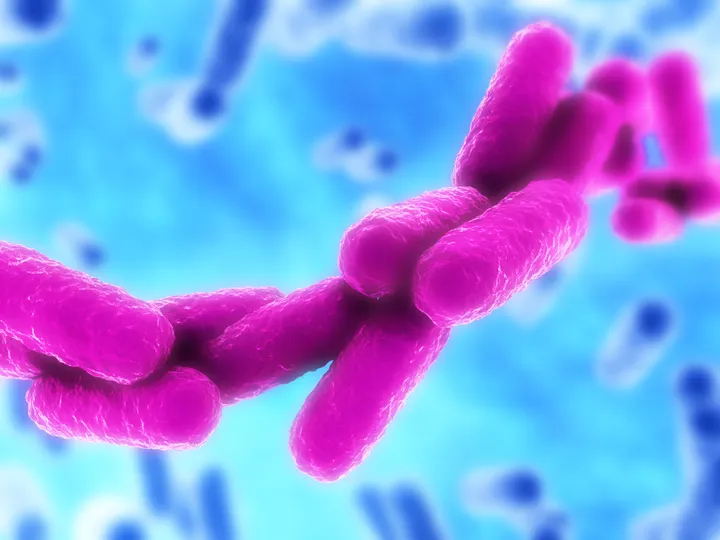
Recent revelations about our microscopic partners and tenants are numerically startling, if not downright existential. Try these for starters: Most of the cells within your body are not human cells, and you are literally teeming with pounds of busy microbes, working to earn their keep while you scan a blog post.
As a physicist, this emerging picture was new to me, but I've had some expert help to digest it now (bacterial pun intended).
Last month, the Human Microbiome Project announced the first comprehensive results of four years of study, revealing details of the trillions of bacteria that coexist on us and within us. To some non-biologists like myself, seeing humans as consortia of many different species is new territory. I had the great fortune of meeting Professor Margaret McFall-Ngai of the University of Wisconsin, as she was in San Francisco several weeks ago to chair a major meeting of the American Society of Microbiology. She agreed to continue my microbiosphere lesson in the blogosphere.
Margaret, you've been thinking about these bacteria for quite a while. But from what you've seen of the Microbiome Project data, what was the biggest surprise?
My biggest surprise from the data is that, much like fingerprints, the microbiota is unique to each person. What is common between people is the set of guilds of microbes -- i.e., while the specific bacteria are not the same species, the species make up groups that have particular conserved functions. A useful analogy might be something like cities: San Francisco and Boston do not have the same people, but to function as a city, they have the same guilds -- bakers, street cleaners, transportation safety folks, gardeners, etc.
OK, let's just hope our microbes don't have a financial services sector.
The Microbiome Project uncovers the bacteria in about 250 healthy human subjects, taken from 15 to 18 body sites apiece. The sites are all technically "outside," or continuations of the body's surface (e.g., face, wrist, inside the mouth, digestive tract, etc.). But you mentioned that these little guests would also influence deep tissues and organs, right? Can they influence, say, a brain?
Even though we don't have tons of bacteria circulating in our bloodstream, the bloodstream does have a profound microbial signature. In analyses of the small molecules (or metabolites) in the bloodstream, about 36 percent of them are bacterial in origin. They are derived from the activity of the bacteria in your gut (principally) and other places on your body. Our microbial partners shed metabolic products that are taken up by the host and find their way into the general circulation. What this means is that every cell in your body serviced by blood (including your brain) does now, and very likely has throughout evolutionary history, interacted with microbial products. They have participated in the shaping of our physiology.
You also mentioned that 90 percent of cells in our bodies are actually bacteria. But even as I started to feel like a walking microbe-loaf, you reminded me that bacteria are much smaller than human cells. Our microbial partners account for "only" about 5 to 10 pounds of our weight. To help us understand the consortium model of a human being, do you have a helpful way of thinking about it?
If the human cells were taken away, and all of the cells of all microbes were left behind (bacteria, fungi, mites, microscopic nematodes), there would be the outline of a human being. They are small, but they are numerous and very active. The human ecosystem is similar to any ecosystem, like a tropical rain forest, coral reef, etc. What the findings suggest is that the biological world exists as a set of ecosystems nested within other ecosystems, each having microbes at their very base.
I've heard the term "medical ecology" for this emerging field. What's your reaction to that label?
This is a great way to think about human biology, but it will be much more. If these things are true in humans, they will apply to all vertebrates. Likely, each time a vertebrate goes extinct, a subset of the microbial world will be lost forever. How the dramatic global ecological changes of today will impact all of these systems remains to be determined. At this point, we need to branch out and learn about the situation outside of humans, as well.
That sounds like a fundamental aspect of Earth's biodiversity, but we don't normally hear microbes included in the calculus of conservation.
To conclude this chat with more standard navel-gazing, what should the average health-conscious human take home for now?
As Jeffrey Gordon (Washington University in St. Louis) said a few years ago, "Honor thy symbionts" -- i.e., people will begin to recognize that, because the microbes are so critical to the conversion of food into the materials that we absorb into our bodies, we should feed them well. The data thus far have demonstrated very convincingly that obesity, for instance, is a disease associated with the imbalance of the microbiota. Also, people should take antibiotics only when they have a bacterial or fungal infection, and they should follow their doctor's advice about taking them. Antibiotics have dramatic, long-lasting effects on the health of your ecosystem.
I assume for obesity that we're left with a chicken and egg issue for now, in terms of which comes first: an off-kilter microbial ecosystem or a steady input of maybe-not-so-good-for-microbe items like gallons of high-fructose corn syrup.
Many thanks to Margaret for taking the time to chat. In closing, I, for one, welcome our new microbial overlords! (Sorry, it's a moldy old meme that I can never resist.)