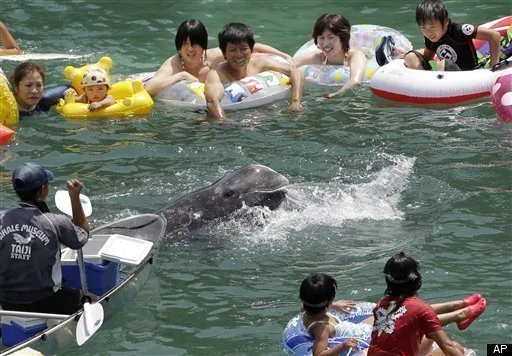
For over two decades, I've been studying and writing about cetaceans, those whale and dolphin mammal cousins whose brain size, close-knit family societies, and communication skills rival our own. Thirty million years older than homo sapiens, dolphins are our evolutionary elders. We have so much to learn from them about how to survive.
Scientists have determined that dolphins are a self-aware species, like humans. They use tools; they pass down their language, and have evolved a sophisticated matrilineal culture. Their echolocation sonar is far beyond our military science. No wild dolphin has ever harmed a human, even when we are attacking them. In fact, dolphins are altruistic and save humans from drowning or shark attacks.
With all that we know now about dolphin intelligence, why does the Japanese government still sanction a brutal dolphin hunt in Taiji? Why does Japan permit this primitive tradition when it also leads the world in such environmental technologies as hybrid cars?
Japan is looking backward when we desperately need this country to join the world in ocean conservation. In the 21st century of dying oceans, do our human cultural traditions trump our need for healthy seas? There are older non-human cultures than ours, and they are the life support system of this blue planet.
But this year, the killing begins again, even after the international outcry raised by the Academy Award-winning documentary The Cove, the Animal Planet series Blood Dolphins, and environmental activists on YouTube witnessing fishermen slashing the dolphins until the sea runs red with blood.
The villagers' boats surround a pod of migrating dolphins at sea and disorient their navigational sonar by banging metal poles. Terrified, the dolphins cling together - they are families, after all -- and are herded into the village's tight cove. Wielding knives, the fishermen stab the dolphins, whose sleek skin is twenty times more sensitive than human's. Wounded and screaming, the dolphins are dragged to the harbor warehouse for slaughter.
"There is nothing to prepare you for seeing it in person," an environmental activist, Leilani Munter, told the Associated Press. "I saw these beautiful dolphins being driven into the cove, and they came out dead bodies."
By this spring, over 20,000 dolphins will die this gruesome, inhumane death. Their meat will be displayed in Japanese markets, where it will be sold for 2,000 yen (about US $16) a kilo.
According to the Associated Press, "most Japanese have never eaten dolphin meat and would find the idea unappetizing." And dolphin meat is a health hazard because of its very high levels of mercury, which exceed even the Japanese government's own health limits.
Citing tradition, the Japanese government dismisses such protests of the Taiji hunt. "If you walked into an American slaughterhouse for cows it wouldn't look very pretty either," one of the fishermen told Japan Focus.
Dolphins are not domesticated and bred for our consumption; they are wild animals and an indicator species of our marine habitat's health. Our seas are not farms, a utilitarian resource for us to plunder. The oceans are our world's womb and necessary for our own survival.
As this year's dolphin hunt begins, there are changes. A few of the youngest dolphins have been freed. But without the family structure and the guidance of the adults these offspring may die anyway.
So far this year, no bottlenose dolphins -- like "Flipper" -- have yet been killed; instead, the fishermen have killed risso dolphins and pilot whales. Some of the Taiji dolphins are separated from their family pods and herded into netted pens, where they will be sold to aquariums and captive swim programs. Captivity for a dolphin is a life-long imprisonment. Dolphins are conscious breathers. That is why in captivity when dolphins suffer from depression, they often simply stop breathing and die.
Dolphins also grieve. When a mother dolphin loses her newborn, she will tow her baby in obvious mourning. Sometimes in the wild, the mother carries her newborn's body until it disintegrates. In captivity, the newborn's corpse is taken away from the mother. What aquarium visitor, looking only for smiling dolphins, wants to witness such grief?
Those of us who visit aquariums with captive dolphins or participate in the swim programs are helping to support this dolphin hunt. If we make our voices heard by boycotting such captive institutions, we could do a lot more to deny the dolphin hunters their financial reward.
The cove in Taiji is as narrow as the mindset driving this dolphin hunt. October 14th is the Save Japan Dolphins International Protest of this annual Taiji dolphin slaughter. All over the world, peaceful protesters will gather outside Japanese embassies. Scientists and activists will speak for the dolphins. We hope Japan will be listening and stop this backward hunt. Maybe we can learn to be more human, more humane.
Here is what I've learned from studying dolphins. Instead of changing their environment to fit themselves, they have adapted to a changing ocean. Dolphins bring their big brains and communication skills to assuring group survival. They do not dominate; they adapt.
That's what wise elders -- and nations -- teach their young: Adapt and change to better fit into the natural world, which is our only home, our habitat. Cultures change. Oceans change. We must change, as well. It's called evolution.
Brenda Peterson is the author of many books, including the National Geographic book Sightings and the Sierra Club book Between Species: Celebrating the Dolphin-Human Bond. Her new memoir is I Want to Be Left Behind: Finding Rapture Here on Earth.
Follow Brenda Peterson on Twitter: www.twitter.com/BrendaSPeterson
You are right, because they are smarter than that.
Humans must be pretty stupid then also because they generally will step in when someone is about to killed...yes I know some won't and when they won't step in what do you think people feel about that! You are right it's not about brains....It is about heart, loyality and devotion!
You said...You urge other people to put their lives on hold and fly to Japan, so I think it is more than justified to ask you when you plan on following your own advice.
Of course I urge others however the only ones who will do that are the people who really want to...what does that have to do whether I go or not! I take care of a dying father and I can't go so continually asking me when I am going is quite rude when you don't even know me. Really you are just being a smart alec and how sad for you to have to continually try to find reasons that go beyond the topic just to try and make a point and whatever point you are trying to make is really truly meaningless. It only has meaning to you and seems to be that you just want to argue!
"The fishermen of Taiji are defiant and will not change, however they do not like the media, they do like the attention drawn to them and their dirty little secrets exposed to the world and they fight this to the hilt."
You are probably right. So having more people there will probably just get them to dig in their heels even deeper, meaning more dolphins killed and a longer time until it stops.
http://www.yourdailyvegan.com/2009/07/16/i-am-scared-and-dont-want-to-die/
One way you can help is to go to several of the websites listed in these comments and get
involved. There are precedents for Japan actually listening to the world's voice and criticism.
In 2000, Mitsubishi, the world's largest corporation, heard the over 1 million letters written to
protest their plans to put a salt plant in a gray whale nursery in Mexico. This far-sighted
decision is a model for what the Japanese government and the fishermen of Taiji might do --
while the world is watching.
Modern physics teaches us that what we closely observe, we change. If we keep our eyes
on Taiji, our attention can actually create change. This is called witnessing. We've just seen
this in the miraculous rescue of Chilean miners -- while the whole world came together and
watched and celebrated.
Take this one day and focus on Japan and ask that they please listen. There is an opportunity
here for Japan to show the world the they will join in the world's work to restore our oceans and
marine life. When I talk about dolphins as our evolutionary elders, I'm hoping that Japan,
with its tradition of respect for elders, will understand that this, too, is part of a culture --
one that includes all that is alive.
http://www.IWantToBeLeftBehind.com
For more sanity, please read my full review:
http://www.theinductive.com/culture/2010/1/21/the-cove-and-the-self-righteousness-of-activists.html
After Breakfast we went to the Cove again. We were going to do a memorial for the dolphins that lost their souls to greed. Save Japan Dolphin’s volunteers, Creig and Leilani bought twenty red roses to offer for the dolphins. Each of them put ten in the water to float out to sea. The police got angry and said that was pollution and that we had to swim in and get them back. We couldn’t believe they said that! It is a crime to throw twenty roses in the water… yet they can dump the guts and the hearts of dolphins in it!?
This shows how much these fishermen and this town can not stand anyone there...for them to say they were polluting the water with roses ....Get Real....They polute by the blood of the Dolphins!
"An aggressive four-year-old bottlenose dolphin has been accused of bullying swimmers and waterskiers in New Zealand.
Rescue services had to be called after the animal's intimidating behaviour prevented six people from swimming back to shore in separate incidents in the past week.
Moko, who weighs some 250kg and used to live off Mahia on New Zealand's east coast, was initially praised for his friendly nature.
But since making Gisborne his home in September he has trapped swimmers, overturned kayaks, tipped over waterskiers, and interfered with surf lifesaving training."
Sure looks like there are reports of dolphins harming humans.
"Thirty million years older than homo sapiens, dolphins are our evolutionary elders."
And that is a pretty foolish statement. Unless you believe that we have much to learn from every species that is evolutionarily older than homo sapiens. Like crocodiles or the Coelacanth. Of course the other way to look at it is that since the Earth has changed over the last 30 million years, and human ancestors have continued to evolve while dolphins haven't. Then humans must be better adapted and more advanced than dolphins.
The new research shows these creatures were smaller, with smaller teeth, but - crucially - relatively bigger brains. Their EQs had jumped to 2.5 - a phenomenon Marino suspects is related to their development of echolocation - the use of sound waves to locate objects - and their complex social lives.
The research shows that about eight out of 67 odontocete species - including dolphins - went through a second boost in brainpower about 15 million years ago, attaining EQs of 4 and 5, although the reasons for this leap remain unclear. And some species' brains also got smaller.
cetaceans, especially dolphins, the more we marvel at their evolutionary
adaptations and skills. As John Lilly, the respected dolphin researcher once
wrote, "You see, what I found after 12 yrs of work with dolphins, is that the limits
are not in them; the limits are in us."
If we can stop killing them, perhaps we can learn more by apprenticing
ourselves to what they know -- and we have yet to discover.
And if their brains grew to process the data from echolocation then that is no indication of increased intelligence. Also EQ is a very bad indication of intelligence in the first place.
Wednesday, October 13, 2010
Thirty Dolphins Escape From the Cove
This morning in Taiji, the fishermen drove a pod of around 30 dolphins all the way to the mouth of the Cove, but at the last moment, the dolphins turned and escaped!!! More to come soon, including a first-hand account from our Cove Guardians who witnessed the dolphin's miraculous escape.
The exact location of The Cove can be seen perfectly on the satellite imagery of BlooSee here:
http://bloosee.com/r/iGaS2V
Pass it on, and let the fishermen in Taiji know that the world is watching!
Onward!