More

Featuring fresh takes and real-time analysis from HuffPost's signature lineup of contributors
Brendan Nyhan

Brendan Nyhan

Posted: September 16, 2010 10:24 AM

Today's New York Times includes a front-page story on a new poll headlined "Poll Suggests Opportunities for Both Parties". In the lede, Jeff Zeleny and Megan Thee-Brenan note the signs pointing to a Republican sweep, but note "while voters rate the performance of Democrats negatively, they view Republicans as even worse, providing a potential opening for Democrats":

Republicans are heading into the general election phase of the midterm campaign backed by two powerful currents: the highest proportion of voters in two decades say it is time for their own member of Congress to be replaced, and Americans are expressing widespread dissatisfaction with President Obama's leadership.

But the latest New York Times/CBS News poll also finds that while voters rate the performance of Democrats negatively, they view Republicans as even worse, providing a potential opening for Democrats to make a last-ditch case for keeping their hold on power.

Is this really true? Will the poor state of the GOP brand limit the party's gains in November? I made this argument months ago (see here, here, and here), but the Republican party's image hasn't prevented it from taking a substantial lead in the generic ballot.

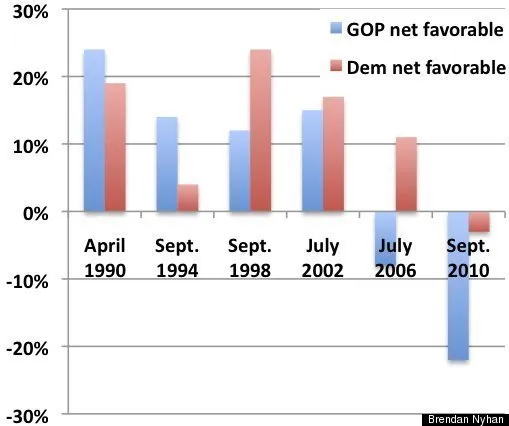
To review the evidence about where the GOP brand stands relative to the opposition party in previous midterm elections, let me update my post from last October. Here's a bar chart of each party's net favorable ratings (% favorable - % unfavorable) for the most comparable available CBS poll from midterm elections between 1990 and 2010*:

2010-09-16-cbspartyfaves.png

The GOP's net favorability ratings relative to Democrats are still worse than any opposition party in the previous five midterm elections (the closest comparison is 1998, when Republicans were seeking to remove Bill Clinton from office).

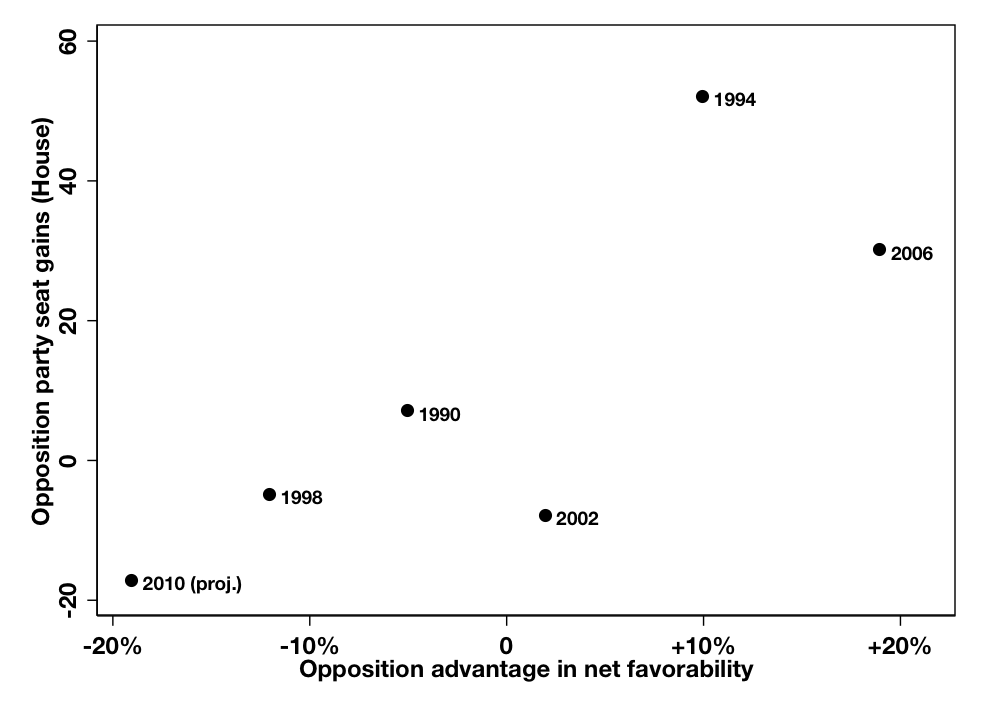
In the past, the opposition party's (dis)advantage in net favorability relative to the president's party has been relatively highly correlated (r=.71) with changes in the number of House seats in midterm elections. However, a simple linear fit shows a totally implausible result for 2010 (Republicans losing 17 seats):
2010-09-16-favseats.png

I'm not buying it. At this point, every other major factor (the high number of seats Democrats currently hold, the fact that it's a midterm election, and the generic ballot) points toward big GOP gains -- the predicted result of most House forecasting models. Unfortunately for Democrats, midterm elections are a referendum, not a choice.

Update 9/17 9:09 AM: Barry Pump points out that the net favorability advantage appears to be a better predictor in the last five midterms than the generic ballot. It's very hard to say what will happen. As he points out, this is uncharted territory:

First, we've never been in a situation until now -- as far as we have data to show it -- where both parties were disliked but one party was disliked far more than another. We've also never been in a situation where the difference between the favorability rankings of the two parties was as great as it is now. (That's from the first graph.)

Second, we've yet to be in a situation until now -- as far as we have data to show it -- where the favorability rankings of the two parties were so discordant with the generic ballot.

* I focus on net favorables rather than net approval of the parties in Congress (which Zeleny and Thee-Brenan cite) because the available data is more comprehensive and the measure is less confounded with feelings about Congress as an institution.

[Cross-posted to brendan-nyhan.com and Pollster.com]


Follow Brendan Nyhan on Twitter: www.twitter.com/brendannyhan

Today's New York Times includes a front-page story on a new poll headlined "Poll Suggests Opportunities for Both Parties". In the lede, Jeff Zeleny and Megan Thee-Brenan note the signs pointing to a R...
 
 
  • Comments
  • 10
  • Pending Comments
  • 0
  • View FAQ
Comments are closed for this entry
View All
Favorites
Recency  | 
Popularity
photo
Computer Geek
Logician Atheist Lefty
10:38 PM on 09/16/2010
I volunteered to deliver applications for absentee ballots to Democrats in my precinct tonight. The guy organizing it said he hadn't seen a response like this - they had to have 2 others come in to help deliver when they had only me scheduled originally. These were Democrats who didn't vote all that frequently and so in his words, these are 'gravy' votes.
Anecdotal perhaps, but it could be that Democrats are listening a little closer than pundits and pollsters want to believe. It sure raised my spirits as I have been disheartened about all the naysaying for the Democrats chances in November.
04:17 PM on 09/16/2010
The difference in favorability is because most Democrats support Democrats while most Independants and Republicans don't support Republicans because they are too much like Democrats. We don't need two parties that both grow the size of government. When that happens you go from being a country of "limited government" to one where government spending at all levels accounts for over 40% of GDP. We only pay 28% in taxes which makes that 40+% more problematic. If a project is worth spending money on then convince people to pay for it. If it isn't then don't spend money on it. A salesmen could sell all the cars, TVs, etc... in the world if his customers didn't have to pay for it. Independant and Republican voters might not all agree on what to spend money on, but they do all agree that we can't spend money that we don't have and it is the job of our politicians to make choices on that spending even when it isn't the most popular thing to do politically.
10:35 AM on 09/24/2010
The cost of the wars would solve most of the deficit. Military contractors are scamming us.
photo
HUFFPOST SUPER USER
demshuff
Fox dumbs down America
02:10 PM on 09/16/2010
Correct me if I'm wrong, but I always considered Independents a group who appeared a cut above the notch, intellectually. They seemed guided by balanced thinking. Have they morphed into something else that I don't know about. Have they been swayed into the fringe. Where are they.
photo
HUFFPOST SUPER USER
justoverit333
make art not war
01:52 PM on 09/16/2010
Why would they use blue for GOP and red for Dem in the chart?
That's confusing.
photo
HUFFPOST SUPER USER
mommadona
I paint. I blog. Therefore, I am.
12:54 PM on 09/16/2010
Uh...as a 'political scientist' you must realize switching those 'colors' on that chart leads to misread/deceptive information, correct?

~ reason 107 why I consider political and economic 'scientists' an oxymoron.
photo
HUFFPOST SUPER USER
NajkaLion
01:27 PM on 09/16/2010
I agree. The reversal of the traditional colors causes cognitive dissonance.
photo
HUFFPOST SUPER USER
Russell Masingale
weary I am of the Astroturf.
05:42 AM on 09/17/2010
and the inability to read charts makes the point that a vast portion of the population is to stupid to be allowed to vote. does a color change really throw you off that much?
photo
HUFFPOST PUNDIT
FoonTheElder
Always choosing between the lesser of two evils
12:20 PM on 09/16/2010
This article brings up the real point that Americans don't like either party.

A recent Zogby poll shows that Americans believe the negative statements that each of the parties makes against the other.

Sixty four percent agree that Democrats will raise their taxes, and 61% agree that Republicans will continue to oppose all of President Barack Obama's proposals because they want him to fail.
The Zogby Interactive poll of 1,980 likely voters was conducted from August 24-26, 2010.
The survey offered four critical statements about Democrats and four about Republicans. Respondents were asked to agree or disagree with each statement in the context of deciding how they will vote in Congressional elections.

Pollster John Zogby: "A still slumping economy and conservative enthusiasm strongly favor Republicans in November. But as these results show, both parties will find a majority of voters ready to listen to why the other side can't be trusted. How each handles these issues will decide which party wins a majority in Congress." "

http://www.zogby.com/news/ReadNews.cfm?ID=1893
Grunty1
Micro-bio this
01:57 PM on 09/16/2010
[61% agree that Republicans will continue to oppose all of President Barack Obama's proposals because they want him to fail.]

Why wouldn't we believe that? Party leader Rush Limbaugh said it outright.