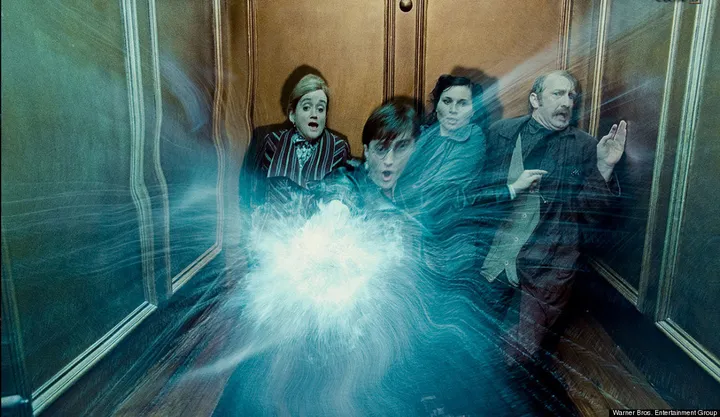
"These are dark times," says the doomed Minister of Magic at the beginning of Harry Potter and the Deathly Hallows: Part I, and we are swept up into what at first promises to be a familiar installment in the series, with our heroes Harry Potter, Hermione Granger, and Ron Weasley leaving their homes at the beginning of a new school year to do battle with the evil powers of Voldemort and his followers.
But we quickly realize that the darkness of Deathly Hallows is much worse than what we might expect.
Up till now, Voldemort has mostly been operating outside the law, through secrecy and stratagem, while Harry and his friends have been supported by a wonderful wizarding world of benign institutions and beloved authority figures, including Dumbledore, the Ministry of Magic, and Hogwarts, as well as their friends, and (at least in Ron's case) their families. But now the government has fallen, and with it all of the mentors and social structures that supported the young people in their fight. Voldemort's world is everywhere, and the world of the good guys has vanished. Not even a Weasley wedding is safe.
The stage is set for an anti-totalitarian resistance tale, with the brave band of young people sabotaging the bureaucratic structures of a neo-fascist state. And for the first part of the film, that is the story we get. Voldemort's government recalls Nazi Germany both in its over-the-top state statuary and its obsession with enforcing blood purity. Witches and wizards of non-wizard ancestry, like Hermione, are to be singled out for torture and death. The film's images of racist propaganda and show trials are familiar to us from stories of fascist regimes, and the early scenes of Ron, Hermione, and Harry infiltrating the newly-fallen Ministry of Magic provide a familiar kind of good-versus-evil clarity.
But when the trio leaves London to look for horcruxes (the enchantments that must be broken in order for Voldemort to be vanquished), the genre of the film shifts into something much more interesting and unexpected. The movie turns into a slow-paced story of the experience of the chosen people (or perhaps more accurately the chosen person and his best friends) wandering almost aimlessly in the wilderness, complete with a portable tabernacle (the tent Hermione thoughtfully brought in her bottomless enchanted bag) and a faithful fire by night (the magical pocket light creator that Dumbledore bequeathed to Ron).
For most of the rest of the movie, the drama is no longer about battles with external forces of darkness. Instead, the suspense is about whether Harry, Ron, and Hermione can remain faithful to the beliefs they've inherited, and to each other. They are battling the darkness within. Many of the epic struggles of Deathly Hallows take place in silence, as one of the young people quietly keeps watch in a deserted British landscape, dwarfed by an endless sky. Sometimes the struggles take place in fraught fights within the group, as they argue over why they're still wandering, whether they're heading anywhere, and how they can diffuse the tense relationships of leadership and loyalty between each other. Even Ron and Harry's dramatic show-down with a horcrux is ultimately less a throw-down with evil than it is a struggle with their own doubt and self-doubt, and with the limits of their loyalty.
In these ways The Deathly Hallows is a very Old Testament film, with all the exile, yearning, loss, and hope that that implies. At the end, it leaves us still wandering in the wilderness waiting for Part II. But in the meantime, as we wait for the moment of messianic triumph, we get hints of other religious stories as well. The only two moments of respite and solace in the film are facilitated by Christian music. On a snowy Christmas Eve in the village where he was born, Harry stops and listens to the music coming from the church, and takes a moment to mourn at his parents' grave. And during one of the most magical scenes in a very magical film, Harry and Hermione dance to the gospel-inflected lyrics of "O Children" by Nick Cave and the Bad Seeds:
"O children, lift up your voice.
Children rejoice, rejoice. ...
Hey little train! Wait for me!
I once was blind but now I see.
We are all jumping on the train that goes to the Kingdom."
The Hogwarts Express may no longer be running, but the Kingdom train is coming...
HARRY POTTER AND THE DEATHLY HALLOWS
Harry Potter - Wikipedia, the free encyclopedia
MuggleNet | The World's #1 Harry Potter Site - Deathly Hallows ...
And the song "O'Children" by Nick Cave, while yes does have a _slightly_ Gospel feel to it also includes lines about passing someone a gun and mentions the word "Gulag" (russian labor camp). All in all, if you actually bother to read the lyrics of the song, it sounds less like a song about anything to do with God, more like a sound about being forgiven by someone else for a personal failing.
On a side note, Nick Cave has publicly stated that he does not believe in the existence of a God.
Harry Potter and god do have one thing in common; that is, they're fictional characters.
Ain't fantasy grand?
Don't let Harry Potter go to your head, it's fantasy, and I'm a firm advocate of fantasy but it has ZERO relevance to reality at that level.
Harry Potter is a good hero. He's flawed, he makes stupid mistakes and never dons the shiny tights and the red cape. He does not win alone, but requires the assistance of many people to overcome Voldemort. I was always grateful to Rowling for never crossing that line.
Honestly, those of you who are losing your minds, upset that these crazy Christians are trying to "co-opt" Potter with the Bible don't know much about the Bible or Potter.
Have you read the quotes on the tombstones of Dumbledore's family and Harry's parents? They are, "For where your treasure is, there will your heart be also," and "The last enemy that shall be destroyed is death." Know where those come from? The Bible. Look closely in the movie--you'll see it there too.
"I think those two particular quotations he finds on the tombstones at Godric's Hollow, they sum up — they almost epitomize the whole series." -J.K. Rowling
Oh, and--SPOILER if you haven't read the end of the book -- Harry sacrifices himself to save the world, dies, and because he so willingly died with pure intentions, rises again from the dead to defeat the enemy once and for all. Sound familiar?
"I go to church myself," she declared. "I don't take any responsibility for the lunatic fringes of my own religion." -J.K. Rowling
I've always been greatful that the religious parallels weren't blatantly shoved at us the way they are in, say,
"The Lion, The Witch & The Wardrobe". It always amazed me the neocons were 'cool' with that series, which also includes witches and magic, but not Rowling's series.
And neocons are cool with C.S. Lewis because he was an atheist turned Christian apologist, and one of the most well-known and influential Christian writers in the last century (i.e. The Screwtape Letters, Mere Christianity, and Narnia).
I think more Christians should appreciate the message in the Harry Potter books, but there is a distinct reason why they promote Narnia over Rowling -- since the movies have come out a lot of people are unaware of the history, but the Chronicles of Narnia were kind of considered the "property" of Christians for a long time, since the books told the story of their faith. Lewis used witches and magic the same as Tolkien did, so I may be as surprised as you that Christians chose "witchcraft" as their primary objection to Harry Potter. That being said, the religious like to support their own, and Lewis and Tolkien were both Christians (Anglican and Roman Catholic). The fact that Rowling's objective is wonderful fantasy and storytelling, rather than allegory, is why many conservative Christians don't like it. And they're missing out.
Get over it. There are many books about Good Vs. Evil. You have the Chronicles of Narnia books by CS Tolkien, Lord of the Rings by JRR Tolkien, Dracula by Bram Stoker and The Stand by Stephen King. There is not really anything new to them but perhaps the characters. Some perhaps better than the others, but ALL show a struggle with inner and outer Evils that haunt the main Character(s). Just STOP putting to much importance in them and just enjoy them.
The Hero's Journey is a much older story than the Old Testament.
Not to mention strong expression of what Rudolf Otto called numinosum.
Something, society and especially our politicians are lacking.
The story of the Heroes Journey is written in our Collective Unconscious, according to C. G. Jung and Joseph Campbell. Each of us responds to stories like Harry Potter, Lord of the Rings, Chronicles of Narnia, the Greek myths and even the bible because they follow a theme that is already existing inside the structure of our very own minds.
It's as if all the possible experiences that a human being could ever have, are pre-wired in our psyches, and all artists are merely tapping into what was already there in the first place.
F&F
Just kidding.
All I will say is that I enjoyed the movie.