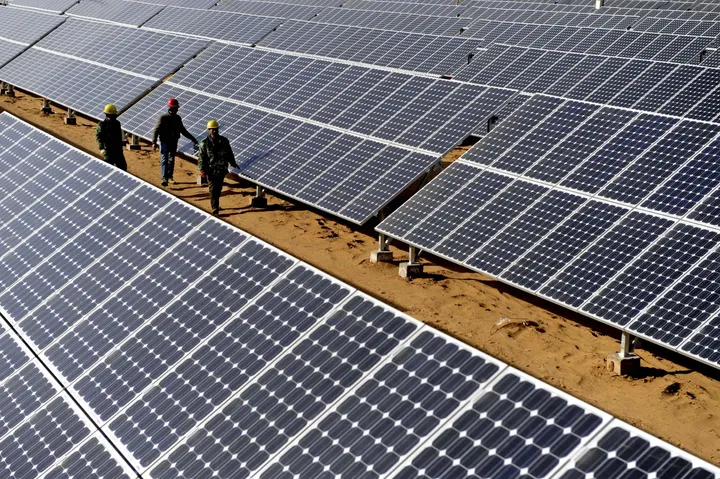
Let's face it: Solyndra wasn't a winner. But it was the company's inability to keep up with rapidly declining solar panel costs -- not its focus on clean energy technology -- that led to its demise.
Nevertheless, the associated job losses and pique of political scandal have overshadowed the real story of the U.S. solar industry. The larger picture shows that solar businesses are growing -- and creating boatloads of jobs. That claim is backed up by preliminary data from The Solar Foundation's National Solar Jobs Census 2011.
As of August 2011, 100,237 solar workers are employed in the United States. Solar is employing workers in all 50 states and across a vast supply chain. To put that in perspective: the solar industry has grown 6.8 percent over the previous year, adding 6,736 new workers in 12 months.
During that same time span, overall national employment grew by only 0.7 percent. The fossil fuel electric generation industry fared even worse, losing 2 percent of its workforce. These are not insignificant numbers -- and all policy makers would be wise to study them carefully.
Unlike the negative conjecture by pundits about the state of the U.S. solar industry, The Solar Foundation's stats are a real snapshot of the industry. (And they're backed by social science researchers at Cornell.) They're also backed up by countless industry success stories. Take solar installation firm SolarCity, which currently employs more than 1,200 people in 11 states. It will create jobs in an additional 22 states thanks to an agreement with the Department of Defense to install 160,000 rooftop solar installations on military housing complexes at 124 military bases across 34 states. The company hopes to fill many of those jobs with veterans and military family members.
Of course we can't forget Sungevity, which just inked a deal to double its workforce. Sungevity founder Danny Kennedy told me recently that all these reports about the death of the solar industry are greatly exaggerated, especially in light of the Solar Foundation's new numbers: "What other industry in America with over 100,000 employees grew at nearly 7 percent year-on-year, while the rest of our economy was doing a dead-cat bounce? The solar industry is one of a few bright spots in America's employment landscape."
Rooftop solar installations are just the beginning. Utility-scale solar provider BrightSource is constructing a solar power plant in the Mojave Desert, a move that will create demand for skilled construction workers. These types of development create jobs along the supply chain, reinvigorating manufacturing companies that had previously supplied parts to older, declining industries.
Meanwhile, the American solar manufacturing industry is holding its own in a competitive global market. America continues to be a net exporter of solar technology -- to the tune of $1.9 billion in 2010. Across the country, solar manufacturing centers are emerging. In the Southwest, SCHOTT employs more than 500 at its flagship factory in Albuquerque, N.M., while Suntech Power employs more than 100 at its factory in Arizona. Other firms -- Hemlock Semiconductor in Michigan, and Wacker Chemie in Tennessee -- prove that solar jobs are growing across the country.
So, yes: Solyndra wasn't a winner. It's disappointing when any American business doesn't make it and jobs are lost. But one isolated case just can't paint an accurate picture of an entire industry. Let's tone down the rhetoric and focus on the data -- and the success stories -- that are abundant in the U.S. solar industry. These should be what guide policy makers and the American public.
Brian Keane is the President of SmartPower, a non-profit marketing organization funded by private foundations to help build the clean energy marketplace by helping the American public become smarter about their energy use.
Follow Brian Keane on Twitter: www.twitter.com/SmartPower_org
Your job numbers clearly include large-scale thermal-solar, which is still pretty $$ per-watt, and is less likely to be improved greatly by technological innovation.
What are we to become a nation of installers of Chinese made solar cells? Excuse me but I really don't see this as a good thing!
And isn't the point of solar - clean energy?
http://www.huffingtonpost.com/2011/09/20/jinko-solar-holding-company-toxic-waste-cleanup_n_971419.html
And all the NF3 being released, you know that greenhouse gas growing at leaps and bounds, 17,000 times stronger than CO2, long lived 500+ years:
http://ewasteguide.info/biblio/nf3-greenhous
And finally taking a swipe at Solyndra! Let's face it they lost even with better technology not because they were a loser. They lost because the Chinese knew that with lot's of cheap subsidized dirty coal energy they could melt sand/silica in intensive energy electric arch furnaces and under cut the competition.
It's a winning formula for fast developing nations, use cheap dirty coal while industrial nations saddle their manufactures with restrictions on fossil fuel usage.
Between 1980-2000 the industrial nations and developing nations used about the same amount of coal approximately 45 quadrillion BTU's. However between 2000-2008 while the industrial nations actually reduced their usage of coal (explains the loss in jobs in the fossil fuels generation maybe a lot more besides) the developing world DOUBLED their usage of coal!
Look the only viable way for the U.S. to go green and the rest of the planet with us is to impose an environmental tariff on products sold here based on the manufacturing, transportation, and sustainability of those products.
If we truly have man-made climate change our current trading practices seem to be the express train to this change!
Don't "buy American" solar panels unless "American" is less expensive.
Solar can not (yet) afford nationalistic idealism.
On the other hand, EVERYTHING ELSE should have a trade tariff slapped on it (if we are to even have a hope of future prosperity). An unlimited supply of really cheap (but must be quality) Chinese panels would virtually guarantee thousands of square miles of install jobs, thus helping with the energy, enviro and economic problems.
It is a shame that our leaders and corporations purposely seek to get rid of jobs. It's a shame that they won't develop robotic factories that make all the parts including batteries 24/7 for (almost) free. It's also a shame that they developed the worst possible kind of nuclear out of many different meltdown proof reactor designs the don't spit out much wastes...
Only through robotic manufacture (anywhere) could solar ever be cheap enough to create real jobs (without subsidies) and do any real good.
How can we compete with China when their goverment gives solar companies billions of dollars in intrest free loans, free land and free electricty for their plants and not to mention they pay their workers $12.00 a day!!!??? How can anybody compete with that unfair advantage???
Our state senator here in Oregon is actually trying to SAVE jobs by places tafiffs on China because of this unfair advantage, we are trying to build american and keep american jobs at the same time using a highly robtic plant, I could gladley show you pictures of exactly how robtic it really is!!
So, I am sorry but I completly disagree with you here, BUY AMERICAN!!!
The U.S. would be the leader in solar panel production if the environmentalist would allow us to mine rare earth minerals. This is the stupidity of the green movement. You can only get rare earth metals in China because as greenies champion solar, they don't allow mining. So China get the industry, and dare I say the jobs. The greenies are shipping our jobs overseas.
The problem isn't the jobs overseas, we are building mostly commodity goods there. The problem is that the previous administration slashed and burned our science budget. Now innovation, what really made the USA, happens more overseas and that is what has caused the issues we face today. I guess fighting Iraq and Afgan was money well spent.
first solar has one of the lowest prices 2.5$ installed per Wp.
Keep up the good work!