The Invisible Hate Crime
Hate crime legislation is aimed at protecting the most defenseless among us who are targeted out of prejudice--minority families who relocate to a previously all-white neighborhood where they are met with a burning cross and a threatening phone call rather than the welcome wagon; gay college students who are assaulted by their schoolmates because they are different; the first Latino employee in an office who is warned to leave the company before it is too late. Clearly, of all those who are targeted for prejudice, homeless members of society are among the most vulnerable of all. They are literally hunted down by everyone from violent racist skinheads to groups of bored and idle teenagers and young adults who get a sadistic thrill out of beating, burning or drowning to death helpless street people. In our highly competitive and increasingly coarse society, negative stereotypes about difference, appearance, and the worth of the poor label the homeless as disposable people. Class based prejudice, which sometimes overlaps with racial hatred among others, remains one of the last widely acceptable forms of intolerance. Yet, homelessness continues to be excluded from most hate crime legislation at the state and federal level. While about a dozen states including California and New York, have considered such measures, only Maryland, Maine and the District of Columbia have added homeless status to their hate crime laws.
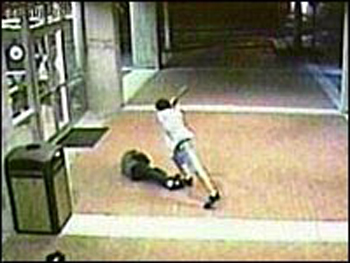
Hate for A Thrill
Just like teenagers who target Blacks, Muslims, or Latinos, those youngsters out for a thrill who attack homeless people get little more than bragging rights with their friends who think that violence is pretty cool. Their shared violence becomes a bonding ritual, not unlike attacks by gangs or the hazing rituals in some fraternities. The sadism in their crimes may originate in the thinking of one or two cruel but influential members of the group The others are "fellow travelers" who really go along to get along. The last thing they want is to be rejected by their friends.
In order to reminisce about the cherished moments they share causing pain and suffering on the streets, youthful perpetrators have actually been known to videotape their tortures--spurred on by the advent of small cheap video cameras, social Internet media and a series of horrendous commercial "bumfights" videos. In the background, through the horrific screams of their victims, the perpetrators can be heard laughing uncontrollably. In their minds, homeless people deserve their fate; they are viewed as nothing more than garbage or trash to be eliminated from the streets. As with other hate crime offenders, these attackers are typically young male "thrill offenders" seeking excitement and peer validation. Fifty-eight percent of those attacking the homeless over the past 10 years are in the 13-19 age group. These thrill offenders, like the more hardened racist skinhead perpetrators, view attacking the homeless as nothing more than a fun communal way of simply cleaning the streets of filth, an activity to be respected rather than reviled.
An Acceptable Form of Prejudice
Sadly, those young people who attack the homeless reflect a more general prejudice. Homeless people are generally regarded as the dregs of society--as chronically filthy, lazy, passed-out drunk, alone, psychotic, and worthless. They are typically seen as bums who refuse to take a job, beg for money and act violently. Youths pick up and act on a combination of messages sent to them by adults. Whether it be in sporting events, reality television, movies or politics coarse, outrageously dangerous, and even violent behavior is portrayed as funny, cool, and strategically smart. Several months ago Maxim, a youth-oriented magazine targeted at college-aged males, mocked the National Hobo Convention in Britt, Iowa, in a blurb titled "Hunt the Homeless." The journal directed its readers to "Kill one for fun. We're 87 percent sure it's legal."
Even Americans who express some sympathy for the homeless tend to accept the stereotype that all of them are motivated by drug and alcohol abuse as well as serious mental illness rather than by such factors as job loss or conflict at home as well. Many Americans also stereotype the homeless as single, working-age men who live, for long periods of time, on the sidewalks, under bridges, on park benches, and in shelters. Actually, more than 40% of the homeless consist of children under the age of five. Moreover, more than two-thirds of homeless teenagers only stay on the streets long enough to resolve their family conflicts and go home. Homeless people come from all walks of life. With the unemployment rate at an exceptionally high 10% nationally, the economic situations of both professional and working-class families can quickly deteriorate into a vicious cycle of job loss, financial problems, health issues, and enormous debt. For some, living on the streets or in a shelter may be their only recourse.
In the 1980s and 1990s, Americans discovered hate crimes committed because of a victim's race or religious identity. More recently, we discovered hate crimes based on a victim's sexual orientation, gender, gender identity and disability status. In 2009-2010, it is about time that we turn our attention to the plight of homeless people who are being attacked in growing numbers, based simply on an ugly stereotype. As both Christmas, New Years and the longest night of the season approach it is time that all people of good will turn their compassion for the less fortunate into action. This week across the nation vigils are being held on December 21 to remember the homeless, while many others will turn their Christmas Day into a day not only of prayer, but of selfless service to the less fortunate.
Hate Crimes Against The Homeless Statistics Act
We can also support legislation known as the Hate Crimes Against the Homeless Statistics Act (S. 1765) which has been placed on the Senate Judiciary Committee schedule this month. If passed, the bill would amend the Hate Crime Statistics Act which already takes note of offenses based on race, religion, national origin, sexual orientation, gender, gender identity and disability status to include hate crimes against the homeless in the data collected by the Attorney General.
If they were included in the annual hate crime inventory taken by the FBI, such offenses might actually be more numerous than other hate attacks. Over the last few years, as increasing numbers of Americans have been forced to live on the streets, by some estimates over one million, there has been a sickeningly high number of sadistic acts of violence directed at the homeless that are not the result of robbery, personal animus or drugs. According to the National Coalition for the Homeless (NCH), fatal attacks on homeless people rose 65% between 2005 and 2008, reaching a total of 70 murders over this four-year period. the number killed has not dipped below 20 a year since 2005.
According to the NCH and the Center for the Study of Hate & Extremism, despite their relatively small numbers, nearly 2 1/2 times more homeless people in America have been killed over the past 10 years in apparent unprovoked bias homicides than the total for all the other hate-crime homicides -- on the basis of race, religion, national origin, disability and sexual orientation -- combined. The FBI documented just 16 hate-crime homicides nationally for the two most recently available years combined, while the NCH enumerated more than three times as many "hate homicides" against the homeless during the same period.
The passage of the Hate Crimes Against the Homeless Statistics Act, introduced by U.S. Senator Benjamin Cardin, will not mandate financial support to government responses to hate crimes against the homeless. The current legislation would merely require that such hate crimes be reported in addition to other bases for bias motivation. Yet, the current bill is nevertheless important because it provides vital information to those who assist the homeless about how we can better protect them and respond to the brutalization of them. Support for inclusion of the homeless in hate crime legislation ranges from conservative Christian Republicans like Maryland State Senator Alex Mooney to Democrats like California State Senate leader Darrel Steinberg. The new federal bill rightly acknowledges that homeless people--no less than racial and religious groups--deserve to be protected from the cruel and brutal treatment of the bigots among us.