Brian Whetten

Brian Whetten

Posted April 20, 2009 | 07:08 PM (EST)

The Real Roots of the Financial Crisis

digg Share this on Facebook Huffpost - stumble reddit del.ico.us RSS

With the financial crisis, we've seen a lot of talk about why it happened and who's to blame. We've pointed a lot of fingers at a lot of targets, including bankers, regulators, and homeowners. We've identified a number of symptoms, including greed, incompetence, fraud, and inadequate regulation.

But none of these explanations speak to the deeper roots of the crisis.

One of the great truths is that "with every great strength comes an equal challenge." So what are the greatest strengths and challenges of capitalism?

The greatest strength of capitalism is its unparalleled capacity for economic expansion.
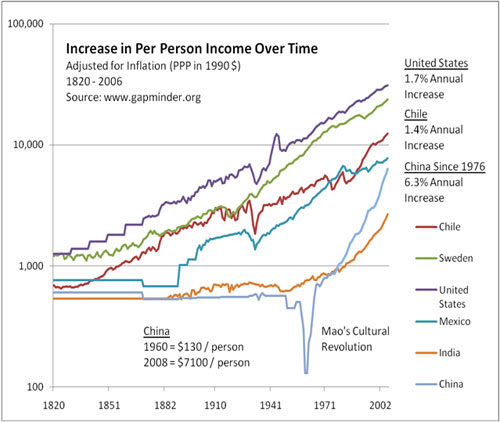
2009-04-16-0graph.jpg

The accompanying figure shows capitalism's remarkable ability to increase our standard of living. For example, for almost 200 years in the US, the amount of real income per person has increased by an average of 1.7% - year upon year upon year. Or look at China. Income was flat until Mao took over, then it plummeted and recovered as they embraced their own version of capitalism, and since then per person income has been increasing by 6.3% per year.

Over time, the power of compounded growth is amazing. In the US, it's the difference (in 1990 $) between $1,200 / person in 1820 and $32,000 / person in 2006. In China, it's the difference between $130 / person in 1960 and $7,100 / person in 2008.

It's why in the US, people now drive to their protests.

At the same time, the current crisis is exposing the challenge that comes paired with capitalism's great strength.

The greatest challenge of capitalism is its addiction to economic expansion.

Many people have been asking about the Wall Street blowup, "how could they have been so greedy?" And, "how could they have been so dumb?"

But what is greed? It's not our desire for money. It's an addiction to our desire for money. It's desire that's gotten out of control. And what always comes with addiction? Denial and self-deception. Greed is stupid - literally - because it's an addiction that causes us to lie to ourselves. Above all else, this crisis was created by an almost ubiquitous level of denial. It was created by the most expensive words in finance, "this time it's different."

This addiction isn't just a problem with the people on Wall Street. Or the people who took out a mortgage they couldn't afford. Or the people who got up to their eyeballs in credit card debt.

It's a core challenge of the system itself.

Our entire financial system is based on the root assumption that the economy will continue expanding -- that there will be more money tomorrow than there is today. How are we funding our retirements? Through the assumption that money we invest in the stock market will grow, because there will be more money tomorrow than today. How do banks make money? By selling interest bearing loans. And what allows us to take out a loan? Our assumption that we'll have more money tomorrow than we do today. Why is our government able to create trillions of dollars in new debt?

Because of the assumption that there will be more money tomorrow than there is today.

Notice how much fear there is of the "R word." Why is a recession so scary? I mean, it's just the difference of a few percentage points, right? No. It's the difference between satisfying our addiction to economic expansion, and going into withdrawal.

It's the difference between the system working and the system failing.

But here's the thing. Exponential expansion isn't sustainable over the long term. It can't be. Our planet has limited resources. Resources that are beginning to be maxed out.

And so this century may be defined in large part by the collision of an unstoppable force -- capitalism -- with an immovable object -- the need for sustainability.

This isn't to say we need to get rid of capitalism. That's regression. Instead, the question we're confronted with is this: how do we evolve our system to the next level? How do create something that includes the strengths of capitalism, while also transcending its root addiction?

In other words, how do we create Capitalism 2.0?

I don't know the answer to this question. Frankly, I don't think anyone does yet. However, here are two big clues.

The next stage of capitalism has to include two key factors. It has to be sustainable and it has to be conscious.

Unconscious capitalism is based in greed, fear and addiction, which creates denial, self-deception, and a lack of awareness. It's blind and reactionary. It's unconscious. It divorces money from meaning, profit from non-profit, and sales from service. It sacrifices long term health for short term gains.

Unconscious capitalism isn't wrong. As individuals, it's blessed us with an unprecedented level of health and wealth. However, infinite exponential expansion can't be sustained. It can't be.

Deep down, we know this. But it terrifies us. So we look away. We prefer to blame Bernie Madoff for his fraud, rather than look at the global Ponzi scheme being created out of our collective denial.

Conscious capitalism requires having the courage to face hard truths today lest they become harder truths tomorrow. It's based in a commitment to personal and spiritual growth, both as individuals, as organizations, and as a world. It requires us to integrate our personal values (i.e. love, growth, giving and connection) with our professional lives. It's based on win/win/win or no deal. It's sustainable.

It's required.

But it's not for the faint of heart.

So what is conscious capitalism and how do we practice it?

We'll be exploring this question in this weekly column.

Welcome.

With the financial crisis, we've seen a lot of talk about why it happened and who's to blame. We've pointed a lot of fingers at a lot of targets, including bankers, regulators, and homeowners. We've...
 
Comments
32
Pending Comments
0
iPhone App Promo

Want to reply to a comment? Hint: Click "Reply" at the bottom of the comment; after being approved your comment will appear directly underneath the comment you replied to

View Comments:
Page: 1 2 Next › Last » (2 pages total)
- joebhed I'm a Fan of joebhed 47 fans permalink
photo

Did you ever identify the roots of the financial crisis?

Here's my quick-take.
The root cause of the financial crisis is a structural and mathematical flaw in the money system. The debt-money system of the private federal reserve bank is broken.
The Austro economists have THIS part right.

The structural flaw is unpayable compounding interest.
Consider the amount of interest that would be due on the amount of new money that was created in 1955, if it were never actually repaid.
When interest as debt-service is never repaid, you get a compounding debt. With a debt-money system, the interest can never be repaid. Because, it is never created.
Da DAH !

ALL money is created as a debt.
The debt-service payment stream is also created, as another debt to be repaid.
Now here's the mathematical part of this real voodoo economics, with my apologies to all the practitioners out there.

The INTEREST on the first debt/loan is NEVER created, and thus it can NEVER be repaid. Instead, it compounds as a debt owed to the bankers creating the debt-money.

This compounding of unpaid interest represents a constantly ballooning volume of UNPAYABLE debt that steals from future generations in our attempts to keep the bills paid. We never create enough money to pay the bills.

Brian, the real roots of the financial crisis are a hundred-year-old ponzi scheme know as the debt-money system.
And, yes, it lacks a conscience.

    Favorite    Flag as abusive Posted 07:23 PM on 04/19/2009
- Brian Whetten - Huffpost Blogger I'm a Fan of Brian Whetten 5 fans permalink

Hi Joe,
I think we're in rough agreement here. The foundation of money is value - if we create more money than GDP, we get inflation or defaults as ways of getting GDP back in line with monetary supply. i.e. the bubble bursting to bring money back in line with value. This is different from the question of how money is actually created, which in our economy is through debt and the fractional reserve system.

This interest bearing debt requires constant exponential expansion of our financial system - this is the core addiction at the heart of capitalism. (Great article on this: http://www.realitysandwich.com/money_and_crisis_civilization)

When we see this, the temptation is to go into judgment of the system, and want to tear it down. Instead of only focusing on the great strength of capitalism (as most want to do) we flip the other way and focus only on its great challenge. But great strengths and challenges come paired together.

My question is: how do we preserve the strengths while transcending the challenges?

Not sure anyone has an answer yet, but its a great question...

    Favorite    Flag as abusive Posted 06:26 PM on 04/20/2009
- schatsie I'm a Fan of schatsie 90 fans permalink

So China and Sweden are growing faster than the US...Hello, communism and socialism... See John Nash's proof that the more we all benefit, the more we benefit....The US has decided to focus the benefits on the HAVE MORES, this was an egregious mistake.

    Favorite    Flag as abusive Posted 12:04 PM on 04/19/2009
- BARRISTER I'm a Fan of BARRISTER 19 fans permalink

For Capitalism to be sustained, those at the top MUST ensure that those below are also enriched.

How else could the system based on consumerism survive unless the Masses are able to purchase the products of Capitalism?

Therein lies the root cause of the fragmentation of the US Economy: the Capitalist Class offshored the Manufacturing Sector to cheaper Labour Markets in an effort to boost their profits, and thereby destroyed the very market for the products - the "Middle Class"- who could no longer afford to buy these products. The rest of the incipient spin you can imagine. Not yet in a full spin but, they must act fast to prevent that from occuring. The solution is to reonshore all those processes without demanding that US Workers accept less than US Living Wages.

    Favorite    Flag as abusive Posted 06:38 AM on 04/19/2009

The need for permanent expansion of markets is what Marx meant by the phrase "capitalism contains the seeds of its own destruction." The system most Americans were taught to trust is surprisingly like a Ponzi scheme: profit from new sources flows back to the older centers of power.

For awhile, flexible/innovative companies lead the search for ever newer exploitable resources of people or materials. Once the whole world is involved—and once capitalist systems must compete with each other, as USA+Euro now do with China & India—it is harder and harder to find & squeeze out the increasing profits that investor-capitalists demand.

I've been haunted by the saying of Indian economist & philosopher P.R. Sarkar, from i think the 1970s: "Capitalism will die a mature death; communism will die a premature death." We witnessed the latter 20 years ago. Sarkar recommended a mixed economy of large public utilities, medium-sized cooperatives, and small mom&pop businesses, within a culture of personal ethics and transformation.

As for the argument about whether meltdown has been due to individual greed or structural flaws in The System: try BOTH. Thinking outside the ideological box may be our only bulwark against life on the street, in worldwide cardboard boxes.

    Favorite    Flag as abusive Posted 12:31 PM on 04/18/2009
- Brian Whetten - Huffpost Blogger I'm a Fan of Brian Whetten 5 fans permalink

Hi Giita,
Thank you for this thoughtful reply. I'm not a Marx expert - in fact, last night I pulled out "Marx for Beginners" to see what he has to offer on this. My sense is that his argument against capitalism is based on a view of capitalism strictly being equal to early industrialism, with no real middle class. And that what little is left of the middle class will shrink more and more over time, leading to revolution. This isn't what happened - capitalism actually increased the middle class, with the aid of unions and government regulation.

Is there anything I'm missing? I'd love any references you have on this...

I totally agree with your last point about greed vs. structural flaws - one of the hallmarks of higher consciousness / awareness is both/and thinking rather than either/or. I think the addiction shows up in all areas - individual, social, and systems.

    Favorite    Flag as abusive Posted 06:38 PM on 04/20/2009
photo

Great article... I like the concept, I have called it compassionate capitalism. Capitalism where all parties realize the needs of the other .. where value is found in typically untraditional areas.. I believe you are absolutely right ... being "consience" of it is key.. conscience of the effects of transactions and systems, and directing those effects compassionately.

thank you

    Favorite    Flag as abusive Posted 11:10 PM on 04/16/2009
- Brian Whetten - Huffpost Blogger I'm a Fan of Brian Whetten 5 fans permalink

Hi William,
Thanks for your feedback, and for joining the conversation. I look forward to hearing more from you (and from everyone who's reading this). Please feel free to check out http://www.consciousbusinessnow.com - I'd love your thoughts on how it relates to what you are practicing.

    Favorite    Flag as abusive Posted 07:00 PM on 04/20/2009

So I guess this might mean that 'the American dream', to which O often alludes, might need to be re-worked?

    Favorite    Flag as abusive Posted 07:46 PM on 04/16/2009
- Christine Hassler - Huffpost Blogger I'm a Fan of Christine Hassler 129 fans permalink
photo

Welcome to the community, Brian - so happy to see this very conscious post. Thank you for encouraging us all to commit to our growth and then bring the values of giving and connection into our professional lives!

    Favorite    Flag as abusive Posted 07:45 PM on 04/16/2009
- sposton I'm a Fan of sposton 204 fans permalink
photo

We can start by reprioritizing a few basic things. We should treat capitalism as a licensed greed working for the overall good. Once a capitalist system seizes to deliver value to us we have the basic right to regulate it, modify it or discard its license. Our mistake was to let the capitalism take the center stage in everything. At the end we have subordinated our humanity to this greedy system. We ended up treated as if we existed for the capitalist system and not the other way around. If we don't get this most basic power equation right we will never reform anything. Capitalism will continue unbridled into its own self-destruction and will take all us along for the ride.

    Favorite    Flag as abusive Posted 07:08 PM on 04/16/2009
- sposton I'm a Fan of sposton 204 fans permalink
photo

Meant to say "ceases" instead of "seizes". :-(

    Favorite    Flag as abusive Posted 09:05 PM on 04/16/2009
photo

No system is perfect, there will always be inefficiency. But complaining about any system would not solve the problem that prevails in the system. So, Mr. Brian is correct about 'not wiping out the system'. We just need to analyze the flaws and take the system to the next level with certain restructuring.

    Favorite    Flag as abusive Posted 06:41 PM on 04/16/2009
- melmoid I'm a Fan of melmoid 12 fans permalink

No one wants to talk about it or even think about it, but it is a failure of our religious structures.

    Favorite    Flag as abusive Posted 03:24 PM on 04/16/2009
- jeanruss I'm a Fan of jeanruss 10 fans permalink

We are experiencing the worst corruption ever exercised in world history, and no one has been arrested for it, that caused it. At www.worldreports.org/news you can get the info on how it was done, who did it, and who is now still enabling the real criminals.

    Favorite    Flag as abusive Posted 03:30 PM on 04/16/2009
- mommadona I'm a Fan of mommadona 183 fans permalink
photo

Thorstein Veblen

"conspicuous consumption"

He would be enthralled by examples of his concept today:
http://www.answers.com/topic/thorstein-veblen

    Favorite    Flag as abusive Posted 02:52 PM on 04/16/2009
- TJCole I'm a Fan of TJCole 185 fans permalink
photo

I wish more people had read J.S. Mill in college...it's all there, easy to read and more than applicable today...

    Favorite    Flag as abusive Posted 01:51 PM on 04/16/2009
- Brian Whetten - Huffpost Blogger I'm a Fan of Brian Whetten 5 fans permalink

Hi TJ,
Do you have some specific ideas or references you'd like to refer us to? I'd love to hear what specific contributions you think John Stuart Mill could add to this conversation.

    Favorite    Flag as abusive Posted 06:46 PM on 04/20/2009
- Kache I'm a Fan of Kache 31 fans permalink
photo

There is a level to this "addiction" that you are not seeing Brian. It's real!

Recent studies have found that making money triggers the same endorphins triggered by cocaine that induce a euphoric high. That's right, making money becomes a physical addiction, just like drugs, sex, and really good rock n roll.

Changing the rules for capitalism would be just as effective as prohibition or outlawing drugs. May I suggest, that an illegal capitalist underworld would be more destructive that the overt kind (think mafia, it isn't just about the money). The problem is not with capitalism so much as it's about human nature and the physical addiction to pleasure endorphins.

Solution: perfecting the orgasmatron. If the orgasmatron could produce greater pleasure sensations than drugs or money (notice I left out sex and really good rock n roll) then maybe people wouldn't bother using them for addictive euphoria.

Now just try getting Congress to fund the Manhattan Project for the Orgasmatron (Woody Allen testifying before Congress would be a hoot in itself)

    Favorite    Flag as abusive Posted 12:54 PM on 04/16/2009
- hollybork I'm a Fan of hollybork 66 fans permalink

Great article. We have not yet conceived of what comes next, truly. It is something so different we probably would run away screaming. And yet it is hopeful that we intuitively believe, as Americans, that we can build something sustainable which suits us - a community of diverse populations sharing peace, prosperity, a common interest in seeking the best for our children and the environment hereafter. How that will be accomplished will call upon all of us, our creativity, will power, moral judgment, talents and spiritual strength. It will require detaching ourselves from much that has grown familiary and reassuring.

    Favorite    Flag as abusive Posted 11:37 AM on 04/16/2009
- Brian Whetten - Huffpost Blogger I'm a Fan of Brian Whetten 5 fans permalink

Hi Holly,
Thanks for this! Yes...when I look at how deep these patterns go, and how fundamental the changes are that may be required, I notice how quickly my mind wants to change the topic... Great self-awareness. And I share your optimism, and your admiration for our belief in our ability to grow and change.

    Favorite    Flag as abusive Posted 06:48 PM on 04/20/2009
- Primadonna I'm a Fan of Primadonna 27 fans permalink

Sustainable and conscious capitalism ... I love to see it here. I'm glad to see your writing on HuffPo, Brian ... as a fellow USMer, it's great to see conscious principles discussed in a wider venue.

    Favorite    Flag as abusive Posted 11:32 AM on 04/16/2009
Page: 1 2 Next › Last » (2 pages total)
Comments are closed for this entry

 You must be logged in to comment. Log in  or connect with 

Connect