
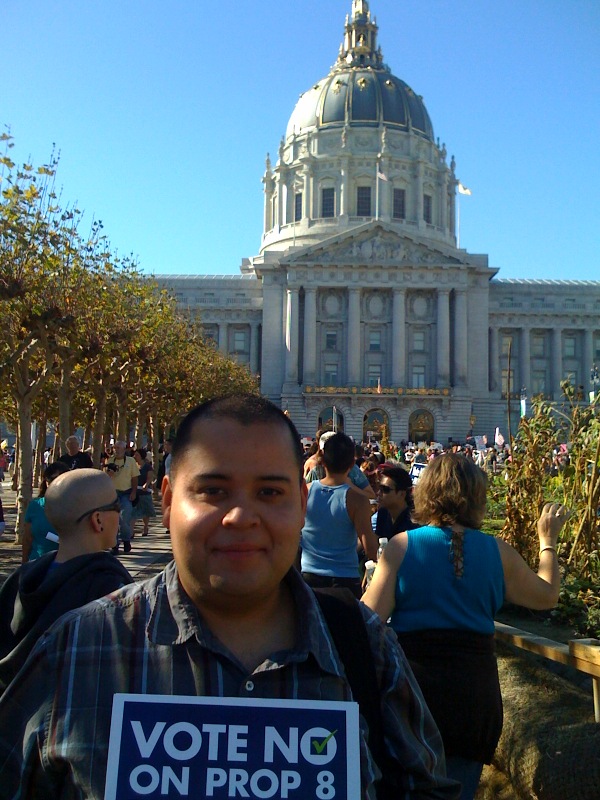
Although the United States made history on Nov. 4 by electing its first African-American president, supporters of California's No on Proposition 8 (a ban on gay marriage) suggest that American prejudice and discrimination still run deep.
After the ban on gay marriage was passed, members of the gay community have come out in cities across the country to protest. (Meanwhile, gay marriages were legally passed in Connecticut last week.) They seek respect, dignity and their civil rights, which to them means the ability to marry who they love regardless of gender. Since the election results on the measure were released, members of the gay community are troubled by the fact that blacks and Latinos voted disproportionately against the measure. And the No on 8 supporters also "estimate that members of the Mormon Church gave more than $20 million to the effort to pass the measure, though that is difficult to confirm because records of campaign donations do not include religious affiliation."
I caught up with No on Proposition 8 supporter Carlos Cabrera, 26, of San Francisco, Calif. Cabrera is a single gay man who is openly concerned about the future of gay marriage in California and across the nation. Although the measure passed on Nov. 4, Cabrera and others have spent their time protesting its passage at rallies, including one this past Saturday at San Francisco's City Hall. He has also talked to numerous family members and friends about the issue.
There are several reasons why proponents of Prop 8 don't want gay marriage or condone homosexuality. For some people, homosexuality goes against God and other religious beliefs. While religious groups continue to question whether homosexuality is genetic or if it is a chosen lifestyle, Cabrera says that he was born this way.
"I knew I was different from the time I was a little boy around five years old. I remember having dreams (non-sexual) about men, and feeling something about them. I couldn't place a label on it until I was a teenager, and even then, only reluctantly. Growing up in a Catholic, Latino household I was very repressed growing up. We never talked about gays. And whenever the topic was mentioned it was either quickly dismissed or my parents would ridicule them. As a result, when I was about 14 and knew for a fact that I was "gay" it was very traumatic for me, internally. I couldn't face this reality, nor could I accept myself as gay until I was nearly 19. That was when I started college, and I met other gay people who showed me that the stereotypes that existed on television (i.e., extremely effeminate gay men who got AIDS and were rejected by their families) weren't reflected in their lives. In fact, they all seemed "normal" to me by most societal standards; they just happened to be gay. Later on, I gained the courage to join my school's LGBT (lesbian, gay, bisexual, and transgender/transsexual people) club, where I later became president and found it much more comfortable identifying openly as gay."
I continued the conversation with Cabrera about his thoughts on Prop. 8.
Why is Prop 8 so important to you?
Well, it's important to me because I believe that everyone should have the right to marry the person that they love. It's an issue of civil equity, not of privilege. And the passage of Proposition 8 saddened me because it's discriminatory against a certain group of people who are doing nothing wrong. Moreover, it troubles me that Prop 8 was such a "wedge" issue for the religious right. Their adamant support for the measure imposes their religious beliefs on others, which I think is just plain wrong and offensive.
What should be the campaign's next steps?
I would say to quit focusing on the past (i.e., lay off the Mormons) and to work toward building bridges with other oppressed community to make it clear that this is an issue of civil rights, NOT *just* queer rights.
What do you say to the people at Yes on Prop 8?
That their stances on 8--whatever their motivation, be it religious or otherwise--has a direct, PERMANENT effect on me and people I know and love. They're robbing me of an opportunity to marry someone in the future. And I think it's a sad statement loaded with intolerance. I would also say that there is no logical reason behind 8. It's just fear of change, of something different.
What could the No on 8 campaign have done differently?
I think that the campaign should have reached out to communities of color and other similarly-oppressed groups. To people who aren't gay and who don't know anyone that is LGBT, I think that it's hard to sell the issue of gay marriage because it might not seem to affect them directly. This is what I mean by making the marriage issue one of civil rights: "injustice anywhere is a threat to justice everywhere," to quote the great Martin Luther King, Jr. It's my understanding that poor communities of color overwhelmingly voted for the measure, which in some senses is completely understandable. Why, after all, should they care about an issue that has been sold as solely one affecting gays and lesbians when there's such a stigma against them to begin with? The campaign should have reached out more to organizations working on other civil rights issues; building stronger coalitions would have definitely been a better approach, in my opinion.
What should No on 8 supporters do now to help?
Re-strategize, re-organize, and reach across the divide to convince the proponents of 8 that the measure is extremely discriminatory.
Are you surprised the ban passed?
Very much so, actually. California is such a liberal bastion in so many other ways. I thought for sure it would be rejected.
What do you think about the fact that 70% of Blacks in LA county voted and the majority of Hispanics in LA county voted against gay marriage?
It doesn't surprise me because of cultural traditions and fear of any upheaval in tradition.
Are the marriages performed before the referendum valid?
I believe so. I think that the Supreme Court added that stipulation in the language for the marriage law in June.
Why is a civil union not enough? Why does it have to be gay marriage?
I understand that although civil unions have the same legal standing as marriages, it is not the same from a societal point of view. It implies a lesser, second-class citizenship I think.
What do you think of Connecticut's ruling in favor of same-sex unions?
I'm thrilled! I hope California's next to overturn 8 and re-institute gay marriage!
What do you say to people who say the protesting is a little bit too late?
I would say that it is a very pessimistic P.O.V. (point-of-view). The result wasn't one that we wanted, obviously, but if we want to change it we need to keep adding pressure to the government in order to get the result that we DO want. Inaction is the last thing, and the worst thing.