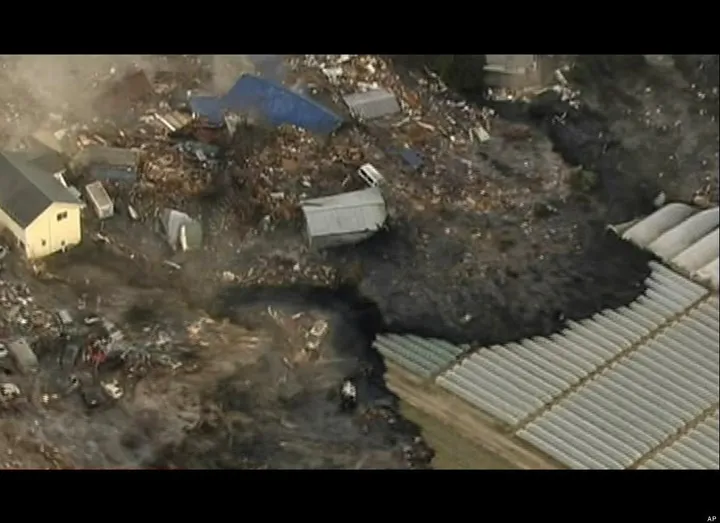
[This question is answered in "The Unpredictable and the Unprepared," a new chapter added to the just-released paperback edition of The Power of the Sea: Tsunamis, Storm Surges, Rogue Waves, and Our Quest to Predict Disasters by Bruce Parker, former chief scientist of the National Ocean Service in NOAA and presently a visiting professor at the Center for Maritime Systems, Steven Institute of Technology. In this post, Dr. Parker provides a short summary of the reasons why so many people died. You'll have to read his chapter for the very compelling personal stories that illustrate what Dr. Parker summarizes below. The rest of the book is also very compelling and the science is fascinating.]
That Japan was not adequately prepared for the tsunami that hit the northeastern Honshu coast on March 11, 2011, first became apparent at the Fukushima Daiichi nuclear power plant. When the earthquake severed the connection between the nuclear power plant and the Japan electrical grid, the diesel backup system turned on as it was supposed to. This was critical, because those generators provided the electrical energy needed to continue the operation of the cooling system, without which there would be a nuclear meltdown. But the seawall in front of the power plant was not high enough to stop the tsunami, and the fuel tanks were washed away. Unbelievably those critical fuel tanks had been situated outside the buildings at ground level. Equally unbelievable, the diesel engines inside the buildings had also been placed at ground level and in the basement below, and the tsunami submerged them. (If the fuel tanks and diesel engines had simply been put on higher floors in the nuclear reactor buildings, which withstood the force of the tsunami, or the sea wall had been higher, there would have been no nuclear accident.)
But the fact that 25,000 Japanese were killed by the tsunami shows that the lack of preparation went well beyond just the nuclear power plants. So one has to ask the question, how could the tsunami have killed so many people in a country that was supposed to be the most tsunami-aware nation on Earth?
Part of the answer is that the Japanese had become complacent about tsunamis and over-confident about the measures supposedly in place to protect them. Although there had been many recent earthquakes, there had not been a deadly large tsunami since 1933. And people forget. In 1960 the tsunami from the Chilean earthquake that had crossed the Pacific and reached Japan killed 142 people. But since then there had only been false alarms, tsunami warnings broadcast but followed by no tsunamis of any significant size. And the fact that the Japanese had made very real progress in reducing deaths due to the frequent earthquakes (better building codes, etc) added further to their false sense of security about tsunamis.
The Japanese thought the sea walls would protect them. About 40 percent of the coast of Japan has sea walls, but unfortunately they had not been built high enough and they failed to protect the people on March 11. How high to build those walls had been a financial decision. It would have been much more expensive to build them high enough to handle a worst-case scenario, which the March 11 tsunami was, produced by a 9.0 earthquake, the fifth largest in modern history. (Of course, if there was one place where the highest and strongest sea wall should have been built, to handle a worse case scenario, no matter what the cost, it was around the nuclear reactors.) There is, however, very little cost associated with designating safe evacuation areas. Surprisingly, many of these supposedly safe evacuation areas were not located high enough and/or far enough inland, and many people who came to these evacuation areas died. Perhaps most important, however, many of the deaths were due to the fact that a large number of Japanese did not know what to do if a tsunami came. They had been trained in earthquake preparedness, but not in tsunami preparedness.
The tsunami struck in the middle of a sunny Friday afternoon at a time when thousands of parents were heading to schools to pick up their children. The stories of what happened at many elementary and junior high schools sadly provide tragic insights into the lack of preparation. However, there was one school district that was prepared, and how those children saved themselves because of their training is a very uplifting story. It is a story that demonstrates the critical importance of disaster preparedness in saving lives, especially for tsunamis, which are unpredictable. In the Kamaishi school district, only five children were lost out thousands (and those five had been at home when the tsunami struck).
In 2005 Professor Toshitaka Katada, a disaster social-engineering expert at Gunma University Graduate School, and his colleagues began giving emergency disaster lessons to students at elementary and junior high schools in the Kamaishi school district. They conducted disaster drills, but they also integrated tsunami awareness into almost all aspects of their school day. The goal of the program was to teach the students to save themselves. The story of how the students from Kamaishi-Higashi Junior High School and Unosumai Elementary School saved themselves during the tsunami provides a heartwarming illustration of the benefit of tsunami preparedness training. The tsunami swept over sea walls and engulfed both schools, yet every one of the 212 junior high students and 350 elementary students who were in the buildings at the time managed to escape.
And what about the tsunami warnings? How quickly were they issued, and how much time did the Japanese have to react? Tsunamis are unpredictable, because the submarine earthquakes that produce them are unpredictable. Also, most submarine earthquakes do not produce tsunamis, so to prevent false alarms an actual tsunami must first be detected (by a DART buoy or a real-time tide gauge) before a warning can be given. This works fine for warning people living along coast far from the epicenter of the submarine earthquake. (Tsunami models did an excellent job of predicting when the tsunami would hit Hawaii or California, hours after the earthquake.) But most deaths occur on the coast closest to the epicenter. On March 11, the very large size of the earthquake was recognized quickly (from the seismic data) and the Japanese Meteorological Agency fortunately took no chances and put out a tsunami warning three minutes later. Even so, it took only 29 minutes for the tsunami to reach the closest point on the Japanese coast.
With so little time to try to escape, tsunami preparedness becomes the most important thing in saving lives. Unfortunately, the response of many Japanese to that warning was inadequate due to their lack of tsunami preparedness training.