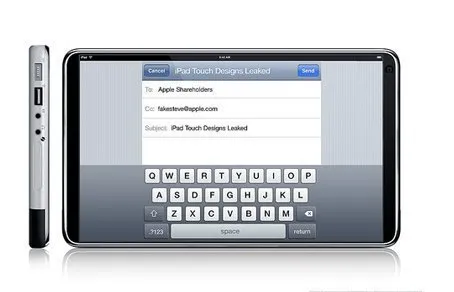
Sixteen years ago, in a small office in Boulder, Colo., Roger Fidler was at the top of the newspaper technology world. Behind him was an original Apple Macintosh Duo laptop fitted neatly into its dock, and a Radius Pivot 15" monitor oriented in its signature vertical position.
And sitting on his desk, next to his cup of coffee and stack of manila folders, was a prototype of a thin - about an inch thick - electronic tablet that was poised to revolutionize the print media.
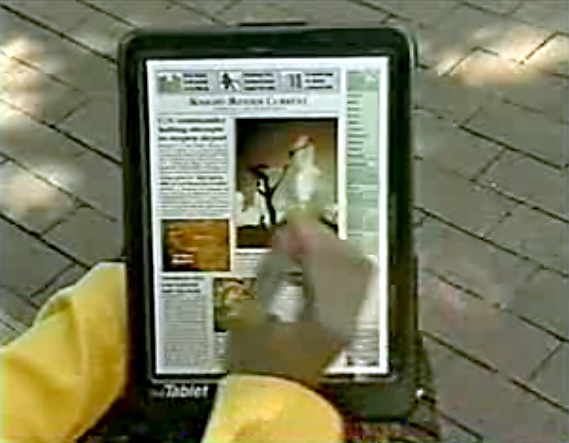
(Knight Ridder's tablet prototype, circa 1994)
The device, slightly larger than an inter-office envelope, would show text, graphics, sound and video - in color - would fit in your purse or under your arm, would be powered by a rechargeable battery and magically connect to other information sources. Sound familiar?
That was 1994. Long before Amazon's Kindle or HP's Slate or Sony's Digital Reader or Hearst's Skiff. Long before Apple's rumored tablet device likely to be unveiled this month at an invitation-only event in San Francisco.
Fidler was in charge of The Information Design Lab, tasked to create innovative solutions for a now-defunct media company called Knight Ridder. At the time they owned more than 30 newspapers around the country - including the Miami Herald, Philadelphia Inquirer and San Jose Mercury News - and used to run a handful of TV stations and cable outlets. (Full disclosure: In a previous life, I was a top editor in San Jose and assistant VP/News at Knight Ridder before it was sold in 2006.)
This was in the heyday of the newspaper business. Big metro papers were throwing off profit margins of 20 and 30 percent. Bureaus in London, Tokyo and Johannesburg were commonplace. Few expected those good times would end anytime soon, although a handful of us knew that technology around the corner could change our lives forever.
Fidler, who also was part of an early videotext experiment in the '80s called Viewtron, said that the newspaper business was on the verge of a major revolution, what he called a "Media-morphosis."
"All forms of media that we know today will be transformed over the next 10-15 years," he said in a promotional video for the device back then, as models wearing shoulder pads under their mustard-colored outfits and news stories about Bosnia were the reference points of the day.
"An important part of this revolution is the emergence of the electronic tablet....Tablets will be a whole new class of computer. They'll weigh under two pounds. They'll be totally portable and have a clarity of screen display comparable to ink on paper. They'll be able to blend text, video, audio and graphics together. And they'll be part of our daily lives around the turn of the century," the narrator said during the video. "We may still use computers to create information, but we'll use the tablet to interact with the information."
Ultimately, Fidler's tablet idea was never made into a real product, and faded away. Later, in an interview, he said screen technology was not yet ready to make the idea a reality (screens at the time just sucked too much power). So funding for the project was pulled, the Boulder lab was closed and the industry moved on to the next big thing -quarterly earnings, acquisitions, younger readers, and a weird invention called The World Wide Web.
Fidler now runs Digital Publishing Initiatives at the University of Missouri's Donald W. Reynolds Journalism Institute and is helping to set standards for e-readers and tablets across the industry.
But, of course, we all know now that Roger was right. He and his team were just a few years too early.
This week, Fidler told me that, between the single-function e-readers like the Kindle and the multi-use tablets like Apple's, the opportunity to realize his dream may still be right in front of us. "We are living in some exciting times," he told me from his home in Missouri. "There is so much happening, so much going on."
Hopefully, Apple and its new tablet will prove that as well, but it may be too late for many in the newspaper and magazine business. Nevertheless, several publishers - Sports Illustrated, Conde' Nast, Popular Science (this one is the coolest) - are showing off their own prototypes for tablet-based publications.
But what if, back then, the industry had the will and the technology was a bit more advanced? Would we still be witnessing the fundamental meltdown newspapers and magazines are experiencing today, or on the verge of that "mediamorphosis" Fidler dreamed about? Or, more likely, would we be still be facing print's end-of-life, just on a shiny flat screen with stories of balloon boy, Octomom and Tiger Woods streaming to our devices every second of every day?
We may really be witnessing the creation of a new mobile media model - much like how the iPhone invented a new cell phone metaphor - one where news, sports and entertainment information are truly portable, readable and in real-time. But it is less likely to save most of the old publishers as to give rise to a new breed of media entrepreneurs who won't have to support those printing presses and those legacy costs. Although, with video and social media and gossip and gaming taking center stage, journalism may play a cameo role, at best.
And, for readers, you won't have to get ink on your hands any more. You can partially thank Roger Fidler for that.
Bryan Monroe is a visiting professor at Northwestern University's Medill School of Journalism. He was the former president of The National Association of Black Journalists (NABJ), editorial director of Ebony and Jet magazines and assistant vice president/news at Knight Ridder. He has also been a regular contributor to CNN and helped lead the team in Biloxi, Miss., that won the 2006 Pulitzer Prize for coverage of Hurricane Katrina. He can be reached at www.bryanmonroe.com.
Follow Bryan Monroe on Twitter: www.twitter.com/bkmonroe
Just because we know it can be spectacularly useless with a bad interface doesn't mean it HAS to be. I think this will be one of those colossal and embarrassing pronouncements when this becomes he NEW platform for entertainment, newspapers and medical workers.
Roger's group's idea was a good one, but most people both inside and outside the company did not understand the Internet much less the possibility that newsprint would be out of date...
The question now, though, is not whether Apple is better than Kindle, etc. etc. but whether more can be done to create or bolster solid journalism so that the e-readers, whichever ones win out, can, in fact, serve to strengthen the journalism community and investment in authentic journalism. How will e-readers help HuffingtonPost or the L.A. Times, CNN & AP or daily newspapers or various non-profits being developed for investigative projects and as daily newspaper alternatives?
How will e-readers strengthen the dissemination and digestion of accurate, engaging news? Will real live human readers use e-readers to read news?
I do thank you for this post. Roger's work 14 years ago needs to be acknowledged.
My take on that in my Spanish blog:
http://blogs.lainformacion.com/tablet-apple/2010/01/10/roger-fidler-y-el-diario-hule-que-todavia-esta-por-llegar/
Your article illustrates the old saying, "timing is everything".
Your guy Roger was a visionary, but unless you're in the right place at the right time (working with the right company and people) all your far-seeing vision will give you is a headache.
And then there's Steve Jobs. His ability to combine his incredible vision with the right business model in the right place at the right time has been the closest thing to creative corporate genius I've ever seen.
So, fasten your seat belt, I think he and Apple are about to (once again) take us "boldly" into the future Roger saw 15 years ago.
http://buythecover.com
BTW: Check out my blog. People tell me I'm sort of a low-tech visionary myself.
Steve Jobs counts on people who like to buy his overpriced toys. Touch screen phone? My husband had one 7 years ago made by Palm. MP3 player? Invented by SIS, not Apple.
I could go on...safe to say, when I get a Kindle, I'll rest assured I'll have a higher quality player for 1/3 the price
Please don't be "playa hatin'" on Steve. :)
He's helped change our world (whether for better or worse is a judgment call).
Somehow, I think you must be a "PC" person. It's like Dems and Repubs, totally different basic software and operating systems. Not that that's a bad thing. It takes at least two to tango.
http://buythecover.com
Mini notebooks and tablet PCs have existed for over 10 years. Even Apple had the "Newton" if anyone remembers that. All of these products were colossal failures because they were too expensive for something nobody really needed. Netbooks are popular now because they're really cheap.
So why would people suddenly want to pay so much more? For multitouch? Why? There's no purpose for multitouch on a device that size. Multitouch is brilliant on a handheld. That is why the iPhone was so revolutionary. But for a device where you're stationary and using both hands, it's nothing more than a stupid gimmick.
The reason for the expectation is Apple's undeniably good quality and great user interface.
You mean like my MacBook Pro with the motherboard that croaked after three months? I've owned cheapo Taiwan PCs that cost half as much and worked for years without that kind of failure.
How - exactly - is a single-use newspaper reader like a fully functional computer?
Be sure to get back tp us on that one.......
In the late 70s's we set up pilot projects/company to deliver the newspapers via interactive TV sets, Way ahead of the internet. Pioneers do get the arrows.
There was always a battle between those that knew what was coming and those that lived in the present (short future, how much will be my bonus at the end of the year) and past (like repug economic ideas, that the entire world has walked away from in many ways, leaving us non competitive in many areas).
Google should have been spawned by a newspaper chain in the same way passenger Trains should have spawned passeger air flight instead of seeing airplanes as competition and not as a transportation nusiness they should be in. Newspapers saw their business as Print first and information/advertizing as second. The wrong order. The placed delivery method above the service/value they provided.
Regards
Regards
Ummm, no--not exactly. Being there and doing it means actually having a device that not only works, but sells!!!
My dad had the idea for inline skates in the 60's. Did drawings, prototypes, the whole nine yards. Except he never bothered to patent or produce them. Ah.....
See the difference?
Apple has done their homework--done it well, and made a superlative product with a market ready to buy it. Anything short of that is just wishful thinking.
Give Apple credit where it it due.
Having a device that not only works, but sells, is one thing, but cold evildoing by means of offpissing concerned world citizens, overhaving other firms whose patents Apple may've ripped, and making damn sure that THEIR SH*T is, and forever will be, THE ONLY SH*T on the market, and also LAUGHING AT OUR ASSES, is cold more than quite another.
THANK YOU, BM, FOR THE TRUTH.
WE ALL NEED IT.
And THAT'S the point--not how good or bad you think their stuff is.
However, for push media, a tablet probably is a good idea.
A GateWay tablet computer is to an Apple Tablet computer what any Gateway product is to any Apple product. We're not talking about toothpaste. This is one business category where the brand does make a difference. Especially the Apple brand.
Steve Jobs and Apple have proved that over, and over, and over again.
You sound like a tekkie and an early adapter. I think you'll be the first in line for the rumored iTab.
http://buythecover.com