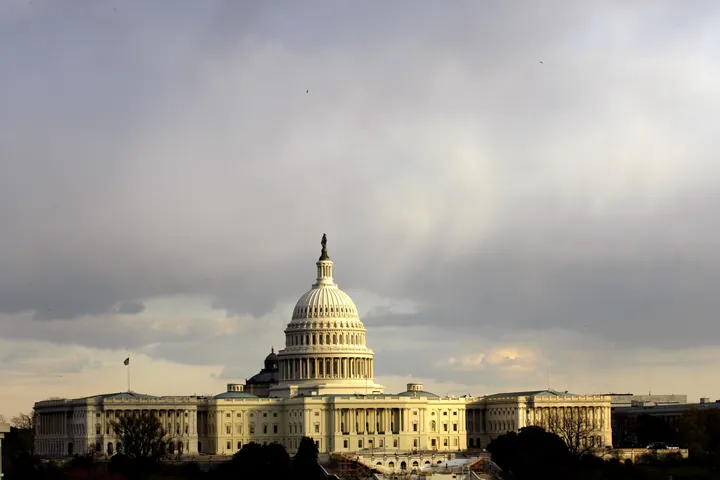
Here's a question: How can you tell which political party is out of power?
Answer: It is the party that cares most about the federal deficit.
Strong concern for the deficit usually equates to a party in the political wilderness searching for its moral voice. The budget deficit, simply stated, occurs when government spends more money than it takes in, and it has become the red herring du jour.
The deficit is real and should not be taken lightly. But with the exception of organizations such as the Concord Coalition, it is the minority party that tends to be more concerned with how the federal government spends its resources.
The chorus of Republican deficit hawks sang several octaves lower when it was their party borrowing money to finance two wars and passing excessive tax cuts.
It was Democrats, leading the deficit charge, accusing President George W. Bush and the Republican-led Congress of squandering the surplus achieved in the Bill Clinton years, and forcing future generations to pay for their lack of fiscal responsibility.
According to former Treasury Secretary Paul O'Neill, late in 2002, he pleaded with the Bush administration, already running a deficit of approximately $158 billion, that it was risking a financial crisis.
Vice President Dick Cheney allegedly responded to O'Neill by saying: "Reagan proved deficits don't matter."
Deficits do matter. Deficits should matter regardless of which party is in power. But in the public conversation, deficits are merely a rhetorical tool to prove politically that the party in power is irresponsible with taxpayer dollars.
We've changed presidential administrations and control of Congress, and the Republicans have magically rediscovered their concern for fiscal discipline that lay dormant when they were the party that controlled the White House and Capitol Hill for six of the past eight years.
This comes from the same party that was blatantly silent during the tax cuts by the Bush administration that failed the make the corresponding spending reductions. That came in addition to borrowing money to pay for two wars that did not have a line item in the federal budget. Now this party is suddenly outraged by the potential cost of health care legislation and the impact it could have on the federal deficit.
The deficit was not an issue for congressional Republicans as they signed off on a misguided war in Iraq, which claimed the lives of more than 4,300 American soldiers and many Iraqis. Now when the issue becomes health care for 47 million of their neighbors, there's a problem.
Republicans are justified to raise concerns about the deficit, which currently as a percentage of the gross domestic product, is at its highest point since World War II. The Congressional Budget Office recently stated this year's budget deficit is nearly $1.7 trillion, more than $400 billion larger than forecast two months ago. Moreover, the deficit by the end of 2010 is projected to be nearly $430 billion more than its prior forecast.
According to the CBO, the increases are largely due to the sharp rise in spending largely due to the fiscal stimulus required for saving the financial system.
Large deficits devalue currency, which leads to inflation. At what point would the U.S. inflation discourage China from lending money so that we can sustain our ravenous consumer appetite?
Moreover, if the impending health care legislation becomes an entitlement, can it be sustained given the trajectory of the deficit?
It is hard to take GOP deficit criticisms seriously given the previous eight years of fiscal mismanagement. Listening to the Republicans' present concerns, one would think these problems began on Obama's inauguration day.
The legitimacy of Republican deficit concerns is undercut by the hypocrisy of the party's recent actions. Democrats and Republicans share the mantle of being historically disingenuous in the deficit debate. Recent history would also suggest that deficits are seldom addressed when one party controls Capitol Hill and the White House.
But the deficit, as a serious issue, has been diminished by the screech of political partnership. Shouldn't this be an ongoing concern that transcends political ideology instead of the hypocritical rejoinder of a party down to its last legitimate dissenting argument?
Byron Williams is an Oakland pastor and syndicated columnist and blog-talk radio host. He is the author of Strip Mall Patriotism: Moral Reflections of the Iraq War. E-mail him at byron@byronspeaks.com or visit his Web site: byronspeaks.com
Follow Byron Williams on Twitter: www.twitter.com/byronspeaks
Want to reply to a comment? Hint: Click "Reply" at the bottom of the comment; after being approved your comment will appear directly underneath the comment you replied to
Is't it interesting that the same people who say protecting Americans with health would cost too much, are the same people who think nothing of spending $12 billion a month on the wars in Iraq and Afganistan, so that Americans are "protected"
Republicans are only principled when they are out of power, and the same holds true of Democrats. Once either party is in power, they throw ideology to the dogs.
I like Christopher Hayes' of The Nation magazine comment on Keith Obermann's show tonight concerning Republicans concern for the deficit. He said that the Republicans are like vegetarians only between meals.
It is much easier to spend other people's money.
Once people get in Congress they think of all sorts of "good things" to spend money on. The definition of "good things" may vary but the spending doesn't.
My grandfather once told me that "philanthropy with other people's money is fun, but it isn't really philanthropy." I am sure he borrowed the phrase.
4. The government would have to take over the Fed, since it could no longer issue debt to print money, it would have to print money to print money.
5. We would no longer be able to borrow money to start wars or cut taxes for the rich. A lot of rich people would lose billions of dollars, China would be very vexed with us, etc.
Simple solution, repudiate the debt!
Seriously, here is what would happen:
1. US dollar would tank in value compared to other currencies, which would help our balance of trade but make Walmart goods (made in china) much more expensive. Net gain for the US, since we would just make more stuff here (but there would be a short term painful time as we adjust to paying more for goods).
2. US would pretty much lose the ability to borrow money, which means the deficit would end (if you can't borrow, you can't spend more than you make). The normal deficit is about 1/2 a trillion a year, of this about 200 billion is interest on the debt. The easiest place to get the other 300 billion is the military, which would be devistated but not destroyed by that cut (we would have to end military R&D, purchasing of weapons, and recruiting, but we could keep the existing ships and tanks running and keep our soldiers and sailers paychecks coming).
3. Social security and medicare would lose their trust funds, so medicare would have to index the tax rate to the payments (and SS would have to do the same in 2017 or so). Payroll taxes could go from 7.65% to 10% or so over the course of 10 years.
Con't
According to former Treasury Secretary Paul O'Neill, late in 2002, he pleaded with the Bush administration, already running a deficit of approximately $158 billion, that it was risking a financial crisis.
Vice President Dick Cheney allegedly responded to O'Neill by saying: "Reagan proved deficits don't matter."
I think that says it all
Conservatism only exists in speeches. It is a code word for the ignorant.
Democrats are more conservative than republicans but have never been given credit except by people who value facts, which automatically leaves out all republicans or they wouldn't be republican.
As a percentage of Gross Domestic Product:
Since WWII the Republicans have ballooned the deficit 20% during their tenure. (were it not for Ike, it would have been 35%).
Since WWII the Democratic administrations have reduced the deficit 48%.
That is a difference of 68%!!!
Conclusion: Republicans are 68% more fiscally irresponsible than Democrats and the numbers back it up.
Or you could say 68% less fiscally responsible.
The Democrats major weakness is dino's, blue dogs etc. If we don't start bringing them into line the Democratic Party will be Democratic in name only, just like the blue dogs.
To be conservative—we need single payer
http://www.rollingstone.com/politics/story/29988909/sick_and_wrong/3
$350 billion a year could be saved on paperwork alone if the U.S. went to a single-payer system — more than enough to pay for the whole thing.
The public option does nothing to reduce the $350 billion a year in unnecessary paperwork and administrative overhead that makes the current system so expensive.
The government plan would be cheaper than private insurance.
And who’s keeping us from a majority vote for single payer—not the repubs –
dino’s, and blue dogs.
It's the dinos, blue dogs AND repubs.
By the way, it would cost $350 billion to buy every share of every health care insurance company...
So for one year of savings you could buy out the complainers...
Just sayin...
Americans' lack of knowledge both about history and about the economy is playing right into the Republicans hands. I bet that if you asked most people they would say that Obama is responsible for the current fiscal year deficit, when we are actually in the final Cheney-Bush fiscal year (which ends September 30). The most the Obama administration could have added to this year's deficit, even if you assume that Bush would not have instituted a stimulus plan, is less than $200 billion - the amount of stimulus money spent so far.
The Republican plan is to force the Democrats to prematurely switch from fighting the depression to cutting the deficit. Then they will be able to blame the Democrats for the economic collapse that will follow.
So Obama is raising the deficit to increase govt spending in a time of severe ecconomic recession ( started under GOP watch)
Bush raised the deficit to start an unneeded war and give rich people more money
tell me how these are the same thing, gopers
Actually Bush tanked our economy with the first tax cut to all his rich 2%ers. Bush only looked after the rich and corporations, 98% of America's citizens are/were just inconvenient flotsam to be used and abused. This might as well be called corporate sponsored slavery.
The Rupublicans may have been guilty of running up deficits but where were the Dems calling for fiscal responsability?
A. It is Republicans
B. http://www.nytimes.com/2001/07/11/us/democrats-say-bush-s-tax-cuts-jeopardize-military-spending.html
C. http://www.sfgate.com/cgi-bin/article.cgi?f=/c/a/2004/09/23/MNGN78TF8B1.DTL
D. http://www.usatoday.com/news/washington/2008-02-03-bush-budget_N.htm
The point is, why weren't Republicans holding tea partie protestes and marching on Washington when bush was running up the deficit? Can't answer this question, can you?
It all boils down to what will affect someone personally. If a person opposes the principle of government deficits but sees no immediate consequences to himself caused by deficits, he is not as motivated to protest. Perhaps he'll email his congressman, but taking time off work and travelling to a protest are just not worth the time as he perceives.
I don't believe that the tea parties were motivated by a concern over the deficit. They were mostly motivated by opposition to the government messing with health care. While we all have complaints about the current system, polls consistently show that the majority is happy with the status quo. This is what Jefferson referred to in the Declaration of Independence: "...all experience hath shown that mankind are more disposed to suffer, while evils are sufferable, than to right themselves by abolishing the forms to which they are accustomed." In other words, we may not like the current system, but at least we know it, and it's not completely intolerable. The message is: The problems that may be solved by reform do not, in most people's minds, justify the risk of an untested system.
I believe that when Bush ran up the deficit, most Americans did not perceive a direct connection between the measures Bush was taking and their own immediate, personal well-being. It was obvious that many people (conservatives included) disagreed with him, but the personal motivating factor was not there.
Anyway, those are my thoughts.
Isn't that the neocon plan?
when in power run up the deficit so when the dems are in control- you can curb spending on social programs by crying about the big deficit (that you created)
Why stop at the deficit?
The entire GOP playbook seems to be to criticize Obama for problems Bush and the GOP created
Rush declares a recession that started 2 years before Obama was sworn in "obamanomics"
T-baggers complain about Govt making healthcare decisions after their representatives intervened in Terry Shaivo's healthcare decision
Beck rails agains obama's Czars- even though they were started under Nixon and Bush had more of them
Next the gopers will blame Obama for his failure to respond to hurricane katrina
It all makes me want to scream but if I did people would think I was a republican.
Great article but the republcans are off in a fantasy land and the truth does not fix into thier world view.
You must be logged in to comment. Log in or connect with