
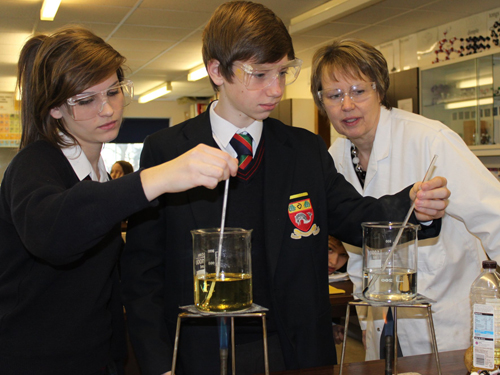
"Children do not always learn what we teach. That is why the most important assessment does not happen at the end of the learning, it happens during the learning." -- Dylan Wiliam
"It is right that teachers and schools are accountable to those with a stake in public education, and this requires assessments that are free from subjectivity. So we do need some form of standardized assessment. However, the United States pays a very high price for its insistence --unique among rich countries -- of doing this almost entirely with multiple choice tests. Even with multiple choice tests, the best way to raise students' test scores is to teach for deep understanding." -- Dylan Wiliam.
Education policy reformers have focused on raising student achievement via a variety of strategies, including curriculum changes, increased use of information technology, changes in the way schools are governed or organized, and even getting rid of incompetent teachers. Leading British educationalist Dylan Wiliam believes the latter will not be effective since it will take too long to implement. His focus instead is on improving classroom practice now. He and his colleagues have developed a classroom program called Embedded Formative Assessment. Over the last four years, this program has been established in over 1000 teacher learning communities in the UK, Australia, New Zealand, Sweden and the U.S., with many claiming it is one of the most effective forms of professional development they have ever participated in.
Dylan Wiliam is Emeritus Professor of Educational Assessment at the Institute of Education, University of London. In a varied career, he has taught in urban schools, trained teachers, directed a large-scale testing program, and served in a number of roles in university administration. Last year, he was a featured guest on BBC 2's The Classroom Experiment.
Professor Wiliam, can you give me the background to the development of your teacher/classroom practice project, Embedded Formative Assessment?
In 2004, we published the main findings from a project with secondary school teachers in Oxfordshire and Kent, England in which we worked with them to help them develop their classroom assessment skills. When teachers prioritized regular assessment as part of daily classroom practice, their students learned 75% more than those taught by other teachers in the same schools. We concluded that working face to face with teachers, we could help them become better teachers.
When a teacher teaches, no matter how well he or she might design a lesson, what a child learns is unpredictable. Children do not always learn what we teach. That is why the most important assessment does not happen at the end of the learning -- it happens during the learning, when there is still time to do something with the information. Our goal was to get teachers to pay more attention to what was being learned while the actual learning was taking place.
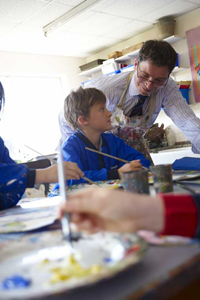
"Every teacher needs to be getting better--not because they're not good enough,
but because they can be even better." -- Dylan Wiliam
Why do you think your program would lead to significant improvement in the quality of teaching on a larger scale?
In America, the focus seems to be on getting rid of incompetent teachers. I don't believe that will be effective, and I also think it will take too long to implement. We have to find ways to improve classroom practice now.
There is no jurisdiction in the world that I know of that requires that teachers increase their competence every year. Instead, teachers are required to show that they have endured a certain amount of professional development (and this is usually specified in numbers of hours) to continue to be employed, or acquired new qualifications, but they don't need to get better at teaching.
Every teacher needs to be getting better -- not because they're not good enough, but because they can be even better. But every teacher needs to be getting better at something that will make a difference to their students, such as classroom assessment. How this is done cannot be scripted -- each teacher will need to work out how to integrate assessment into their classroom routine. The "top down" bit is that every teacher needs to be getting better at something that will improve learning for their students, because schooling is a one shot deal for kids. What each teacher works on, however, is up to them -- that's the "bottom up" bit.
Once each teacher has committed to a particular improvement in their practice, they share their promise with a group of peers, typically between 10 and 12 teachers. A month later they meet again and report back results. It's a bit like the idea of Weight Watchers. Teachers tell us that having to report back to their peers on their promises keeps them focused on bringing about the change.
What are the main elements of the assessment process that teachers are taught?
The main elements of the program are an initial workshop, and then monthly meetings of groups of teachers, where they support each other in keeping to the promises they made. The five key strategies of classroom assessment are sharing learning intentions with students, eliciting evidence of achievement, providing feedback that moves learning forward, activating students as learning resources for one another, and activating students as owners of their own learning. The "Keeping Learning on Track" pack provides teachers with over 20 practical, ready to implement classroom techniques for each of the five strategies.
Where can schools find this product?
In the U.S., materials to support these teacher learning communities are available from Northwest Evaluation Association in Portland, OR. The product, called "Keeping Learning on Track," involves all the materials needed for schools to deliver an initial workshop and to run the 16 monthly follow-up meetings over the following two years.
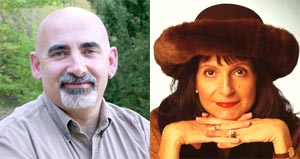
Professor Dylan Wiliam and C. M. Rubin
Photos courtesy of Beechwood Sacred Heart School UK and Dylan Wiliam
In The Global Search for Education, join C. M. Rubin and globally renowned thought leaders including Sir Michael Barber (UK), Dr. Leon Botstein (US), Dr. Linda Darling-Hammond (US), Dr. Madhav Chavan (India), Professor Michael Fullan (Canada), Professor Howard Gardner (US), Professor Yvonne Hellman (The Netherlands), Professor Kristin Helstad (Norway), Professor Rose Hipkins (New Zealand), Professor Cornelia Hoogland (Canada), Mme. Chantal Kaufmann (Belgium), Professor Dominique Lafontaine (Belgium), Professor Hugh Lauder (UK), Professor Ben Levin (Canada), Professor Barry McGaw (Australia), Professor R. Natarajan (India), Sridhar Rajagopalan (India), Sir Ken Robinson (UK), Professor Pasi Sahlberg (Finland), Andreas Schleicher (PISA, OECD), Dr. David Shaffer (US), Dr. Kirsten Sivesind (Norway), Chancellor Stephen Spahn (US), Yves Theze (Lycee Francais US), Professor Charles Ungerleider (Canada), Professor Tony Wagner (US), Professor Dylan Wiliam (UK), Professor Theo Wubbels (The Netherlands), Professor Michael Young (UK), and Professor Minxuan Zhang (China) as they explore the big picture education questions that all nations face today.
The Global Search for Education Community Page