
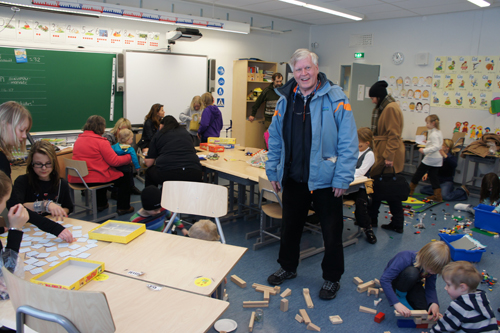
Aurora School Principal Martti Hellström in the classroom with his pupils
If you thought you knew everything about the remarkable transformation of Finland's schools from mediocre to one of the top performing school systems in the world, think again. Native Finn Pasi Sahlberg (educator, researcher, advisor on global education reform, and Director General of CIMO in Helsinki, Finland), who has lived and closely studied this remarkable reformation, tells the full story in his newly released book, Finnish Lessons -- What can the World Learn from Educational Change in Finland? Sahlberg shows how the Finnish ways of improving schools differ from the global educational reform movement and from the North American educational policies and reform strategies. It's a wake-up call for all countries around the world who aspire to achieve excellence.
This week in The Global Search for Education, Pasi Sahlberg, Finnish school Principal Martti Hellström, the enchanting students of the Aurora School in the city of Espoo and I share some Finnish lessons with a unique look inside the 5th grade classroom of a typical Finnish primary school.
"The Aurora School," Pasi explains to me, "serves its community by integrating all pupils in normal classes without segregation or selection of pupils based on their characteristics. The school emphasizes leadership and shared responsibility of teaching all children so that their different talents and abilities are respected. This school is noteworthy in that it utilizes in a representative way the local autonomy that the current legislation offers to schools." The answers to my questions below are based on Pasi's conversation with Aurora School Principal Martti Hellstrom:
What are the backgrounds of these pupils? What is the diversity (racial and socio-economic) within the class?
Pupils come from the Lippajarvi neighborhood of the city of Espoo. It is a typical suburban district of the city. Some parents have a relatively high level of wealth. However, most children live in an average middle class family. Some live in lower income homes. In this school, about one tenth of the pupils have an immigrant background family. That is less than many other schools in Espoo. Some schools have over a quarter of the children coming from an immigrant background.
How long is the school day?
The school day starts between 8 and 9am in the morning and finishes between 1 and 2pm in the afternoon. The class has 25 lessons a week. Each lesson is 45 minutes long. There are 3 hours and 45 minutes of instruction each day on average. In the Aurora school this class (5th grade) has one four-lesson day, one six-lesson day and the other days are five lessons long.
Does the school provide a meal service and is it free for any of the students?
The school serves a healthy, tasty, warm lunch each day for all pupils. The school meal has been free of charge for all children in Finland since 1943.
What percentage of the children read at their grade level or higher?
In Finland, we don't categorize children according to their reading skills. In each class we have children with varying abilities and talents. So does this class in the Aurora School. Teaching is adjusted to serve the different abilities in the classroom.

Children with development disorders or other disabilities are placed in the same class with all other pupils.
What percentage of the children can do math at their grade level or higher?
In Finland, we monitor pupils' learning achievement at the national level only using sample-based tests. We don't have data available that would allow us to answer that question. In our city, we know that our pupils, on average, are a little bit above the national average based on these sample-based tests. The Aurora School has been in the sample and the school has performed at a good level in the city of Espoo.
How much homework do the children get each night?
The role of homework in Finnish schools has continuously become less important. Pupils do their learning assignments mostly during the school day so that they can spend time with their own activities at home. According to our surveys, Finnish pupils in basic education spend less than one hour per day doing homework.
Do these children take a standardized test during the school year?
Standardized tests are not used in Finland like they are used, say, in the United States. Instead, we follow pupils' progress with school-made summative and diagnostic assessments in order to find out which children need more help than others to be successful.
How does the teacher assess the student's work each term?
Pupils are given two report cards each school year. In grades 1 through 4, the reporting is based on a description of the pupil's strengths and all the areas which need more development. In Grades 5 and 6, progress is assessed using grades of 4 to 10. Assessment is based on teacher-made tests or tasks, and so-called continuous performance of pupils.
Is the curriculum centralized or teacher driven?
Finland has a three-tier curriculum system. The framework and broad principles are defined at the central government level. Based on this national framework curriculum, municipalities then design their local policies for curricula. Normally, the concrete curriculum work takes place at the level of schools according to the municipal guidelines. Today, the flexibility at the level of schools is a little less than it used to be in the 1990's.
How much music and art (all the art forms) are there in the curriculum?
Fifth grade pupils have 25 lessons a week. Nine lessons of the 25 weekly lessons are arts, music, craft work and sports.
Are the teachers happy with the quality of the school's facilities?
At the moment, the Aurora School facilities are good based on the average national level. However, Aurora was built in 1957 and its annex in 1982. The school awaits a long-promised renovation. It should begin in 2014.
What is the starting salary of a teacher? What is the upper end of the range?
A newly appointed teacher receives about 2300 euro a month (or about $40,000 per year before taxes). The tax rate in that salary category is about 25-30%. At the upper end of the range, the salary is 3400 euro a month (or about $59,000). This is their basic salary. They can actually earn more than this depending on their additional duties within the school.
What qualifications do the teachers have?
All teachers have a master's degree from a Finnish University. (Note: Only Finland's best and most committed teachers make it into the profession due to its popularity and the intense competition to become a teacher. Each year, many of the most talented and motivated students submit applications but only about 1 out of every 10 will be accepted into primary schools. The total annual Finnish applicants, in all the five categories of teacher education programs, number about 20,000.)
What parental involvement is there in the school?
Parents participate in many different ways. Each class has its own PTA. The basis of these PTA's in the Aurora School is the Home and School Association (Koti ja Koulu Yhdistys). The school board of the Aurora School decides on the most important things. Most of the board members are parents of the pupils in Aurora. Some of these parents also voluntarily assist teachers during the school day.
This video was made by the pupils of the Aurora School. It's about "Siesta" i.e. the 75 minute recess each day of the week when students can do whatever they want to. Many do music or sports or go to rehearse theater or simply do their "homework."
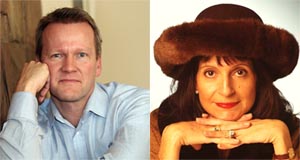
Pasi Sahlberg and C. M. Rubin
In The Global Search for Education, join me and globally renowned thought leaders including Sir Michael Barber (UK), Dr. Leon Botstein (US), Dr. Linda Darling-Hammond (US), Dr. Madhav Chavan (India), Professor Michael Fullan (Canada), Professor Howard Gardner (US), Professor Yvonne Hellman (The Netherlands), Professor Kristin Helstad (Norway), Professor Rose Hipkins (New Zealand), Professor Cornelia Hoogland (Canada), Mme. Chantal Kaufmann (Belgium), Professor Dominique Lafontaine (Belgium), Professor Hugh Lauder (UK), Professor Ben Levin (Canada), Professor Barry McGaw (Australia), Professor R. Natarajan (India), Sridhar Rajagopalan (India), Sir Ken Robinson (UK), Professor Pasi Sahlberg (Finland), Andreas Schleicher (PISA, OECD), Dr. Anthony Seldon, Dr. David Shaffer (US), Dr. Kirsten Sivesind (Norway), Chancellor Stephen Spahn (US), Yves Theze (Lycee Francais US), Professor Charles Ungerleider (Canada), Professor Tony Wagner (US), Professor Dylan Wiliam (UK), Professor Theo Wubbels (The Netherlands), Professor Michael Young (UK), and Professor Minxuan Zhang (China) as they explore the big picture education questions that all nations face today.
The Global Search for Education Community Page.
Images courtesy of Pasi Sahlberg and the Aurora School.