As I contemplated what to write about in my post for National Work and Family Month, an interesting piece of research crossed my desk entitled, "Are Family-Friendly Workplace Practices a Valuable Firm Resource?"
What caught my attention was the ironic disconnect between what the study intended to conclude and what the findings actually proved (and the authors missed):
- Intended Conclusion: "Family-Friendly" work practices (FFWPs) are not valuable to organizations;
- Actual Unintended Conclusion: "Family-Friendly" workplace practices are very valuable to businesses and people...as long as they're implemented well and you know what you are talking about. Unfortunately, too often that's not the case.
How does a gap like this happen? The researchers made the same mistakes that many stumble over, and these common oversights are what suck the value out of "Family Friendly" work practices.
The authors didn't consider the importance of effective implementation and what that looks like in action. And they didn't position and talk about the practices in a broad, strategic, business-oriented way. When FFWPs are effectively implemented and strategically positioned, the value that they provide to the business in terms of financial performance is proven and measureable.
So, how do you reconcile these two radically different conclusions?
Let's start with a real-world example of how strategic flexibility helps a business run better, smarter and save money
We've been working with a multi-national company that wants flexibility in the way work is done to become a more visible and consistent part of their day-to-day business (the authors of the study consider all forms of flexibility "Family-Friendly" work practices).
As we interviewed leaders and employees, they shared numerous examples of how flexibility in the way work is done has allowed the business to run smarter and better:
- Because people were able to work from home, the company was able to stay open and operational on a number of days when snowstorms would have, otherwise, halted business.
- By shifting and staggering the times people on the team started and stopped working, the business was able to expand customer service hours without paying overtime to the non-exempt staff.
- Because their job requires absorbing and analyzing large amounts of complex information, people will often work remotely either from home or another quiet location to get more done efficiently and productively.
- As the company has grown, office space is a premium. By coordinating days worked at home, and in the office, it limited the need for additional office space.
- Because many of the employees at the company have long commutes through heavy traffic, by shifting hours to avoid the worst traffic or working from home periodically the level of employee stress has been reduced.
And when asked, "What do you think the role of flexibility will be in the organization five years from now?" Every person, no matter what level, said, "There will only be more of it" for all of the reasons listed above and more, because they know that flexibility, informal and formal, helps the business run more productively and saves money.
"Family-Friendly Work Practices...do not affect firm performance directly or indirectly" What?!
This client came to mind as I read the "Are Family-Friendly Workplace Practices a Valuable Firm Resource?" study by Nick Bloom from Stanford University, Tobias Kretschmer from University of Munich and John Van Reenen published in the Strategic Management Journal (June, 2010).
Normally, I give research a quick review and move on. But, in this case, Ifelt compelled to respond to the study's conclusions for two reasons.
First, Freek Vermeulen, an Associate Professor at the London School of Business, wrote about the results in an article on Forbes.com entitled, "Are Family-Friendly Workplace Practices Worth Their Money? New Evidence." This means that the results have entered the mainstream press, and are potentially influencing the decisions of business leaders who may be considering whether or not to support a work+life initiative.
Second, the study's rather emphatic conclusion that Family-Friendly workplace practices don't positively affect the financial performance of a business is, in fact, wrong.
Here are the study's official conclusions in more detail:
"In this paper, we studied the impact of Family-Friendly Workplace Practices (FFWP) on firm performance, and found that increased provision of FFWP is only (weakly) positively correlated with better firm performance if we omit management quality. Once we control for general management quality, there is not significant association between FFWP and performance measured in different ways."
Wow! Can't get much clearer than that. Now, let's look at how they are wrong...and how they unintentionally prove that well-implemented and effectively positioned practices are very valuable and do enhance financial performance.
Compare the official conclusions of the study to our client's experience above. The increases in productivity and cost savings would not have happened without being creative and flexible in how, when and where people were able to get their work done.
So which is it? Are FFWP's nice-to- have, but non-essential, profit neutral policies as the study suggests, or are they valuable, real-world strategic imperatives?
Let's look more closely at the specifics of the study's conclusions:
After reading the study in detail, my interpretation of the thinking that led the researchers to their official conclusion is as follows:
Step 1: An organization provides (but doesn't care about actual take-up or use of) a bundle of Family-Friendly Workplace Practices (FFWP) that the researchers define as:
- "Hours worked"
- "Holidays taken"
- "Childcare flexibility--Degree of flexibility in case of unexpected childcare emergency"
- " Childcare subsidy--Presence of a subsidy to help pay for childcare"
- "Working from Home--Entitlement to work from home during normal working hours."
- "Job Switching--Entitlement to switch from full-time to part-time work."
- "Job Sharing--Entitlement to job sharing schemes."
In other words, FFWPs are mostly informal and formal flexibility, with one benefit (vacation), one culture measure (hours worked) and one direct support (childcare subsidy).
Step 2: Then, an organization either makes sure that there are no other good management practices in their company and, if they do exist, those practices and FFWPs are kept completely separate. These good management practices would include:
- Operations practices--lean manufacturing techniques; documentation of process improvement, rationale behind introductions of improvements.
- Monitoring--tracking of performance of individuals, reviewing performance (through regular appraisal and job plans); consequence management (making sure that plans are kept and appropriate sanctions and rewards are in place).
- Targets--whether goals are simply financial, or operational or more holistic; realism of targets (stretching, unrealistic or non-binding); transparency of targets (simple or complex); range of interconnection of targets (whether they are given consistently throughout the organization).
- Incentives--promotion criteria, pay and bonuses, fixing or firing bad performers, where best practice is deemed to be an approach that gives strong rewards for those with both ability and effort.
Step 3: Assuming Steps 1 and 2, then the researchers conclude, FFWP have no impact on organizational performance. Say what? Come again? Of course, any kind of flexibility or work+life support isn't going to have a positive impact on performance if no one uses them, and they aren't aligned with other good management practices. Both of these factors are a critical to the success of any "Family-Friendly" workplace practice, especially flexibility.
You can't uncouple FFWPs (esp. flexibility) and good management practices. Why would you? It makes no sense.
In fact, the study's authors actually agree with and reaffirm the many studies that have found a strong direct link between FFWPs and financial performance.
But the authors then challenge the validity of these same studies because other good management practices weren't removed or controlled for in the analysis. When that happens, the results change to no financial impact:
"Prior work looking at the association between FFWP and firm performance has generally found a positive association whether performance was measured in terms of work attitudes, organizational citizenship or even firm productivity." And "(We found) a positive correlation between firm productivity and FFWP..." BUT, "FFWPs do not relate to firm productivity when quality of management practices is removed."
Looked at another way, perhaps the authors of the previous, highly-reputable studies didn't control for good management practices because they understood that those practices, along with a supportive culture, are critical to the success of any flexibility or work+life initiative. No organization can separate the two if they want to achieve the same broad, strategic results as our client company above. In fact, it's a critical part of a solid implementation strategy. For years, the excellent, rigorous research of Ellen Galinsky and Terry Bond at Families and Work Institute has shown that both workplace flexibility and what they call "workplace effectiveness" go hand in hand. (It would have been interesting if the authors of this study had reviewed their research).
In our consulting practice, the concept of "strategic flexibility" infers the direct link between flexibility in how, when and where work is done and alignment with good management practices. To us, you can't break them out separately because they must exist concurrently if you want to make flexibility a meaningful, real part of the way you do business. It's a non-negotiable. The American Psychological Association's Healthy Workplaces model also assumes the same integration.
Language and how you position any work+life or flexibility practice matters. A big part of the problem with the study is the language the authors used throughout.
First, they labeled the bundle of practices they measured as "Family-Friendly." In fact, only one practice in the entire bundle has anything directly to do with families. Most involve flexibility in the way work is done, and the others are benefits and culture norms that affect everyone, not just people with families.
Yes, different types of flexibility help families manage the personal responsibilities, but by assigning that label "Family-Friendly," organizations miss out on the all of the other applications that directly benefit the business, as well as people:
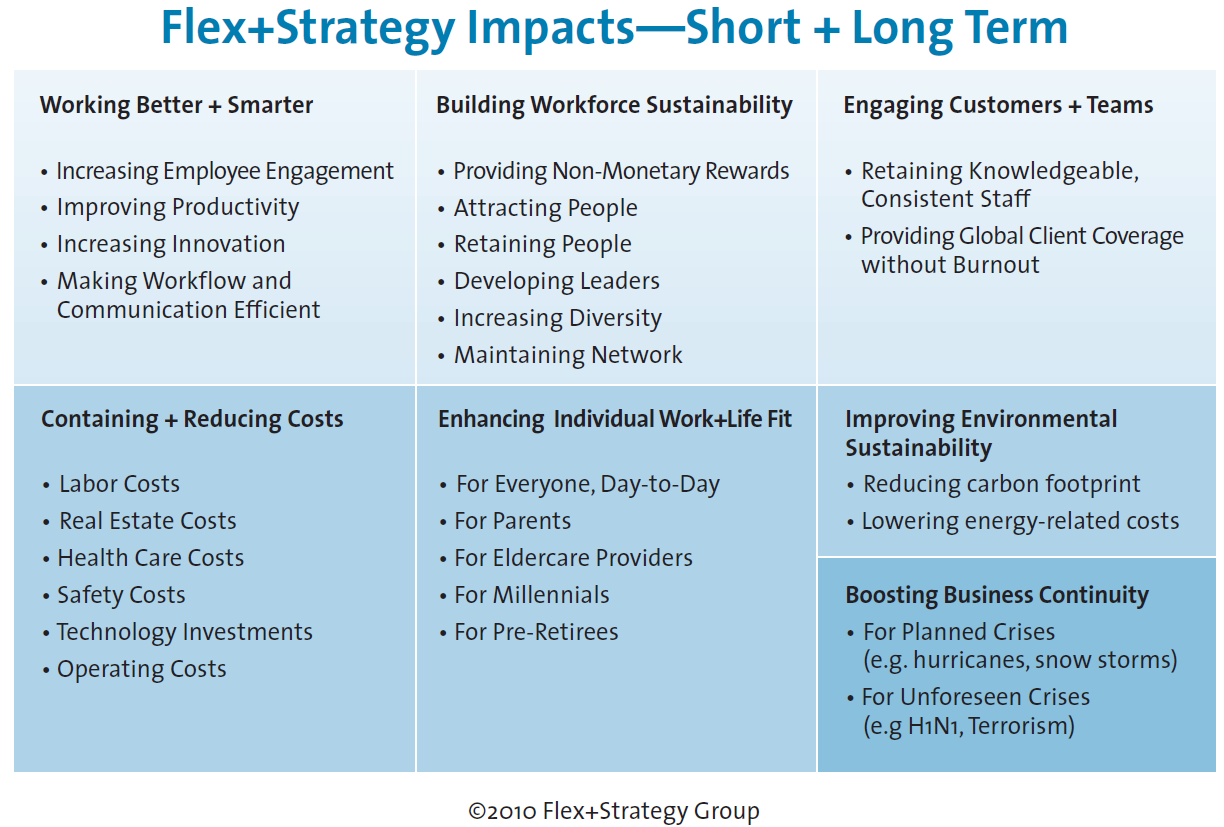
Second, there's nothing strategic or business-oriented in the way the authors describe the FFWP practices: "childcare flexibility," "entitlement to work from home," "job sharing schemes." It should just be "flexibility," 'work from home," "job sharing." No family-oriented qualifiers.
In the end, the authors unintentionally prove just how valuable "family-friendly" workplace practices are to the financial performance of an organization:
At minimum: Even if a business has no other good management practices in place, they can simply offer informal and formal flexibility, vacation and childcare supports (not caring whether or not people actually use any of the practices) and there will be no net negative impact on profit. It will cost you nothing. They will pay for themselves.
In other words, a company can just write a few policies, put a flexibility toolkit on the internal portal, offer a child care subsidy, and not do anything about implementation, and the worst thing that can happen is they don't lose any money. Not bad.
But with good implementation and the right strategic positioning: Imagine the potential positive impact on financial performance. If the organization focused on improving utilization and access, as well as on alignment with other good management practices, the financial return is proven and measurable.
Just ask our client...a real company, realizing real returns.
Happy National Work and Family Month!
For more from Cali Williams Yost, see the Work+Life Fit Blog and connect via Twitter @caliyost