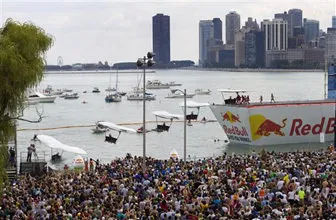
Recently there has been a surge of interest in human-powered aircraft (HPAs). Red Bull's Flugtag has generated a number of bizarre flying machines, but most of the activity in this field is more serious in nature. For example, I'm working at AeroVelo, an organization of students and professionals dedicated to efficient engineering in human-powered transportation. Our current focus is on the Atlas Human-Powered Helicopter (HPH), an entrant into the Sikorsky Prize competition. At $250,000, the Sikorsky Prize is the third largest in aerospace history, requiring a human to hover for one minute and reach an altitude of 3 meters (10 feet). The competition is heating up, and it looks like one of the teams in the running (hopefully ourselves!) will capture the prize very soon. So how did we get to this exciting milestone?
The saga of HPAs is in some ways that of flight itself. Leonardo da Vinci sketched the first well-known concept of an aircraft in 1490: a wood and canvas machine with flapping-wings powered only by the pilot. Da Vinci's craft never flew, but Dr. Todd Reichert and I would realize his ancient dream in 2010 (more on that later). Many of the intervening attempts at flight would be human-powered and would teach much, but the invention of the gasoline engine and subsequent Wright brothers' flight in 1901 meant that use of the underpowered human engine was shelved. There were brief flights by HPAs through the mid-20th century made by aircraft like Mufli, Puffin, and Jupiter, but sustained human-powered flight remained elusive.
The Royal Aeronautical Society and the British Industrialist Henry Kremer provided the first real impetus for human-powered flight in 1959: a prize for the first HPA to fly a 1-mile figure-of-eight course. Paul MacCready and his team flew the Gossamer Condor into history in 1977, with the crucial insight that an aircraft lightly-built yet enormously large and ponderously slow would require much less power. In fact the entire project team, ranging in age from 12 to 80, was able to fly the aircraft. MacCready was named "Engineer of the Century" by the American Society for Mechanical Engineers in 1980, for this and other accomplishments.
Subsequent prizes spurred development at a breakneck pace. MacCready's team captured a second Kremer prize (for a flight across the English Channel) with the Gossamer Albatross flown by a competitive cyclist in 1979. The Kremer Speed Prize was offered next for an aircraft to fly a 1,500 meter course in under three minutes, requiring a leap in the speed and power required. MIT won the challenge with the Monarch B in 1983, and the Gossamer Bionic Bat and German-made Musculair were able to improve upon their course time for subsequent 2nd- and 3rd-place prizes.
HPAs to follow were largely built for a love of engineering and pushing the envelope. A brilliant team at MIT was responsible for the most focused development program of HPAs ever, building BURD (which made brief hops), Chrysalis (a contender for the Channel Prize), Monarch A & B, and the prototype Michelob Light Eagle culminating in the Daedalus in 1988. Daedalus was designed as the perfect HPA, meant to replicate the mythological flight of its Greek namesake. The Daedalus was flown 79 miles over the Aegean Sea from Crete to Santorini, and to this day holds almost every record for HPA endurance and distance. Notable aircraft such as the Velair (Germany) and Airglow (UK) have been built and flown since, but another great leap has been hard to come by.
Our team achieved one of the last aviation firsts in 2010 with the flight of the Snowbird Human-Powered Ornithopter (flapping-wing aircraft). This feat had been called impossible because of the inefficiency of flapping-wing flight at the scale required for an HPA. However, our lab at the University of Toronto had extensive research experience in both ornithopters and lightweight aircraft, ideally positioning us for this challenge.
That being said, a number of technological factors arising in the past few decades made our success, much less HPAs in general, possible. Modern materials like carbon fiber composites have been crucial for many HPAs. Also, the explosion of computing power has been indispensible: desktop PCs are now available that have the power of 1980's supercomputers. This has been especially important for AeroVelo, where we developed optimization programs for the Snowbird and Atlas that simultaneously analyze the aerodynamics, structures, and other important aspects of the aircraft. These codes require hundreds of hours of computing time that would have cost a fortune to run just a few years ago.
What have HPAs given back? Their construction methods are gaining traction in high-altitude long-endurance (HALE) unmanned aircraft that offer a viable alternative to satellites for many applications. The most important contribution, in my opinion, is the dissemination of the mentality of "doing more with less". Exposure to engineering with human-power in mind shows what can be done when you "simplicate and add lightness". A streamlined bike that can go 73 mph (Vortex, which we designed and built, and holds the collegiate world speed record) shows the extent of what is possible. As the world moves towards less energy-dense solutions like battery and human-power, this mindset could fuel a transportation revolution.
It's been an exciting 30 years for HPAs, and hopefully the next few are just as interesting. There's the longstanding Japanese Birdman competition and the growing Red Bull Flugtag, both entertaining spectacles. More seriously, an HPA competitive event called the Icarus Cup has been founded in England, taking place this June. Moreover, there has been talk of HPAs as an exhibition event in the Olympics. As Jay Leno joked upon hearing of the flight of the Snowbird, maybe soon Southwest will let have you fly yourself to your destination. For now, the team and I working on Atlas are just concerned with defying gravity.