It's really quite amazing. The main response at Tuesday's opening hearing of the Senate Environment Committee on the Clean Energy Act was that its 2020 goal -- a 20 percent reduction in U.S. emissions of greenhouse pollution -- was over-the-top ambitious. Senators, both Republican and Democrat, expressed grave concerns that such a goal would somehow tank the economy. In fact, it's somewhat alarmingly unaggressive -- and won't do as much as it should to jump-start the clean-energy revolution we need for economic recovery.
It appears that those who complain that 20 percent is too ambitious haven't been tracking our progress for the past three years. Every year the Energy Information Agency (EIA) forecasts how much carbon dioxide the U.S. economy will emit over time. At the end of 2005, EIA projected that the U.S. would emit 7,500 million metric tons (mmt) of CO2 in 2020 -- up from about 6,000 mmt in 2005. That's a big increase.
But in the three years following that forecast, 100 coal-fired power plants were canceled, 24 states adopted renewable-energy standards (which collectively added up to about 10 percent of national electrical generation), and Congress passed a 35-mpg fuel-efficiency standard. So at the end of 2008, EIA issued a new estimate, which was that America's CO2 emissions wouldn't grow at all between 2008 and 2020 -- and that by 2020, we would be emitting only 6,000 mmt.
Then this year, as a result of the Obama administration's stimulus package, its adoption of even more aggressive vehicle fuel-economy and emission standards for 2016, the cancellation of more coal-fired power plants , and the economic downturn, EIA projected that by 2020 emissions would actually decline to 5,900 mmt.
So, in four years we have reduced our 2020 emissions trajectory by 1,600 mmt.
Is it now too ambitious to take another ten years to reduce those 2020 numbers by a further 1,200 mmt, which is all that the Senate Clean Energy bill would require? Is it possible that we've already taken all the easy, cheap steps we can to reduce carbon waste in our economy?
No way. Not even close.
To illustrate, I prepared a little chart. It shows the progress we made from 2005 to 2009. Then, out at 2020, it shows the impact on our CO2 emissions of a few simple, affordable improvements we could make in our energy sector -- things that would create jobs, enhance our national security, and clean up pollution while speeding the economic recovery.
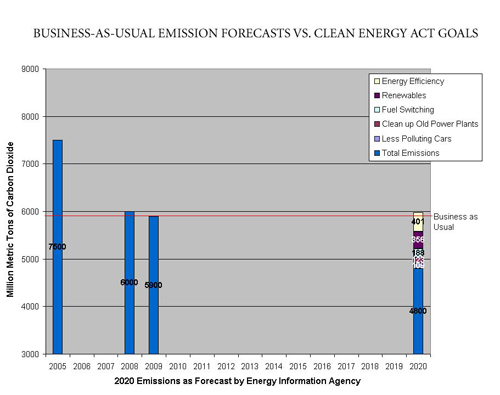
Not only did I find 1,200 mmt of potential "no regrets, good investment" savings that we could make but I also found a little more. That's why the bar on the right goes a bit above the "business as usual" line -- we've got a few extra emission savings. A few examples: just continuing to improve vehicle performance from 2016 to 2020 saves another 109 mmt; state energy-efficiency standards could yield another 401 mmt. This package of steps -- which is only illustrative -- requires no increase in our energy bills. The savings from the efficiency measures would easily make up for the costs of things like switching from coal to natural gas and cleaning up old power plants.
So my scenario is actually short of what we can and should achieve. And yet, all the Beltway crowd can do is moan, "It's too hard."
Hey, Washington? It's time to join America.