More

Featuring fresh takes and real-time analysis from HuffPost's signature lineup of contributors
Carl Safina

GET UPDATES FROM Carl Safina
 

Bluefin Tuna: In Danger But Not Endangered

Posted: 05/31/11 08:43 PM ET

On May 27, the National Oceanic and Atmospheric Administration (NOAA) announced it won't list Atlantic bluefin tuna as endangered. (Note timing: a Friday before a 3-day holiday.)

The decision is understandable. The warm-blooded giant bluefin tuna can exceed half a ton and swim at highway speeds. Though also extremely large, the federal government is slower and colder. For the tuna, life would have been easier, perhaps even possible, if it were listed as endangered. For the government, life would have become a little more difficult. The decision was not up to the beleaguered bluefin, which lives by facts, not opinion.

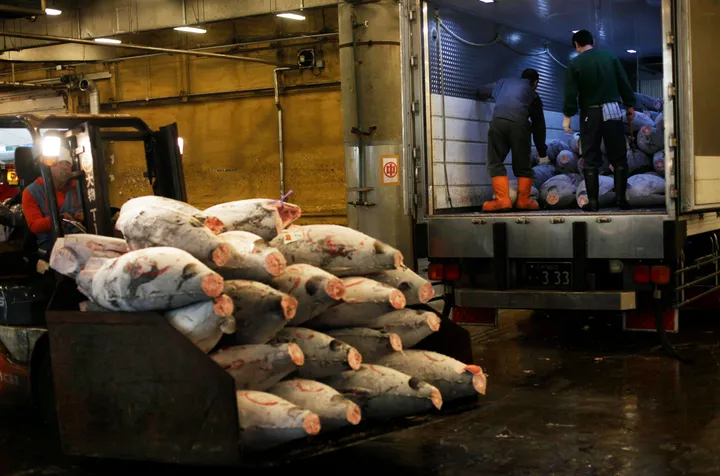
The Atlantic bluefin tuna is not in imminent danger of extinction. Neither is the American buffalo; it's just demolished. Atlantic bluefin are, similarly, demolished. Officially bluefin are down 80 percent. But that's since the mid 1970s, when population estimates began. Yet back in the mid 1960s, commercial fishing boat operators were so alarmed by the decline in bluefin tuna that they themselves spearheaded forming the International Commission for the Conservation of Atlantic Tunas. And if you read accounts of bluefin tuna sport-fishing in the 1920s, it's easy to conclude that bluefin today are in the single-digit percentages of their former numbers. The schools of fish we used to see frothing the ocean's blue prairies in the 1980s are gone. The difference between the buffalo and the bluefin is that for the buffalo the main hunt is ended.

The bluefin is on a path to endangerment. And so we wait. One of the weaknesses of the Endangered Species Act is that it sets a floor -- preventing total extinction -- rather than setting a standard of abundant, viable populations. (By contrast, the Clean Water Act sets a standard: that America's waterways must be "fishable and swimmable.")

Lack of progress on bluefin rebuilding is frustrating. The tuna commission has been broken for decades. The original idea was that countries would come together to maintain populations of fish that they all relied on. In reality, each country seeks for itself the highest quota it can wrangle. And so things spiral.

The dearth of available procedural avenues sent conservationists to the Endangered Species Act. Yet even the Endangered Species Act could do little to control fishing by other countries when the fish migrate outside U.S. boundaries. This weakness is cited by U.S. fishermen opposing endangered listing (their main concern, of course, is to keep fishing). But endangered species status has greatly helped sea turtles and birds that cross out of U.S. air- and sea-space. That's because, for much of the year, they stay within areas controlled by the United States.

Similarly, the Endangered Species Act could have extended significant help to Atlantic bluefin tuna. There are two Atlantic bluefin breeding populations that don't interbreed, and the most depleted one breeds exclusively in the Gulf of Mexico. (The other breeds in the Mediterranean, where fishing is out of control. Individuals from both breeding stocks mix during migrations throughout the Atlantic.)

In the Gulf, federal rules limit how many spawning bluefin commercial fishing boats can keep. But commercial long-lines with hundreds of baited hooks targeting yellowfin tuna inevitably kill--then must discard--significant numbers of bluefin tuna. Because all bluefin they encounter in the Gulf are breeders from the deeply depleted west-Atlantic-stock, the Gulf is important. This month, the feds required Gulf longliners to use hooks designed to straighten under the strain of a giant bluefin. But they don't always work (see here). So the dwindling breeders remain at risk.

The right thing never happens for bluefin tuna. I've worked to persuade the tuna commission to lower catches. Fishing interests squashed us. We tried the international body that regulates wildlife trade -- and restricts things like elephant ivory, rhino horns, and cat skins -- to help bluefin. Fishing interests squashed us there, too -- and served bluefin at the meeting. Then we sued the U.S. government to at least close the Gulf of Mexico spawning areas during the spawning season. We lost.

So, after 20 years one comes to a certain inevitable conclusion: don't expect miracles; don't expect anything. And so, a new do-it-yourself effort, coordinated in part by Pew Charitable Trusts, is encouraging Gulf of Mexico longliners to voluntarily switch away from bluefin-killing longlines to a trolling technique and a tended-line method that would hook few, if any, bluefin tuna. The idea is: longliners would, in exchange for private money, agree to permanently change techniques. The conservationists would also work with national retailers to get them a premium price for a better, cleaner fish product. But NOAA has to officially sanction the deal. This time, they need to do the right thing.

 
On May 27, the National Oceanic and Atmospheric Administration (NOAA) announced it won't list Atlantic bluefin tuna as endangered. (Note timing: a Friday before a 3-day holiday.) The decision is unde...
 
 
  • Comments
  • 14
  • Pending Comments
  • 0
  • View FAQ
Comments are closed for this entry
View All
Favorites
Recency  | 
Popularity
03:25 PM on 06/02/2011
The author, Mr. Safina, is a Pew (Sun Oil co.) fellow. The spraying of Corexit in the Gulf poisoned our air, water, humans
10:39 AM on 06/02/2011
Does NOAA have a proposed regulation on requiring different gear? If so, when is the public comment period? That would be a helpful piece of information. Also, is PEW simply paying tuna fishermen to not fish, or subsidizing the use of the alternative gear technology with lower bycatch?
photo
HUFFPOST SUPER USER
Chad Wheeler
12:40 PM on 06/01/2011
When I read this headline, it instantly made me angry. Then I read the article, and understood. Thank you for such a moving and powerful essay. I hope many read this, and change their ways. (Though not too hopeful. Humanity has made me a realist not an optimist.)
This user has chosen to opt out of the Badges program
photo
DaneAZ
Trapeze Artist
10:48 AM on 06/01/2011
The Blue Fin will go extinct.
That's how humanity operates.
02:46 PM on 06/01/2011
And when they're gone,so goes the money. Real long range investment planners aren't they? Same holds true for a lot of other ocean life.
photo
Help USA Taxpayer
Shared sacrifice is taxing TV/internet advertising
06:49 AM on 06/01/2011
Saw a Bluefin Tuna caught on a 25 person charter boat last year and the Captain bought the fish from the fisherman , only one bluefin allowed per boat, so when another bluefin was caught and released the mate said it will die anyway because of the long struggle to get it in the boat - what a shame such a great sport fish
photo
HUFFPOST SUPER USER
Scottsman
Carpe Diem
01:41 AM on 06/01/2011
clean water will be the next war motivator
photo
HUFFPOST SUPER USER
Scottsman
Carpe Diem
01:39 AM on 06/01/2011
its easy , the fewer the fish , the higher the price, profit vs sanity
photo
HUFFPOST SUPER USER
mudshark12
Now who are you jiving with that cosmik debris?
12:43 AM on 06/01/2011
I used to love eating tuna until I heard about their being over-fished and in danger of becoming extinct. I quit eating tuna for this very reason. I wish everyone would do the right thing and let the Bluefin Tuna recover by stopping the consumption of them. Besides, they are not as tasty as the smoked Herring, mmmmmmmmm yum!
photo
HUFFPOST SUPER USER
TheSarge
Firearms Inst Environmental Activist
12:37 AM on 06/01/2011
If I recall we haven't been able to raise Bluefin in captivity yet, they require a profoundly complex set of factors, current, light,temps etc. Might be an interesting grad paper, Ill have to do some reading.
12:03 AM on 06/01/2011
I don't think I'd go blaming the Endangered Species Act for this. Your story makes it obvious that the ESA is the wrong tool for the job. You are right to blame the failings of the commissions, etc. But the ESA is a last-chance measure -- not comparable to the Clean Water Act. We need better basic fishery conservation laws and enforcement AND the ESA for when all else fails. This is, of course, assuming that NOAA properly concluded that bluefins are not threatened with extinction at this time, and that's not a sure bet...

Anyway, if you like the ESA for what it's supposed to do, you shouldn't bash it for not doing what it ISN'T supposed to do.
photo
HUFFPOST SUPER USER
realitytrumpsbull
two 'alves of coconut!
09:16 PM on 05/31/2011
Another comment on all of this would be to submit an open forum question to the food industry at-large, to find out just how much waste there is in all of this. What's really a crying shame is when the food biz ends up killing something, only to throw it in the garbage later because no one bought it or the people that bought it just never ate it. Waste not, want not...
photo
HUFFPOST SUPER USER
realitytrumpsbull
two 'alves of coconut!
09:06 PM on 05/31/2011
It sounds to me like maybe it's time to temporarily re-purpose a portion of our commercial fishing industry into operating land-based hatcheries, where lil baby tunas can get hatched out, and then spread out upon the ocean's waters to grow up and become healthy, table-ready half-ton supercab tunas. Or, we need to find a way to supplement the national food supply with something that doesn't have to be caught 100 miles out in the middle of the ocean by a gigantic floating food processor. Like maybe...apples? Eat an apple, instead. If less people buy tuna, grocery chains will order less replacement stock. We can grow apple trees all day long in this country, and apples are good food. Even if they don't get imported from TaxHavestan...
photo
HUFFPOST SUPER USER
TheSarge
Firearms Inst Environmental Activist
07:53 PM on 05/31/2011
The Japanese go through Bluefin like a fire in dry grass.