I'd been in Niger for less than a day, and things were not quite what I'd expected. There are few obvious signs warning visitors arriving in the capital, Niamey, a slow-paced and laid back place, that life for millions of Nigeriens is beginning to get extremely desperate.
A worsening food crisis prompted the government to acknowledge a problem in March and launch an emergency appeal for help.
The appeal by Niger's new military leaders, who took power in a coup in February, was seen as an important break from the past. In 2005, during Niger's last serious food crisis, the previous government had strongly denied there was any problem.
Aid agencies, like Oxfam, have also been sounding alarm bells, warning that this year more than seven million, approaching half of the population, are facing hunger with malnutrition rates on the rise. Yet donors have been slow to respond and organisations like Oxfam are struggling to fund programmes to deal with the widening crisis.
Niger is already one of the poorest countries in the world. And it boasts some unenviable statistics: the fastest population growth in the world, which has seen the population rise from 2.5 million in 1950 to more than 15 million now; one of the world's highest infant mortality rates; more than 40% of children under-five underweight for their age, their growth stunted by hunger; low literacy and school attendance rates.
It's a country that often experiences cycles of drought which has a devastating impact on the majority of its people who live in rural area, depend on subsistence agriculture and breeding livestock. But this year has been worst than most. Erratic rains last year caused a 30 percent reduction in cereal production.
You would hardly know it in Niamey, where the bustling colourful markets are full of fresh fruit, vegetables and cereals. The same is true across most major towns, with much of the food imported. The problem, say analysts, isn't the shortage of food available, but the ability of people to access it.
Prices have soared - in some areas, doubling. But incomes have fallen by the same amount. Families have been forced to sell their highly valued but currently under-fed livestock and receiving prices that are pitifully below normal market rates. They're selling their remaining family assets and agricultural tools; often getting heavily into debt in order to borrow money to buy food and seeds for planting.
And that's forcing families to pull their children out of school and abandon their homes, moving to towns and cities, often crossing borders, in search of help.
Oxfam driver, Mohamed, pointed out people in the street to me as we traveled to the office. "They're not from Niamey", he said.
"They're beggars and they've come from the countryside."
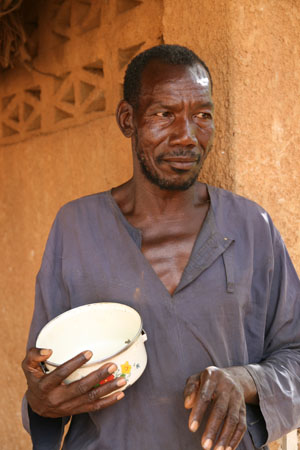
Some estimate that the number of people begging in the capital has doubled this year. As we drove, I started to notice some telling signs. Often, women and children resting from the overpowering heat under trees; children approaching cars at traffic lights gesturing and pointing to their mouths that they are hungry and holding out their hands in expectation of food or money; women using sieves to sift through the sandy ground to find any grains of cereal that had escaped from food trucks. It wasn't so easy to tell, though, if these were families newly-arrived from the countryside. But outside the Oxfam office that morning, I met father of two, Issoufou Moumouni, walking down the street with a small tin bowl in his hands. He told me he had left his village in Fandou-Kaina, in Oullam region three weeks ago. He guessed that nearly forty men from the village of around 50 households had left home in search of work and food in the last few months.
"Its very bad this year. We can't grow anything. There is no rain and there is no hope", he told me, smiling ruefully.
But if things are bad now, they're likely to get worse. We're at the start of what's known as the hunger gap season. There are several months to go before the next harvests in September. If Nigeriens, well-used to dealing with drought and hunger, are struggling now, one can only fear what will happen in the coming weeks unless they get much more help.
Our 2024 Coverage Needs You
It's Another Trump-Biden Showdown — And We Need Your Help
The Future Of Democracy Is At Stake
Our 2024 Coverage Needs You
Your Loyalty Means The World To Us
As Americans head to the polls in 2024, the very future of our country is at stake. At HuffPost, we believe that a free press is critical to creating well-informed voters. That's why our journalism is free for everyone, even though other newsrooms retreat behind expensive paywalls.
Our journalists will continue to cover the twists and turns during this historic presidential election. With your help, we'll bring you hard-hitting investigations, well-researched analysis and timely takes you can't find elsewhere. Reporting in this current political climate is a responsibility we do not take lightly, and we thank you for your support.
Contribute as little as $2 to keep our news free for all.
Can't afford to donate? Support HuffPost by creating a free account and log in while you read.
The 2024 election is heating up, and women's rights, health care, voting rights, and the very future of democracy are all at stake. Donald Trump will face Joe Biden in the most consequential vote of our time. And HuffPost will be there, covering every twist and turn. America's future hangs in the balance. Would you consider contributing to support our journalism and keep it free for all during this critical season?
HuffPost believes news should be accessible to everyone, regardless of their ability to pay for it. We rely on readers like you to help fund our work. Any contribution you can make — even as little as $2 — goes directly toward supporting the impactful journalism that we will continue to produce this year. Thank you for being part of our story.
Can't afford to donate? Support HuffPost by creating a free account and log in while you read.
It's official: Donald Trump will face Joe Biden this fall in the presidential election. As we face the most consequential presidential election of our time, HuffPost is committed to bringing you up-to-date, accurate news about the 2024 race. While other outlets have retreated behind paywalls, you can trust our news will stay free.
But we can't do it without your help. Reader funding is one of the key ways we support our newsroom. Would you consider making a donation to help fund our news during this critical time? Your contributions are vital to supporting a free press.
Contribute as little as $2 to keep our journalism free and accessible to all.
Can't afford to donate? Support HuffPost by creating a free account and log in while you read.
As Americans head to the polls in 2024, the very future of our country is at stake. At HuffPost, we believe that a free press is critical to creating well-informed voters. That's why our journalism is free for everyone, even though other newsrooms retreat behind expensive paywalls.
Our journalists will continue to cover the twists and turns during this historic presidential election. With your help, we'll bring you hard-hitting investigations, well-researched analysis and timely takes you can't find elsewhere. Reporting in this current political climate is a responsibility we do not take lightly, and we thank you for your support.
Contribute as little as $2 to keep our news free for all.
Can't afford to donate? Support HuffPost by creating a free account and log in while you read.
Dear HuffPost Reader
Thank you for your past contribution to HuffPost. We are sincerely grateful for readers like you who help us ensure that we can keep our journalism free for everyone.
The stakes are high this year, and our 2024 coverage could use continued support. Would you consider becoming a regular HuffPost contributor?
Dear HuffPost Reader
Thank you for your past contribution to HuffPost. We are sincerely grateful for readers like you who help us ensure that we can keep our journalism free for everyone.
The stakes are high this year, and our 2024 coverage could use continued support. If circumstances have changed since you last contributed, we hope you'll consider contributing to HuffPost once more.
Already contributed? Log in to hide these messages.