- BIG NEWS:
- Green Living
- |
- Green Energy
- |
- Animals
- |
- Energy
- |
The Hmong villagers of Chiang Mai Province in Thailand eat a well-balanced diet. They raise pigs and other livestock, grow cabbage, tomatoes and corn. A typical meal might consist of rice with spicy minced pork sauce and soft-boiled vegetables. Unlike the vast majority of meat production in the United States, their animals are not genetically cloned and raised in pens at the expense of the animal's health and, arguably, the consumer's, but pastured outdoors on a healthy, natural diet.
So, "what happens if you take remote Chiang Mai villagers who've never seen a burger, who don't even have a word for 'burger' and ask them to compare Whopper versus Big Mac in the world's purest taste test?" the new campaign from Burger King asks.
Well, for one thing, vomiting, diarrhea, and with extended use, Type 2 diabetes, obesity and vitamin deficiency (i.e. the impact of the American diet on Greece). But most of all, you get a classic story of American corporate colonialism, sickly masked in that all-too-proud illusion of goodwill.
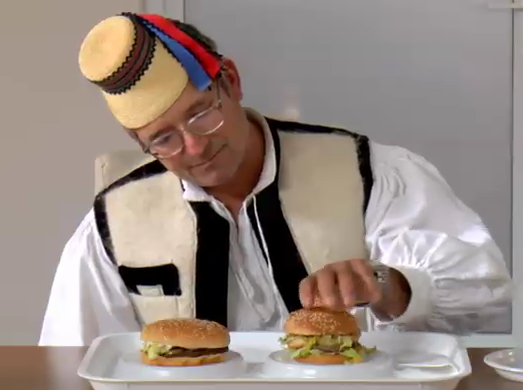
It's hard to tell who's more clueless when watching the behind-the-scenes footage of the ad campaign currently on the Whopper Virgins website (yes, that's their website): the peasants, who pick up parts of the burger in disconcerted quandary, or the producers, who ham themselves up as rugged pioneers, going out to discover "typically very difficult people to find" and thrusting burgers before their innocent eyes. The producers - or whoever they are - on screen set the tone for the pseudo-serious docu-mercial, talking with self-satisfaction about the project as some kind of neat cultural exchange (of course, Whoppers beat out Big Macs in the end). Oh, we get to see the nitty gritty: the burgers must be purchased from a franchise within fifteen minutes of reaching its taste-tester, so an SUV tosses up gravel in one shot as a PA simultaneously bursts out the door running with two paper bags - talk about fast food.
It's no wonder that many of the indigenous people offered "no preference" between the two sandwiches. Almost nothing in the Whopper and Big Mac resembles natural, unprocessed food save for the sad strips of lettuce and pale tomato. Least of all not the square of yellow cheese, which cannot even be called cheese according to the US Code of Federal Regulations, but rather "pasteurized process cheese food." It's doubtful the beef patty is recognized as meat at first glimpse, with its grayish hue, floppy, flat shape and enough preservatives to keep it intact for decades.
Aside from the familiar face of cultural bullying the campaign exposes, and the further exoticisation and exploitation of indigenous peoples from around the world - topics which can and will be argued about 'til the cows come home - the Burger King Whopper Virgins commercials exemplify two very disparate ways of looking at food. On the one hand, heavily processed, genetically modified, fast and far from homemade. On the other - and there is one scene in the docu-mercial of native foods being scooped up and the American producers enjoying plates full of it - grown, raised and cooked with knowing care by the village that consumes the food itself. Fast, versus slow.
In the very final scene, a producer asks an Inuit what he thought of the burger. After replying that it was "very good," the producer persists, "How does that compare to seal?" No deal. The Inuit replies: "I like seal better."
These are not just the philosophical musings of a new...
Two significant comments in the past two days by...
Long before $150,000-gate, Sarah Palin seemed to...
The Obamas dropped by the Vatican on Friday, with daughters...
Yesterday evening, Greg Sargent reported on The Plum Line that one of Alaska Gov. Sarah Palin's key reasons...
I never actually heard the words made famous by a certain man on a certain TV show. Instead I got a lot...
Jim Hansen is director of the NASA Goddard Institute for...
Don't write off Saint Sarah all you political pundits,...
ANCHORAGE, Alaska — The former fiance of Gov. Sarah Palin's...
Hermione herself, Emma Watson, charmed David Letterman and...
Think Progress flags David Brooks telling...
While we of course do not claim to know anyone's thoughts, we nominate these...
The Daily Show's John Oliver is unhappy with mainstream journalism, and even drearier...
For this week's installment of their "Lunch with the FT" feature the...
Al Franken's been anointed as Minnesota's junior senator, but how did the...
SYDNEY — Residents of a rural Australian town hoping to protect the earth and their wallets...
"What's for dinner?" A lot of us ask that question right...
Want to reply to a comment? Hint: Click "Reply" at the bottom of the comment; after being approved your comment will appear directly underneath the comment you replied to
I know if one of those Inuits were to offer me some seal meat, I would throw it in his face for trying to force that fat-laden, high cholesterol, low-vitamin crap on me! How DISGUSTING! How INSULTING for him to think I would be interested in trying some new food unless it is antioxidant rich, low fat, and high fiber! Good thing the Inuits aren't the imperialists!
I am in favor of people from all parts of the world making efforts to learn about and experience other cultures whenever they are given the opportunity. These ads were an opportunity for hundreds of people to experience American food and a piece of American culture. I think more offensive than the imperialism suggestion is to suggest that these people should wall themselves off to the world and not be allowed to experience other cultures and learn from them.
If someone from this town in Romania flew to America to give us an opportunity to try their native food it would be downright offensive for us to refuse to try their food. I think most people who see the world as a global melting pot of many different races, religions and cultures would embrace the opportunity to try food they had never experienced before. Let's not sit on our American high horse and judge by a double standard here.
Opportunities for people in the world to experience new foods and new cultures should be embraced, not attacked.
It is interesting how the Burger King missionaries described people's reactions. Without context, I might mistake this team for a group of very understanding, patient, and non-judgmental anthropologists teaching Neanderthals about fire. I haven't noticed any gentle, condescending rhetoric regarding the Burger ambassadors' ignorance of the local food. This campaign isn't about sharing cultures, just scrounging up new customers.
In fact, it's not exceedingly polite to waltz into a foreign country and cram your culture down everyone's throat. Polite travelers show a genuine interest in other cultures, and generally go to new countries with their eyes and ears open and their mouths shut. Having conversations about your home culture while abroad is wonderful, but it's different from entering a foreign country with a loud-mouthed agenda.
The name "Whopper Virgins" is a dead giveaway. Virgins are naive, corruptible, and there's a sick illusion of power and ownership over whomever you "deflower." (Think about it -- "she never had sex" is a little less severe than defining someone as a virgin.) As someone already pointed out, it is amusing to picture a troop of Burger King reps parading into foreign countries with their feathers puffed out, hamburgers held proudly, probably to find dozens of confused people who don't really get what all the fuss is about. Unfortunately, Burger King is more persistent than that, and with their influence and money, it's too easy for them move in and take over, welcome or not.
I understand everything you are saying about Burger King's agenda and wanting to sell burgers etc. etc. But the bottom line is that I'm sure the people actually involved in this, from Romania, Thailand etc. enjoyed the experience and gained something from it.
If you have any evidence to the contrary, I have yet to hear it - just peoples own theories about why this is bad. Rather than just assume and decide what is best for people living in other cultures, maybe we should, you know, actually ask them their OWN opinion instead of deciding it for them (an extremely offensive and perhaps typical bully-headed American act).
All of the evidence we have right now says that these villagers were delighted and grateful for the opportunity to participate in this experience. Do you have evidence to the contrary? Have you talked to these villagers and they told you or someone else that they were offended by meeting the people from Burger King?
If so, please share that evidence. Without it, you are just making assumptions about what you believe is best for people in other cultures, without actually listening to what they themselves would like to experience.
Burger King's trans fat menu is enough to keep me to continue looking for a place to eat.
the first time I saw this commercial, my thought was "who in the hell dreamed this up"? How out of touch do you get when you become too greedy for the $? Disgusting! Insulting! Disrespectful!
I saw this commercial yesterday and was totally shocked and disgusted. Having just read "In Defense of Food: An Eater's Manifesto" by Michael Pollan, I had Westernized diets and diseases on my mind. To me, this commercial is an absolute slap in the face of the people who are suffering from these diseases (heart disease, Type 2 diabetes, cancer, etc).
I didn't see the end where the Inuit said he liked seal better (or it wasn't in the version I saw - I don't know), but I have to admit that it's witty and pokes fun at themselves a bit. I don't think BK is too worried about people switching from their product to seal though, so it's a pretty safe concession.
Moral of the story: don't watch commercials or do what they want you to, which is ALWAYS buy their product.
I'm impressed that Huffington Post posted this article, kudos.
While I don't have it in me to be quite as condemnatory (or just plain offended. I still have to ration out my anger, even in this post-irony age), I found the BK ads to be unintentionally hilarious. It's really just a nonsensically proud declaration of utter ignorance regarding one's own flaws.
I see these BK ads, and I think to myself, "really? Of all the things we might export, we chose this?"
You must be logged in to reply to this comment. Log in or