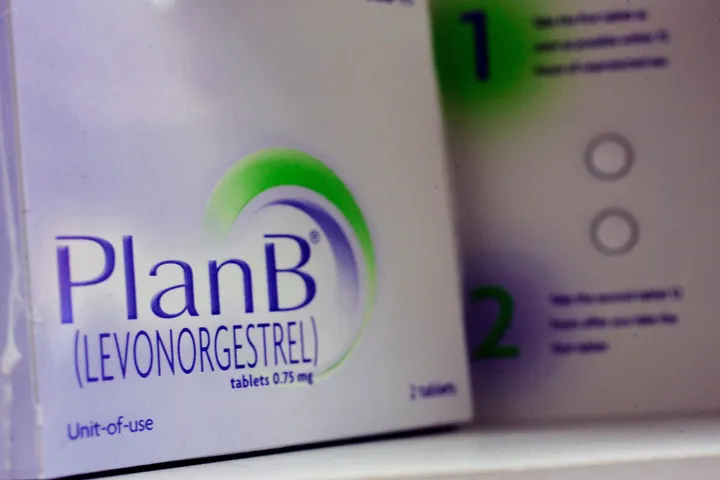
In a country where nearly half of all pregnancies are unplanned, effective birth control isn't just a convenience -- it's an urgent health need that too many women are still unable to meet. We've seen some promising signs of progress recently, including a government decision to require new health plans to cover contraceptives without copayments. Yet every step forward seems to trigger a reflexive backward leap. This week, after years of acknowledging that emergency contraceptives are safe and effective for nonprescription use, the government missed a tremendous opportunity to make emergency contraception more available to women who need it.
I'm talking about the decision regarding Plan B One-Step, the "morning-after" pill. After a careful review of the scientific record, the independent nonpartisan Food and Drug Administration (FDA) determined that the product should be freely available on store shelves -- just as other over the counter medicines are -- so that any woman of reproductive age can get it quickly in the event of an unplanned or unwanted sexual encounter. After all, it's called emergency contraception for a reason -- it is meant for emergencies and works best when used as soon as possible after unprotected sex.
After reviewing extensive clinical evidence, FDA Commissioner Margaret Hamburg agreed with the agency's scientific advisors that Plan B One-Step "is safe and effective and should be approved for nonprescription use for all females of child-bearing potential." By overruling Hamburg's decision, the Department of Health and Human Services has ensured that Plan B One-Step will stay out-of-reach for too many women -- hidden behind pharmacy counters rather than appearing on store shelves. The product is already available on request to people 17 or older, but requires finding a pharmacy, with a pharmacist, that's open. Women also face the real chance of having a pharmacist deny their request for emergency contraception, because some states allow pharmacists to refuse to provide emergency contraception from behind the counter.
Unfortunately, the opponents of birth control of all types have painted a picture of 11- and 12-year-old girls rushing to the local drugstore to snap up emergency contraception. How crazy is that? As a mother of three kids, I'm pretty aware that very few kids that age are sexually active, and even fewer are looking to shell out $50 for a treatment they don't need.
Planned Parenthood strongly supports parents in their efforts to protect their teens' sexual health, and we work with teens to encourage responsible decisions and help them delay sex until they are ready for it. In fact, Planned Parenthood provides more sex education to young people and their parents than any organization in America. Studies consistently show that the more we provide honest information and health care services to young people, the more likely they are to make responsible decisions and delay sexual activity.
The reality is that some teens become sexually active before they're old enough to buy Plan B without a prescription and 750,000 teens become pregnant every year. That means we should do all we can to keep teens from being parents before they are ready. Requiring a prescription provides an additional barrier to accessing Plan B, which means an additional barrier to preventing teen pregnancy. And as researchers have pointed out, physician supervision through issuing a prescription does not improve a woman's ability to follow the directions for medication usage. Put another way, young adolescents should not be singled out due to concerns about an inability to follow the directions.
Unfortunately, this hysteria is a smokescreen that has obscured the real issue: women need better access to this safe, effective and vitally important medication. As its name implies, emergency contraception is intended for use in urgent situations -- like when another form of birth control fails. The sooner you take it after unprotected sex, the more likely it will be to prevent an unintended pregnancy and all of the serious health and life consequences that accompany it. When that emergency arises, often the local pharmacy will be closed for the night, the weekend, or a holiday. By stocking Plan B One-Step on the shelves in drugstores, supermarkets and convenience stores, we could improve women's chances of finding it when they need it most. That's one reason a back-up form of contraception shouldn't be kept behind pharmacy counters.
But it's not the only reason. Even for a 30-year-old woman, slipping a packet from the store shelf into your shopping basket is a lot easier than announcing your predicament at a crowded pharmacy counter. In some towns, the lack of privacy can be a real disincentive for women in need. The current restriction would make sense if women needed pharmacists' oversight to use emergency contraceptives safely. But Europeans have bought them off store shelves for years, and research has shown no need for more medical oversight.
Despite all the political efforts to restrict it, access to emergency contraception has expanded steadily in recent years. But we can't afford to accept the status quo when women's health is at stake. The right plan for Plan B is to ensure women can access it when they need it.
Cecile Richards is president of Planned Parenthood Federation of America and the Planned Parenthood Action Fund.
Follow Cecile Richards on Twitter: www.twitter.com/cecilerichards
Arianna Huffington: Sunday Roundup
David Katz, M.D.: How About Plan 'D, For Data' For Plan B?
It was about interfering in and attempting to impose controls on the bodies of females. Just more of the same-old same-old.
Notice the lack of all this phony weeping, wailing and gnashing of teeth with regard to the ability of teenage boys to obtain condoms. Notice that no such overweening concern exists about MALE "children" obtaining "birth control without (parental) knowledge". I'm even willing to wager that most parents, upon finding a condom amongst their teenage son's effects, congratulate the young man on his mature sense of responsibility - IF anything is even said to him at all. It would take him stealing Dad's Viagra to gin up anything remotely near the level of hysteria that always surrounds access for women (both adult women and biologically functional female teens and pre-teens) to reproductive healthcare options.
It's all about the hypocrisy.
I am talking about parents rights and responsibilities for their children. And while I don't disagree that some parents view sexual activity by their sons different than by their daughters, it is much less prevalent than you suggest, and virtually disappears when we are talking about younger children (and remember, the issue here is children younger than 17).
The great majority of parents care about whether their male children are having sex. They don't want their younger boys taken advantage of, and they don't want their older ones to find themselves fathers at a young age, or to get in trouble with the law, or to be taking advantage of younger girls. And they recognize that for boys as well as girls, sex can make early relationships more intense, leading to more emotional pain when they end, and can lead to an atmosphere where other risky behaviors take place.
Your comments do not focus on any real concerns, just largely ideological chimeras.
I realize there are complications that can occur just like with any foreign substance you ingest but nobody gets told no when they go to the doctor and the doctor has to make an educated guess on what will work for the women and girls it is being prescribed to. So why can't we make it as simple as this:
Low hormones: Take generic pill A
Heavy cycles: Generic Pill B
Smokers: Pill C
and so on and so forth. As someone who has been off and on BC since I was 14 years old I can tell you that all docs do is guess and if for some reason one pill doesn't work they just move on to the next one. I really would have no problem whatsoever with my daughter walking into a pharmacy and buying the pill anymore than I would have a problem with her buying cold medicine, Midol or Tampons...all products with the potential to kill if take wrong.
(1) Do not take Plan B One Step if you are pregnant because it will not work.
(2) Do not take if you know you are allergic to Plan B One Step.
I wonder which warning the young teens will not understand.
http://www.thespec.com/news/canada/article/634953--honour-killings-about-men-controlling-women-s-bodies-expert-tells-shafia-trial
Of course no such constrictions are applied to teenaged males.
I am male and do not believe that making this easier to get will lead to any increase in sexual activity in teens and might even help reduce teen pregnancy.
To all those people who mention longterm side effects isn't it better to have one pill maybe once in someones life than taking contraceptive pills for decades with known bad side effects.
Lastly and most important it should be a persons choice based on whats best for them in their circumstances
The decision requires a prescription for those under 17. Its about children, not about women.
What about those parents/adults who've dropped the ball... or even refuse to pick it up? Why are girls being left to shoulder the burden of their parents' neglect/ignorance?
My mom was an anomaly considering her conservative, rural WV background. She had no problems talking to my sister and me about sex. She told us every line/pretense/persuasion tactic males would use to get what they wanted (Dad just nodded), and because she was open and honest, we believed her.
Nowadays, many parents don't want sex ed in school. They want to handle this topic at home. Then they don't. Sometimes they avoid this 'embarrassing' subject for religious or cultural reasons (or both). Sometimes parents are busy or think their little angels couldn't possibly be thinking about sex because they get good grades, etc. Whatever the reason, so many parents have dropped the ball that girls as young as ten are getting pregnant in 21st century America... and we as a society are paying for it.
IMHO, FEMALES should be able to choose whether to alter their lives forever with a child. If she's IRRESPONSIBLE enough to have unprotected sex, let her be RESPONSIBLE enough to try to correct her mistake. Don't make it hard for her to do so.
It's all about controlling females.
Does one have to have a consult with a Pharmacist when buying?
If its expensive - no Pharmacist will put it where it can be shoplifted.
The lawyers need to get a grip and go into a Pharmacy and check out locations of such items as Plan B, condoms etc. That's if they can manage it between drinks and engaging with a young staffer !
Even the new rules for Plan B push the envelope 12 months too far. By legal definition, anyone in the US under the age of 18 is a minor. They can't legally smoke, drink, sign contracts or even own property without a Guardian. Anyone who thinks having unprotected sex is preferable to smoking or drinking probably disagrees with the new Plan B rules.
All the rules say is that the emergency contraceptive can't be purchased without a doctor's prescription. In many states a teen can go to a doctor on their own initiative without parental permission. What the rules do is inject a certain amount of dispassionate adult advice into the mix.
Before a doctor will sign for the prescription, he/she will do an exam and talk to the young girl about her options. Since when is this a bad thing? How many 12 to 16 year olds do you know who are competent to make life-changing decisions without adult input?
The adolescent brain works entirely differently from the adult brain. You can't say teenagers should be exempt from prosecution as adults simply because they are teenagers and in the next breath say teenage girls are competent to make adult judgements about their sex life based on exactly the same research.
Think of the teenage brain as a car with a superb engine and no brakes.
A 13-year-old girl who has had sex ('consensual' or not) isn't thinking like an adult. They don't sit down, grab the phone and call their doctor to make appointments. They often panic. If the girl doesn't have adults she can talk to (for whatever reason), or money or access to a free clinic, she may bury her head in the sand and refuse to think about the consequences until it's too late. And if a girl is having sex at 13, she's missed out on A LOT OF HELP already.
I think this OTC pill should be available to kids 15 and older, though. Some health concerns can outweigh the eighteen-is-an-adult law, IMHO.
We have a felony and people are concerned about access to erase the evidence.
If I had teenage daughters I'd keep a box of Plan B (along with a box of condoms) in the bathroom closet right next to the tampons....
long-term side effects. Does anyone besides me remember DES ?