Celia Chen

Celia Chen

Posted: August 24, 2008 08:18 PM

Notes on a Party: Soliciting the Elusive R.S.V.P.

digg Share this on Facebook Huffpost - stumble reddit del.ico.us RSS

Lately, I've noticed a curious trend. While digital invitations have made it easier than ever to reply to a party invitation, guests have become increasingly relaxed about showing up to the actual event.

What is it about the convenience of an electronic invite that makes one forget about common courtesy?

Don't get me wrong - I think the application of technology on event planning is brilliant. For hosts, it has made the overall process of organizing any kind of event significantly more efficient with customizable invitation design, Google maps, simple guest list uploads (and downloads), as well as interactive features like photos, video and community. New companies like pingg.com have even made digital invitations aesthetically pleasing and, thankfully, advertising free.

What I have a problem with, as an event planner, is the slow demise of basic etiquette when it comes to responding to and attending social engagements. Events, whether big or small, take time to organize from sending out the invitations to creating the menu to arranging the entertainment. There is a tremendous amount of work that goes on behind-the-scenes to ensure that the event experience for guests is seamless. Ironically, the biggest effort goes towards elements of the event that need to be appear to be effortless.

So, is it any wonder that planners, after all that work, feel frustrated when their guests are noncommittal about their R.S.V.P's?

There was a time when manners seem to play a defining role in one's character. It just wasn't socially acceptable to treat formal engagements with our modern day blasé attitude. Perhaps it was the formality of a printed invitation that required guests to pay a certain amount of consideration to the event itself. Or, perhaps the physical act of mailing a reply card back to the host was reminder enough that attendance was important?

To further deliberate on the topic, I turned to Lisa Hoffman of Ceci New York, a world-renowned graphic designer (who has won awards for her bespoke wedding invitations) to get her thoughts on soliciting the ever-elusive R.S.V.P.

Hoffman points out that R.S.V.P. comes from the French phrase, "Répondez, s'il vous plaît," which simply means, "Please reply." These four letters should be enough of a signal to guests that the host needs to have an accurate headcount to make arrangements for the event.
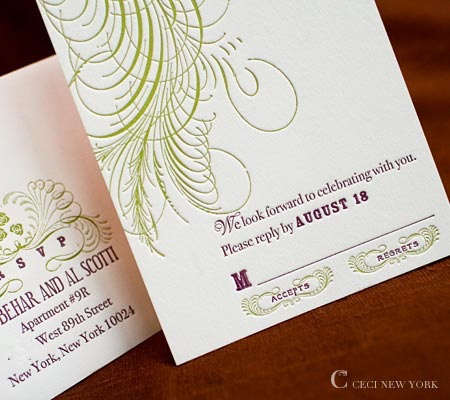
2008-08-22-reply_green1.jpg

Below, Hoffman shares her simple guidelines for how to R.S.V.P.:

R.S.V.P. is printed on a response card:
- fill in and reply by the date indicated and return in the enclosed envelope. Make sure you include the full names of you and your guests.

R.S.V.P. is on invite but no separate response card included:
- send a personal handwritten response to the host to the return address on the mailer envelope.

R.S.V.P. by phone number:
- call and make sure to speak to a person - answering machines are typically unreliable.

R.S.V.P. by email:

- it's totally acceptable these days to save time money (and a tree) to accept or decline electronically through email.

Regrets only:
- this means reply only if you cannot make it. If your host doesn't hear from you, they are expecting you to show up.

No reply requested:

- Not typical and remember, it is always polite to let someone know your intentions!

In terms of actual attendance at an event, guests should remember Hoffman's four golden rules (which are based on proper etiquette):

1. Changing an "accepts" to a "regrets" is only admissible in the event of an illness or injury, a sudden inescapable business conflict (that your boss won't allow you to get out of in risk of losing your job) or a family emergency. If something like this should happen to you, notify your host right away.

2. Changing a "regrets" to an "accepts" is considered doable and always a possibility but only if it will not mess up your host's plans. Check with them as soon as you know to see if they can accommodate you.

3. Canceling because that "better" offer came along
is never OK. Stick to your original plan - better things will come your way in the future.

4. Being a "no show" is unacceptable. If you said you would be there, let your hosts know they can always count on you. Anyone who receives an invitation has an important obligation to attend.

Follow them to ensure your name never gets dropped from the guest list!

Tell us your thoughts! Why do you think it is so hard for people to RSVP to an event or to stick to their commitment to attend?

A seasoned event planner, Celia Chen is the Founder and Editor-in-Chief of Notes on a Party, an online magazine about entertaining that celebrates Events from the Inside Out™. For a behind-the-scenes look at VIP events and tips on party planning, visit http://www.notesonaparty.com.

Follow Celia Chen on Twitter: www.twitter.com/celiawchen

 
Comments
7
Pending Comments
0
iPhone App Promo

Want to reply to a comment? Hint: Click "Reply" at the bottom of the comment; after being approved your comment will appear directly underneath the comment you replied to

View Comments:

It is a tremendous problem for the sandbox set too--I had to hunt down at least four families to find out if their tots were coming to a 3rd b-day bash. Bad news for the next generation of socially maladjusted kids.

    Favorite    Flag as abusive Posted 10:28 PM on 08/28/2008

I think this topic you discuss here is such a great one b/c it's definitely an issue.

Why the flakiness? I think it's a combination of a bunch of factors-- laziness, schedule craziness, casualness, etc. For certain, the informality of an online invite, no matter how beautiful, results in a lower percentage of responses. People get emails all day everyday, so you need to address them in an alternate way if you want to convey that this is a real event, into which you are putting a lot of time, effort, emotion, money, whatever. I'm not saying I'm opposed to the email invite because it's a great thing, especially from a sustainability perspective, but when sending an email invite you need to be extra prepared to do follow-up. The upshot is that the follow-up is easy because all of the email addresses are already organized.

I also think it's a product of city life. I'd wager that this is not a problem in more remote areas, places where people are not getting invited to multiple parties a night on a consistent basis. People receive so many invites, many which are last minute, that they want to keep their options open.

And finally, people are used to getting things done on a crazy quick turnaround. Seventy person cocktail party tomorrow night? Sure, no problem. This mentality becomes imbedded in our minds and we forget that most events actually require planning, and guest count is part of that.

    Favorite    Flag as abusive Posted 02:22 PM on 08/26/2008

The thing about being part of the internet generation is that we never see the result of our click clacking cyber lives. Click here, something happens there, and boom: you are going on vacation. Or load an image here, change the jpg size , and boom: you are publishing nudie photos of a celebrity you took with your camera phone last night. Ha! Really, the author highlights the more subtle yet specific etiquette issues emerging from internet use, including the ease with which one can shirk out of basic responsibilities (like RSVPing). Hopefully, manners and human interaction will see a resurgence with thoughtful articles coming from helpful experts like Ms Chen. Brava.

    Favorite    Flag as abusive Posted 01:12 PM on 08/26/2008
- Celia Chen - Huffpost Blogger I'm a Fan of Celia Chen 4 fans permalink

Margaret, you make an interesting point here. While we all agree that technology makes it easier for us to communicate (via email, text message, IM, Twitter and Facebook), it also gives us a little bit of distance. We can avoid awkward conversations or "shirk out of responsibi­lities/com­mitments" because we are not having a face to face or phone conversation. Perhaps it is the impersonal nature of digital communication that makes us feel less accountable for our words and thus our actions?

    Favorite    Flag as abusive Posted 01:42 AM on 08/28/2008

Great piece. Agree, eliciting an RSVP is certainly an art form as you and Lisa so eloquently explain. That said, in this digital age, your best chance of getting a timely rsvp is to reach out to a guest in a way that works best for them. If they're on cell, send a text invite, if they're on a PDA, send an email, if they love their social networks, post to facebook/twitter etc, if they prefer old school send a printed invitation. You're bound to get a quicker response if you reach your guests where and how they want to be contacted.

The best part is that with pingg (*note I work w/ the company) you can design an invitation and can send it via email, text, print (add an address, pingg prints, stamps and mails for you), web, social networks etc. all at the same time and all from the same platform. If sent digitally, the recipient can read all the details and then immediately click yes/no/maybe directly from their bberry, iphone, cell etc. Of course you can arrange for all your guests to get reminder messages. I always like sending out the address an hour before the event so everyone has it handy. We've found that all these pingg tools seem to do the trick. Happy entertaining!

    Favorite    Flag as abusive Posted 04:40 PM on 08/25/2008

Celia, thanks for a great piece. I think one problem with modern RSVP systems is that people often use a platform like evite which requires you to RSVP when you're at a computer (it is very hard to get evite to work well on a blackberry). An easier solution is to have an online invite system that's well integrated with smart phones so you can easily click "yes" on the invite when checking incoming emails on your blackberry or iPhone. I think pingg does this or is at least planning to - or a simple email text invitation would work and enable potential party-goers to simply hit "reply." Agreed that people should RSVP to events so the planner can properly prepare for the party.

    Favorite    Flag as abusive Posted 12:04 PM on 08/25/2008

As always, you raise an important and timely issue, Celia. However, you accidentally lay the question to rest in the asking. As Lisa points out, “RSVP” is inherently French. Americans are increasingly averse to all things French. From our zut alors! reaction to Sarkozy’s choice of spouse to our growing antipathie for fries, France is becoming Public Enemy nombre un. Using "RSVP" in correspondence, whether printed or digital, subtly tells the person to whom you’re extending an invite that you’re a Francophile. Your guests’ failure to respond or show up after responding affirmatively is a passive aggressive protestation against France. An easy remedy to this epidemic of poor etiquette is simply dropping “RSVP” from American vernacular in favor of the far simpler, less pretentious and entirely domestique “Please reply.” In this heure d’ la guerre, it’s the very least we can do as proud patriots.

-Adam D’vine

    Favorite    Flag as abusive Posted 11:04 AM on 08/25/2008
Comments are closed for this entry

 You must be logged in to comment. Log in  or connect with 

Connect