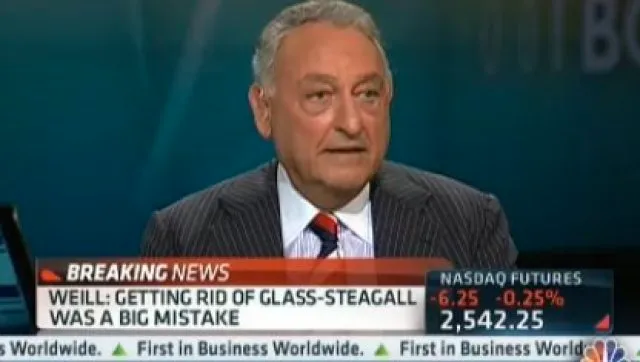
Sandy Weill's signature accomplishment during his long career on Wall Street, Citigroup, engaged in fraud on a massive scale, unfettered risk taking and then needed a massive taxpayer bailout during the 2008 financial crisis because it was so big it couldn't be managed.
Yet only now does Weill say it was all a mistake.
That's the context you probably didn't get during Weill's bizarre interview with the business news network CNBC (where I used to work) this morning. After years of defending the monstrosity he created and the monstrosities that it spawned, Weill now says that these big banks are too big -- they can't be managed and their existence may lead to another financial crisis.
Weill, of course, spent much of his 50-plus years on Wall Street creating just the opposite, the entity known as the financial "supermarket" where traditional commercial banking services of lending and deposits are combined with risk taking Wall Street stuff all in one place. Citigroup was the first, and unfortunately not the last, of this disastrous breed of bank.
It's a shame it took mountains of sleaze, tremendous shareholder losses, a financial crisis and taxpayer bailouts for Weill to see the light because there are many valid reasons to break up the banks. We had a financial crisis (and subsequent taxpayer bailouts) largely because of enormous risk taking at the mega-banks like Citigroup, which led others to blindly copy the firm's risk taking model until the entire system blew up in the fall of 2008.
Even so, it's hard to take Weill seriously. First this is a man with an ego the size of the bank he created. People who know him say he needs media attention like an alcoholic needs a stiff drink, and he's gotten precious little of it since retiring from the banking business six years ago. Yesterday made him feel like the same old Sandy again.
Then there's his record as a banker, which should banish him from ever dispensing advice on the business he helped destroy. Follow this timeline: In 1998, Citigroup was created by merging the investment banking business of a company Weill ran, known as Travelers Group, with the large commercial bank known as Citicorp. The merger was technically illegal because still in existence was a Depression-era law known as Glass-Steagall, which prevented such combinations.
Glass-Steagall was based a simple premise: Commercial banking deposits are federally insured. So why should the taxpayer be on the hook if some mindless trader bet the ranch and lost?
That common sense was lost on Weill, his buddies in Congress and the Clinton Administration, particularly then-Treasury Secretary Bob Rubin. In an act of bipartisan stupidity, the whole lot of them got rid of Glass-Steagall and replaced it with the Gramm-Leach-Bliley Financial Services Modernization Act of 1999, which made Citigroup legal, and ushered in an era of unprecedented sleaze on Wall Street.
Of course there's was always sleaze on Wall Street -- it just got bigger with Citigroup. Firms like JPMorgan and Bank of America copied the flawed mega-bank model and risk taking. Smaller players like Bear Stearns, Lehman Brothers, Morgan Stanley and even the prestigious Goldman Sachs began ramping up risk to compete with the supermarkets that had so much money and capital at their disposal.
But Citigroup wasn't just big. It was bad -- literally bad. The firm under Weill financed frauds like Worldcom and Enron without a second thought. Its stock market analyst Jack Grubman -- who was supposed to be dispensing unbiased advice to investors -- would moonlight as an investment banker, thus raking in fees from companies whose shares he was touting to unsuspecting investors.
Weill himself was in the middle of the muck; he prodded Grubman to upgrade shares of AT&T, where he was a board member. He did it at a time when the firm was vying for a lucrative role as an AT&T underwriter. When Grubman did as he suggested, and his bankers won the deal, he then got Grubman's kids into a fancy pre-school in Manhattan, which Grubman once lamented was harder to get into than "Harvard."
You can't make this kind of sleaze up. Nor can you make up what happened next; Weill resigned as chief executive at Citi, but remained as its chairman until 2006, and the firm began to ramp up risk as a way to pay for running such a costly operation.
Yes, the House of Sandy came crashing down in 2008, a couple of years after he was out. But his team was still in place. Years earlier Weill banished Jamie Dimon from the firm because he was jealous of the press attention that Dimon received. But his yes men and women were a disaster as Citigroup's failure in 2008 demonstrated.
One of those yes men was Rubin, who jumped to Citigroup not long after he helped Weill kill Glass-Steagall, making tens of millions of dollars as a deal maker and board member.
At least Rubin has kept a low public profile. Weill, until today apparently, has been in denial. He's defended killing Glass-Steagall and he never took responsibility for the sleaze and risk taking he set the stage for with his diabolical concoction.
Today Citigroup is a shell of its former self, its shares hammered by the financial crisis. Most other banks aren't doing much better, and they can thank Sandy Weill for showing them the road to ruination.