Time to start thinking outside the chicken-bun. The sales of KFC's notorious (and bun-less) Double Down are, well, down. They're immaterial according to KFC's CFO. Fear not, friends, other fast food purveyors are happy to step into the void. Taco Bell has introduced its $2 meal, McDonalds and Burger King are holding firm with their $1 burgers, while Denny's has developed belly-ballooning meals at $2, $4, $6 and $8. Sweet, you say! Who doesn't want to save cash? The only problem is this brand of cheap comes at an astonishingly high cost -- to us all.
Where do I begin? Let's see, we've got the health risks and costs associated with the antibiotic dosing of animals on industrial feed lots; the wholesale government subsidizing of corn to feed these animals; the cornfield chemical fertilizer run-off killing rivers and lakes (and an awful lot of lean-protein fish); widespread animal waste pollution; an obesity epidemic spurred by cheap, fatty food that costs us $147 billion a year; the alarming rise of antibiotic-resistant bacteria among farm animals; the increase in chronic preventable diseases linked with foods high in saturated fats; let's not forget that pesky bugaboo, global warming, whether in the form of farting cows or exorbitant transportation costs; or much closer to home, perhaps right on your plate, the increase in contaminated foods (and deaths) that comes with industrialized food production.
My favorite article on this matter is TIME's Getting Real About the High Price of Cheap Food, which spells it out in clear, unmistakable terms. If you don't have time for clicking, the man himself, Michael Pollan, put it all together in In Defense of Food:
"All of our uncertainties about nutrition shouldn't obscure the plain fact that the chronic diseases that now kill most of us can be traced directly to the industrialization of our food: the rise of highly processed foods and refined grains; the use of chemicals to raise plants and animals in huge monocultures; the superabundance of cheap calories of sugar and fat produced by modern agriculture; and the narrowing of the biological diversity of the human diet to a tiny handful of staple crops, notably wheat, corn and soy. These changes have given us the Western diet."
High costs, indeed.
So, if this is in fact true, what are we left with? We all need protein, among other things, to live. If we're trying to be careful with our dollars while still managing to eat, is our last surest option the drive-thru lane -- or are there other possibilities?
In my quest to speak with experts on all matters food, I reached out to Dawn Jackson Blatner, RD LDN, best-selling author of The Flexitarian Diet and a spokesperson for the American Dietetic Association , to try to get not only an answer but answers: actual things we could and should eat. Blatner is known for her straight-up nutrition tips and recipes that make a real difference.
"When it comes to health, and cost, I always recommend to my readers and clients a simple swap," Blattner says. "You see, when you swap to more meatless meals, you'll easily meet your protein needs. Plus, you'll enjoy added health benefits such as decreased risk of obesity, diabetes, cancer and heart disease. Plant proteins are so protective of our health. They're a rich source of fiber, vitamins, minerals and antioxidants. What's more, meatless is not only delicious -- it's incredibly easy to prepare!"
"Plus, here's the kicker: it's also less expensive than a meat-centric meal. Consider in June 2010, according to the most recent government figures from the U.S. Department of Labor, that one pound of beans was $1.34 versus spending 2.5 times more money for boneless chicken breast ($3.32/pound) and lean ground beef ($3.51/pound) and 4.5 times more money for sirloin steak ($6.00/pound). That's real savings you can bank on! Every week. Every month. Every year."
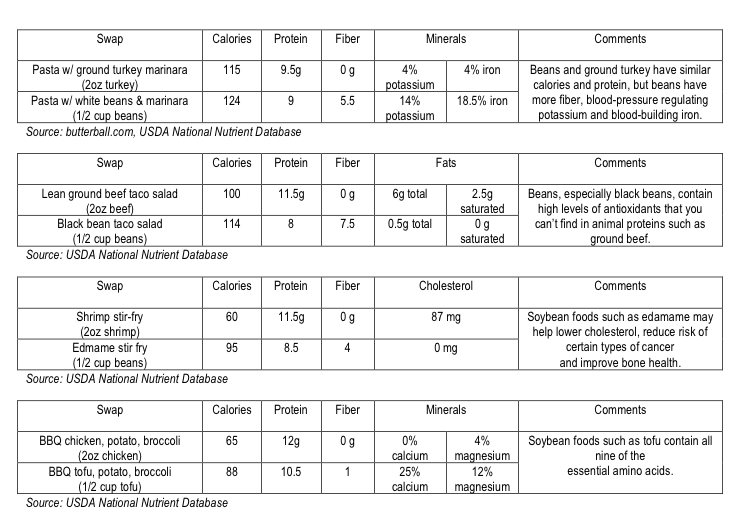
Blatner put together this handy swap chart to make it easy for you to see how you can get all the protein you need -- plus necessary fiber, vitamins and minerals -- with these simple tasty substitutions.