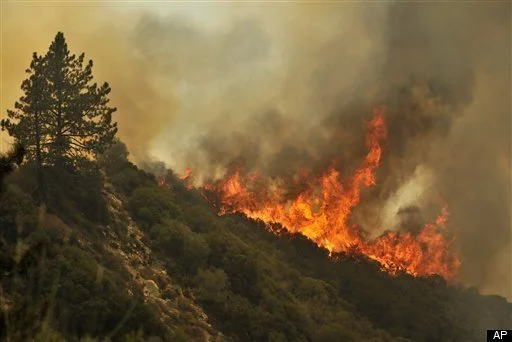
As of Sunday, the Station Fire north of Los Angeles had caused two deaths, destroyed 76 homes, and scorched 157,000 acres of the Angeles National Forest, which is visited by millions of hikers, trail bikers, campers, picnickers, and skiers every year. It burned right through one of the most beautiful parts of the San Gabriel Mountains, which feature rugged terrain covered by elfin chaparral forests in lower elevations, sycamores and alders alongside streams, and majestic conifers in higher elevations. Coyotes, mountain lions, mule deer, bighorn sheep, raccoons, rattlesnakes, and scrub jays are among the local inhabitants. You are probably familiar with these mountains even if you've never been there; the views along the Angeles Crest Highway are used in countless movies and commercials when wilderness scenery is required. The San Gabriels are sacred space to me; for decades, I hiked the trails that now wind along barren grey hillsides dotted with charred tree stumps. Sadly, I've seen this happen before: part of the burn area went up in flames in the smaller Sage Fire of 1979. And it will undoubtedly happen again and again.
The area ravaged by the Station Fire is mostly covered by chaparral, a name for the various dense, prickly shrubs and small trees that cover the San Gabriels and many other southern Californian hills and ranges, up to the point at which conifers take over. Manzanita, scrub oak, chamise, laurel sumac, ceanothus, and buckwheat are types of chaparral, which thrives in Southern California's Mediterranean climate of mild winters with moderate precipitation and hot, dry summers. As I wrote in a previous blog, "Chaparral adapted over the millennia before man's arrival to natural fires caused by lightning strikes. Most chaparral species can't reproduce without brushfires. They have hard seeds that will not germinate without fire; they lie dormant in the earth for decades until the next blaze comes along. Many chaparral species also sprout back from root crowns after a fire or other disturbance. 'Fire ecology' is the study of such interrelationships. Where there's chaparral, there are going to be wildfires." ("Global Warming Not Behind SoCal Fires").
Chaparral is dangerously flammable by the end of summer. Large wildfires can be driven by the strong Santa Ana winds that arrive in the fall and winter (the Station Fire was a huge blaze not propelled by big winds and would have been much worse if a Santa Ana event had occurred). In any event, chaparral is likely to burn, sooner or later. The question is: can we change our land-use patterns and fire-safety behavior to avoid tragic deaths and property loss during these wildfires, and reduce the millions of dollars spent fighting them?
There is a raging debate among specialists about whether "prescribed burning" to reduce the buildup of old chaparral (which theoretically makes for greater fuel) is effective in preventing giant wildfires like the Sage or Station blazes. A recent AP article, "Feds failed to clear brush in L.A. wildfire area," cited critics who felt that "protests by some environmentalists" had helped keep the Forest Service from completing important pre-emptive brush burning. In truth, there is a split between scientists about this practice, and it is sometimes called the "Minnich vs. Keeley" debate. UC Riverside geography professor Richard A. Minnich believes that controlled burns will eliminate the most dangerous patches of chaparral (older and denser) and create a mosaic of different-aged shrub, thus reducing the potential for catastrophic fires. U.S.G.S. ecologist Jon E. Keeley argues that wind is the main culprit in the big blazes that threaten communities, not "fuel load." In his view, the roaring Santa Ana winds, which can create walls of fire that push embers a mile ahead, will burn through anything, young or old. He says controlled burns only help with low-threat fires during moderate weather and are largely inefficient. In addition, they can be environmentally harmful; if prescribed burns are too frequent, they can outpace the ability of native species to recover. (I quoted Keeley about fire ecology here: "Chaparral and Global Warming Footnotes").
While there is controversy over the efficacy of controlled burns, many experts agree that better urban planning and fire-protection practices would help. Real-estate developments continue to push further into foothills covered with chaparral, putting those houses, and the lives of firefighters, at risk. And homeowners who live in foothill and mountain areas are not doing enough in terms of brush clearing, tree trimming, and other fire-safe practices.
Botanist Nancy E. Grulke emailed me that there are "more people, more people in close contact with wildlands, more people in close contact with wildlands without defensible space, more people to either start fires intentionally or accidentally, and fewer fires in near-recent history to reduce biomass in chaparral that is burning."
Grulke is an expert on the effects of air pollution on trees in the Sierra Nevada and San Bernardino Mountains. She has found that air pollution has significantly weakened conifers such as ponderosa pines and Jeffrey pines, making them more susceptible to drought and bark-beetle attacks, and less resistant to fire (see the abstract "Air Pollution Increases Forest Susceptibility to Wildfires: A Case Study in the San Bernardino Mountains in Southern California" by Grulke, Minnich et al). In other words, reducing smog in a big way will protect our forests, as well as our lungs.
The chaparral burned in the Station Fire will begin its renewal in the next winter rains, but it will take many years to replace the oak trees, big-cone spruce, incense cedars and ponderosa pines that were lost. I take heart in a sight I saw during my tour of the Sage Fire burn area in 1979, when a green hummingbird with a red throat alighted on the blackened branches of a manzanita shrub. It was the only color in a sea of blacks and whites and greys. The chaparral ecosystem will regenerate, but we need to find a better way to co-inhabit the foothills and mountains of California to avoid the loss of life and property that accompanies these big fires.