More

Featuring fresh takes and real-time analysis from HuffPost's signature lineup of contributors
Chris Mooney

Chris Mooney

Posted: October 27, 2010 07:02 AM

It's a staggering paradox, when you think about it.

We live in a country, the United States, that boasts the finest universities in the world. It's a country that invests far more in scientific research than any other nation -- the president's total 2011 budget request for research and development is $148.1 billion.

We're the globe's scientific leader, then -- but there's no telling how long it will last. We're allowing ourselves to fall behind other countries in science education and clean energy innovation, and behind what the times require in medical research. Meanwhile, the U.S. public barely seems aware of what's wrong, what's being missed, why science matters to their lives.

The Tea Party is the latest incarnation of Americans' scientific cluelessness. It has impelled a field of congressional candidates who overwhelmingly deny one of the most central conclusions of modern earth science: Human beings are driving a dramatic change in global climate that will unleash increasingly severe consequences in our lifetimes and well beyond.

But this latest politico-scientific transgression emerges against a broader backdrop of American scientific disengagement. We've all heard the statistics about how large percentages of our fellow citizens don't know how long it takes for the Earth to revolve around the sun, or reject the scientifically established theory of evolution. But I'm more disturbed by polling figures on the public's general distance from the scientific world. Figures like these:

  • Only 18 percent know a scientist personally. For most, the first thing that probably comes to mind when they think "scientist" is a Hollywood stereotype -- or the local TV weatherman.
  • 44 percent cannot even name a scientific role model. And among those that do give a name, their top three choices -- Bill Gates, Al Gore, and Albert Einstein -- are either not scientists, or not alive.
  • Information about science is vanishing from the national news media. According to 2008 figures from the Project for Excellence in Journalism, if you watch 5 hours of cable news, you can expect to see about a minute devoted to science and technology coverage. And no wonder: Only 13 percent of Americans now say they follow science and technology news "very closely," and that number has been dropping in recent years. The media is giving the people what they want.
  • Perhaps most disturbing: Far fewer Americans today describe scientific innovations as among the country's top achievements -- 27 percent in 2009 versus 47 percent a decade earlier. The same goes for space exploration and the moon landing -- far fewer rank it as our greatest overall achievement.


These kinds of statistics have consequences. Take clean energy, the industry of the future. Globally, the clean energy economy is booming -- and China is now its clear leader. The U.S. fell into a distant second place last year in clean energy investment and finance, as China spent $ 34.6 billion to our $18.6 billion.

A similar story emerges in the biomedical arena, where our research investments haven't kept pace with national health priorities. For instance, Alzheimer's disease is now the seventh leading cause of death in the US, and accounts for 34 percent of total Medicare spending. Yet in terms of research, it's a stepchild: Funding through the National Institutes of Health is currently less than $ 500 million per year.
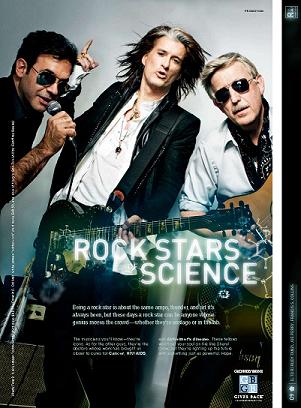
2010-10-27-RockStarsofScienceSpreadfinal_Page_1.jpgHow do you make Americans more focused on the centrality of science to our future? It isn't easy given the nature of our national conversation -- with serious science news vanishing from the media -- and our already limited attention constantly directed elsewhere, including debating whether to elect global warming denying candidates to Congress this November 2.

One initiative I've begun working with to help counteract this trend is the Geoffrey Beene Gives Back® Rock Stars of Science ™ campaign (100 percent of net profits from this designer menswear brand funds cancer research and other causes). The idea is to pair together researchers with top musicians -- e.g., Joe Perry meets NIH director Francis Collins, who actually happens to be a guitar player, pictured at right -- to raise the visibility of the scientific life and endeavor, and to call for a greater commitment to finding cures to the most devastating diseases. The first installment appeared as a public service ad in GQ last summer, and the next one hits just after the election, in GQ's December "Men of the Year" issue.

The point to emphasize here is that our scientists are heroes, not geeks. They're the last caste of explorers, and represent the very epitome of passion for a career. They don't do what they do for personal enrichment, but rather, because they get a crack at solving the greatest remaining mysteries. Their lives are adventure stories.

We need to mobilize American kids to want to be scientists; and American adults to see how science -- and the policies tied to it -- affect to their lives and our future. Science has to stop being something those strange other people do; it has to be something we all live and breathe.

In this context, if a group of rock stars can cast some refracted light -- if that's what it takes -- then so much the better. We'll all benefit in ways each of us can understand -- in health, jobs, prosperity and quality of life. And, oh yeah: We'll understand ourselves, and the universe, a little bit better.

Now that would really rock.


Follow Chris Mooney on Twitter: www.twitter.com/ChrisMooney_


  • Comments
  • 61
  • Pending Comments
  • 0
  • View FAQ
Comments are closed for this entry
View All
Favorites
Recency  | 
Popularity
Page: 1 2 3  Next ›  Last »  (3 total)
05:02 PM on 10/30/2010
I didn't read all the comments, but even if it's been suggested earlier, it can't hurt to repeat -- HuffPo needs a science section! Science is not the same thing as tech.
photo
HUFFPOST SUPER USER
station agent
06:47 PM on 10/31/2010
Seconded...
02:39 PM on 10/28/2010
I've got IT !!!
02:23 PM on 10/28/2010
The sense I get from casual observation is that K-12 science education in the US is primarily an effort to equip students with a kit of scientific facts and that “science literacy” is often measured by asking “quiz show” type questions related to science. There is little to demonstrate the relevance of this “kit” to people’s everyday lives. I would prefer to see more focus on how the scientific process really works and why it is worthy of confidence. Aristotle reasoned that the more an object weighs, the faster it should fall. Galileo measured this and found it to be otherwise. You could measure this yourself, or check out the measurements undertaken by others. The results are consistent. Surely the authority of properly conducted experiments trumps the Aristotelian “think” method.

Those who for a variety of reasons would like you to ignore reality spread the message that practitioners of science inhabit an irrelevant self-important club, if not engaged in a subversively anti-American effort. Yet this "club" produces so much that is demonstrably sound, and ignoring reality so often leads to unpleasant consequences. Scientists are worthy of respect for the care with which they conduct their craft, and many benefits that can be shown to have resulted from this, but it is actually the authority of experiment and of very careful observation that makes their activities relevant. You don’t need to wear a white coat to appreciate the value of evidence.
02:10 PM on 10/28/2010
"Science Rocks" - If you actually wanted anyone to read and comment about this blog entry(besides "nerds"), you wouldn't have used this in the title! Non-scientists will NEVER buy it!

Scientists have to start making headlines (political and controversial ones) - BIG ONES - if they want to start getting some attention and respect. People just don't pay attention anymore if it's not LOUD. Just look at how much attention was paid to the Juan Williams, "non-story", and the totally absurd claim - actually given time on all the media outlets - of a "time traveler" in an old Charlie Chaplin film (so where were the cell towers? - anybody care?). Compare this kind of coverage to any of the major scientific breakthroughs that have been made over the last decade... Zzzzz.

Maybe what we need (or at least the majority of ignorant and uneducated Americans) is a "science tabloid", full of claims of scientists doing "secret experiments", or having secret lives full of sex and drugs!!! Yeah... that's the ticket! Any volunteers?
08:40 PM on 10/27/2010
Interesting. Later as I was checking twitter (which for me is all comedians) I thought it would be cool to have a twitter stream of just interesting scientists. I tried to find this blog entry by looking at the categories above and noticed there is no science category. But there is a NY, LA, Chicago, Food, and Fashion category. Ironic.
HUFFPOST SUPER USER
William50
06:36 PM on 10/27/2010
It is true that other countries are producing more teck and scientists then America. One fact is because they have three to four students for every one we have, the second is very undemocratic, the government and schools go after these gifted students and help them.
Today, in America are the thinkers of tomorrow. But we spend more on criminals each year then helping to make sure the students have the needed equipment and teachers they need.
The American party understands the failure of the public school system, but also understands a change in the drug laws would free thousands of individuals and allow more money into schools. This money, now spent housing, legal and court systems, a small part, channeled into schools and into students homes plus haveing access to the best best teachers in the land at an early age will change the future.
I would never be one of these few. But I do know that if we allow them to access the knowledge of the best minds at a young age they will reshape your and my future.
05:36 PM on 10/27/2010
Unfortunately, what modern science needs in America is fewer Einsteins and maybe a few more "Rambos". Sad to say, but the only way that Americans will come to respect and pay attention to scientists (and what they do for a living), is when they start getting rewarded with Wall-Street/Brain-Surgeon scale salaries and have recruiters scouting them around the world (as happens with sports stars). Getting more movies made, featuring scientists as the heros (not just bumbling nerds), wouldn't hurt either.

Scientists themselves, also, share part of the blame for not getting their share of respect, though. They have to do a much better job of growing a pair when it comes to advocating for scientific policies that could have political consequences and pushback (such as stem-cells, global warming, space exploration). Scientists need to become much more assertive and much less passive than they are currently percieved to be, which also adds to people having less respect for them. It also wouldn't hurt if they had a really strong international union and some strong lobbyists.

In summary, there won't be any quick or "cute" solutions to this problem of scientists not being respected in America - they're just going to have to start kicking some ignorant butt for a change and start demanding serious money for providing serious solutions to difficult problems.
photo
HUFFPOST SUPER USER
OldHick
05:01 PM on 10/27/2010
Science has ended - too many socialists.

How's about making a better phone - like the one I had with Bell AT&T?
photo
intotheabyss
Imperialism is a form of insanity.
04:42 PM on 10/27/2010
Our corporate masters don't want us to learn science. It's none of our business like how to run the country is none of our business. Ignorance is good for the plutocrats.
photo
HUFFPOST SUPER USER
Overtone
See bio on the Aesop Institute website
04:41 PM on 10/27/2010
An unrecognized national security issue can bring science back in surprising ways that will benefit everyone!

Imagine New York, Washington, D.C., Boston, Chicago, Seattle and most of the Eastern U.S. without power for a period of several weeks or months. Cities around the world could suffer the same fate.

Recently, a new 11 year sunspot cycle began. So far, two solar threat events missed earth. NASA suggests, if either had hit earth's geomagnetic field, 130 million Americans might lose power for many weeks. The cost the first year might equal that of both current wars!

See: http://www­­­­­­­­­­­­­­­­­­­­­­­­­­.­­a­­e­­­s­­­o­­­­p­­­­i­­­­­n­­­­­s­­­­­­t­­­­­­i­­t­­­­u­­t­­­­­e­­.­­­­­­o­­r­­­­­­­g

The steps necessary to rapidly reduce dependence on power grids can accelerate development of little known, slowly emerging, potentially extremely inexpensive, green systems.

This remarkable new science will accelerate the development of cheap green power.

It provides a strategy that can supersede the fruitless debate over climate change.

And effectively fight Global Warming, boost the economy, generate lots of jobs and reduce dependency on fossil fuels and unstable areas of the globe.

The Aesop website outlines presently hard-to-believe, very low-cost, alternatives that are expected to power homes, businesses, automobiles and trucks.

Future vehicles might become power plants when suitably parked. No wires needed. They will become alternatives to coal and nuclear plants. Even better, they could pay for themselves!

Imagine what could be accomplished once exciting new science and technology opens cost-competitive paths that prevent the little recognized threat of massive power failures!
photo
HUFFPOST PUNDIT
StopThePlanet
Relentless pursuit of every silver lining's cloud
04:01 PM on 10/27/2010
There is a simple reason why this nation is in decline. You can't manipulate people who deal in facts. That is why our leaders want us to be driven by belief.
03:55 PM on 10/27/2010
I am a high school math teacher, with a focus on statistics education. This past year, 2 of my students were national champions in a poster contest sponsored by the American Statistical Association. I am appreciative that professional organizations have created programs which allow students an opportunity to demonstrate their talents; programs which encourage hard work and serious scientific study.

At the same time, I was dismayed that no newspapers in my area saw fit to publicize this great news. In the 8 years I have been working with math students as a team coach and organizer of an annual stat fair, I have sent out many press releases attempting to highlight the scientific achievements of my students, with no response. It's always been true that the public cares more about the football team or the marching band than science, but trying to encourage students to pursue serious scientific endeavors becomes difficult when it's perceived that the work is unimportant, or too quirky, to their peers and the public..

Let's start to highlight the positive achievements of our young scientists consistently, and a new generation of explorers will develop naturally.
HUFFPOST SUPER USER
BabsBP
My micro-bio is empty, and I like it that way.
04:22 PM on 10/27/2010
Keep up the great work. Send out multiple press releases, make sure to include quotes from students, and follow up with phone calls to the press. Good reporters are now as over worked as teachers are.

Maybe your students could also create a blog of their work and awards -- then you could let the press know how to track their work.
05:46 PM on 10/27/2010
Step 1 (you probably have already done this): Get. Parents. Involved.

Let them be the cheerleaders - both within the competitions *and* within the school district and community. Reach out to team parents and there's a decent chance you'll find someone who knows someone in the media. Reach out to local politicians - maybe you'll stumble on one who will help your students get some visibility.


Step 2 (I *know* you're already doing this): Regardless of the results of step 1, keep working with the kids. Who knows - maybe one of them will someday be in a position to really spotlight academic achievments of students and the seeds you plant now will be the thing that nudges them into pointing that spotlight into the right place.

Step 3: Reach out to the leaders of the football team and band. Work toward having them see you as a peer and not a subordinate. Once the leaders are seen treating you and your students as equals, the members of the football team and band will generally follow. (This approach has started to make things better for the robotics team I coach. Some football players have already stuck up for our team members when other football players were mocking them.)

And FWIW: When I look back at my education, the two teachers that really had the most impact on me were both HS math teachers.

Your job is important!
03:55 PM on 10/27/2010
How do you feel about Obama's push to divert NIH and NSF funding AWAY from scholarly research INTO Community Based Participatory Research (CBPR)?

After all the indignation we heard from Obama on the campaign trail about Republicans meddling with Science, he is now working to change the very nature of scientific inquiry.

Instead of focusing on how scientifically sound a proposal is, there will be a new focus on how it benefits the community around your institution, with a major focus on "under-served" communities, and "social justice".

That isn't even science, in my opinion. It's an attempt to turn the NIH and NSF funding apparatus that has served us so well into a vehicle for social change.

Obama telling the new NASA chief that his primary responsibility is to build relationships with the Mus1im world is another example of the subversive redirection of science into a vehicle for social change.

Obama should be ashamed of these efforts, and should stop meddling with Science and scientists.
photo
usna73
We are all in this together
03:19 PM on 10/27/2010
As a young boy I remember being implored by JFK. WE were going to put a man on the moon via the science of NASA. WE choose to do things because they are "hard" rather than "easy."

We were poor, but dreams didn't cost us anything, nor the imperative to do great things via science.

Keep going Chris. Keep the imperative alive.
02:57 PM on 10/27/2010
While I agree that basic scientific ignorance has become a serious problem for our culture and our economic future, we should remember that much of our scientific and economic progress was driven by military and weapons development and large budgets for military R&D. Scientists and engineers were needed for national defense preparations and weapons development. The manned space program - while inspiring in many ways - was also a product of Sputnik and the need for better ICBMs and targeting electronics. Now that our military hegemony is threatened by fiscal ruin and the economy is dominated by financial interests, we can expect even less innovation from government funding of research.

And private investment in basic research? No way! They can't even get loans to drill for oil or repair our wobbly infrastructure, let alone fund basic research. No immediate profits for the financial boiler room boyz, so fagettaboutit.

The other problem is that I suspect the Ruling Classes do not want an educated population, and the progressive deterioration of education since the 1970s is evidence of this desire becoming reality. They want uneducated and unskilled serfs who will eventually compete with the cheapest of foreign labor.

Oh, and you might try getting a rock star under 30 to glamorize scientists. I love Aerosmith, but c'mon, they are GEEZERS, dude!