
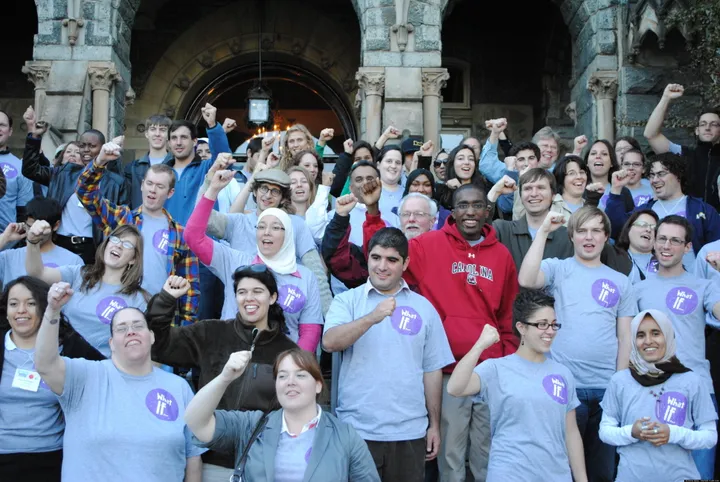
Atheists are leading the charge for interfaith cooperation. If that sounds contradictory, allow me to confirm: I just saw it with my own eyes.
Last weekend, more than 200 college students and 100 faculty and staff from across the United States converged in Washington, D.C. for five days of interfaith training. Students and campus staff participated in two consecutive Interfaith Leadership Institutes, planned and run by the Interfaith Youth Core (IFYC), where they received intensive training that prepared them to take the lead in a national movement for interfaith cooperation and social action.
The Interfaith Leadership Institutes, co-hosted by the Georgetown University Berkley Center for Religion, Peace, and World Affairs, consisted of a series of trainings, speeches and events intended to equip hundreds of student leaders and campus allies with the vision, knowledge and skills necessary to lead interfaith and community service initiatives on their campuses. The White House Office of Faith-Based and Neighborhood Partnerships hosted a session for each institute, and then participants spent two days at Georgetown being trained and equipped.
I was honored to join these students and their staff and faculty allies as a speaker and volunteer IFYC Alumni Coach for the institutes. I was amazed by the enthusiasm and compassion modeled by everyone I met, but as a secular humanist and interfaith activist, the number of nonreligious participants present is perhaps what excited me the most.
Lyz Liddell, Director of Campus Organizing at the Secular Student Alliance, was one of the student allies in attendance. Liddell believes the institutes were a watershed moment for nonreligious participation in the interfaith movement.
"This institute changed perspectives for both theists and nontheists," said Liddell. "Hearing repeated language specifically including nonbelievers -- such as 'people of all religions and no religion' -- made it clear that atheists and other secular worldviews are welcome and needed at the interfaith table. Likewise, having nontheists represented helped religious attendees really understand that nontheists want to be involved and are willing and eager to be included."
As an Alumni Coach, I am working with 20 other IFYC alumni to serve as mentors to the institutes' budding student leaders. One of the students I am mentoring is Michael Anderson, a junior at McKendree University. Anderson sees interfaith work as a pragmatic necessity. "We're all just human beings, and we have to come to a conclusion on how to live together," said Anderson.
Vlad Chituc, a junior at Yale University, was also there to learn more about interfaith leadership. Chituc was surprised and impressed by how welcoming the institute was to atheists and other nonreligious individuals. "I found that the entire conversation stemmed around people saying, 'We really want to include nonreligious people; how the hell do we do that?' Now I don't know why I was expecting the discussion to focus more on whether or not we should even be involved in the movement," Chituc said.
Chelsea Link, a junior at Harvard University, said that she believes that her humanist values require her to find common ground with religious people. "When I found humanism, I felt like many humanists and atheists were detached from religious communities, and many were antagonistic toward the religious," Link said. "Meanwhile, at interfaith events, I didn't see much of an invitation for atheists or humanists. The religious and nonreligious don't know how to deal with each other; I'd like to see more reaching out from both sides. We shouldn't be afraid of each other!"
Adam Garner, a senior at the University of Illinois at Urbana-Champaign, agreed with her. "I want to make the world a better place through service and I want to fight religious intolerance. The IFYC, and especially our Interfaith in Action group here on campus, allows me to accomplish both goals in one fell swoop."
I have been working for several years now as a secular humanist promoting interfaith and nonreligious understanding, so I was honored to receive an invitation to share my story and my message at a reception following the White House session, hosted by the El-Hibri Charitable Foundation in celebration of the launch of the Interfaith Leadership Institutes. Speaking before a group of policy and philanthropic professionals, I explained that there are many atheists, agnostics, humanists and other nonreligious individuals like Anderson, Chituc, Link, Garner, Liddell and others at the institutes who wish to seek understanding, respect and collaboration with their religious neighbors.
After my speech, I got the opportunity to talk with many of the policy and philanthropic professionals at the reception, and they affirmed my belief that the nonreligious are an essential asset in this movement. President Obama has spoken frequently of the role that the nonreligious play in American pluralism, so I was both pleased and unsurprised to hear that those involved in the current administration's efforts to ensure interfaith cooperation agreed.
The IFYC Interfaith Leadership Institutes proved that the interfaith movement has hit a critical mass. The student-led, national Better Together" campaign is at the forefront of an emerging societal shift toward inter-religious tolerance and cooperation. Including the nonreligious only strengthens these efforts. Atheists, agnostics, secular humanists and the like have a vital stake in ensuring that America's promise of pluralism is realized, and it is exhilarating to see more of us decide that collaboration is more important than division.
"Some of the best interfaith leaders I know are not people of faith, but their understanding of secular humanism inspires them to create bridges of cooperation between people from different backgrounds," said IFYC Founder and President Eboo Patel. "They recognize that religious tolerance is a 'public good,' which benefits everybody, including the nonreligious. They also recognize that perhaps the greatest interfaith divide in our society is between 'believers' and 'nonbelievers,' and that they have a special role to play in bridging that divide. And from what I have experienced myself, I believe that as well."
With more than 300 students and staff equipped to make interfaith cooperation through social action a reality on their campuses and in their communities, they now know that the nonreligious will be there working and engaging in dialogue alongside them for the public good.
When I first started doing interfaith work, I didn't see many other nonreligious people involved. Now we're impossible to miss.