
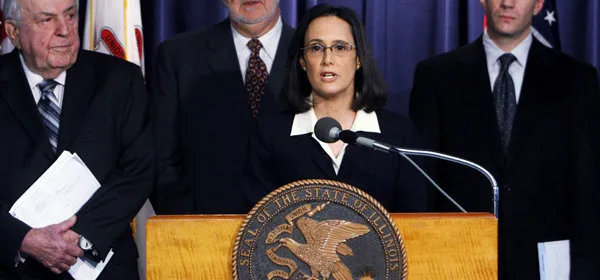
The Illinois Supreme Court has just, without comment, rejected what was in essence a coup attempt by the state Attorney General, which would have installed the Lieutenant Governor in Governor Blagojevich's place. Attorney General Lisa Madigan's legal reasoning was, to put it mildly, unique. She tried to make the case that the Governor was "unfit for duty" and therefore had to be replaced so the state could continue to function. The entire episode raises a bigger question: could this ever happen to the President of the United States? The answer turns out to be: "Yes, but... it'll probably never happen."
But before we get to speculation about future constitutional crises, let's first look at what happened in Illinois. Madigan, in her role as Illinois Attorney General, attempted to get the state's Supreme Court to approve removing Blagojevich from office. Her legal reasoning was based on a slightly-vague clause in the state's constitution which was clearly meant to be applied for medical reasons. If the governor falls into a coma, for instance, it allows the Lieutenant Governor to become the Acting Governor so the state has an executive officer at all times. The clause could also be used if the governor had gone obviously insane, to remove him from power because he is dangerous to the future of the state. The case would be hard to make politically, unless the governor had blatantly gone bonkers, but legally it could be successfully made if the need ever arose.
But Madigan tried to argue something for which the clause was never intended -- that the governor was politically a liability for the state and to protect the state's future he should be declared "unfit for command." This reasoning works in military law, but Madigan appears to be the first to attempt it in civil government. For example, on a warship you would think that the Captain is the most powerful officer on board. Everyone has to follow his or her (legal) orders. Except for one person -- the ship's doctor. The highest medical officer on board has the obligation and duty to declare the Captain medically unfit for command, and the Captain cannot order him to do otherwise. If the doc gives the captain a "downcheck," then the next-most-senior officer assumes command until the Captain gets medically approved for duty. And the downcheck can happen for any viable medical reason -- including mental health. Even in pop culture, sometimes "Bones" McCoy would tell Captain Kirk he wasn't fit to command, and Kirk just had to lie back and deal with the fact.
But the state of Illinois is not a warship. Or the starship Enterprise, for that matter. And unless the governor is obviously and verifiably medically unfit to serve (being in a coma, for instance, or otherwise unconscious) removing a governor will always have political implications to it. Which is why impeachment is the only true option. Which Illinois is already beginning, meaning that Blagojevich may be gone from office -- just a little later than Lisa Madigan would prefer.
But what about the sitting U.S. President? Could such a thing ever happen on the federal level? To answer this question, we turn to the Twenty-Fifth Amendment, enacted during the Cold War when the prospect of nuclear annihilation was first considered, and the question of succession got a lot more important. Section 3 of the amendment covers what is supposed to happen when the President is temporarily unable to serve -- by being operated on, for instance, and under general anesthesia. The President is supposed to sign a letter and give it to both the Senate President Pro-Tempore and the Speaker of the House stating he will temporarily be unable to serve. The Vice President takes over as Acting President, and then when the President is able to serve again, he sends another letter saying so, and everything goes back to how it was before the temporary disability.
The only time when this would have been useful, it didn't happen. Because the President had been shot, and had no time to sign letters before being operated on to save his life. When Ronald Reagan was shot, this led to the following comical assertion by Secretary of State Alexander Haig:
Constitutionally, gentlemen, you have the President, the Vice President and the Secretary of State in that order, and should the President decide he wants to transfer the helm to the Vice President, he will do so. He has not done that. As of now, I am in control here, in the White House, pending return of the Vice President and in close touch with him. If something came up, I would check with him, of course.
This, of course, was absolute bunkum. Haig has been ridiculed ever since for saying this, which is often misquoted as: "I'm in charge here." In fact, during Reagan's time under the knife, technically nobody was in charge. We don't like to admit that, but it is true. The Vice President has absolutely no power whatsoever until that letter is signed. Anyone who follows any orders the veep gives at such a time is following an illegal order. It would be the duty of the entire military and the rest of the government to refuse to follow any such orders. The only other time I can remember where the boundaries of the Twenty-Fifth Amendment were bent (if not broken) was on the morning of 9/11. The question of what Cheney ordered, and whether Bush approved any of it before the fact has never been adequately investigated, as far as I am concerned.
But we're getting lost in the wrong section of the amendment. Because the next section clearly lays out the legal process for a coup of the President of the United States. It doesn't use the word "coup," but the end result would be the same. Here is Section 4 in full:
Whenever the Vice President and a majority of either the principal officers of the executive departments or of such other body as Congress may by law provide, transmit to the President pro tempore of the Senate and the Speaker of the House of Representatives their written declaration that the President is unable to discharge the powers and duties of his office, the Vice President shall immediately assume the powers and duties of the office as Acting President.
Thereafter, when the President transmits to the President pro tempore of the Senate and the Speaker of the House of Representatives his written declaration that no inability exists, he shall resume the powers and duties of his office unless the Vice President and a majority of either the principal officers of the executive department or of such other body as Congress may by law provide, transmit within four days to the President pro tempore of the Senate and the Speaker of the House of Representatives their written declaration that the President is unable to discharge the powers and duties of his office. Thereupon Congress shall decide the issue, assembling within forty-eight hours for that purpose if not in session. If the Congress, within twenty-one days after receipt of the latter written declaration, or, if Congress is not in session, within twenty-one days after Congress is required to assemble, determines by two-thirds vote of both Houses that the President is unable to discharge the powers and duties of his office, the Vice President shall continue to discharge the same as Acting President; otherwise, the President shall resume the powers and duties of his office.
So, if just over half the Cabinet voted to depose an unpopular President, and they got two-thirds of Congress to back them up, they could install the Vice President instead.
But it's nothing to get very worried about. This is why the answer to the question of whether the President could ever be deposed in such a fashion is: "Yes, but... it'll probably never happen." Because the amendment actually sets the bar higher for doing so than impeachment itself.
Impeachment begins in the House, and Articles of Impeachment must be voted out of committee and voted on by the entire House. The Senate then conducts the trial, and a two-thirds majority is required (remember the Clinton years?) to remove the President from office. But this is actually easier than what is described above, for two reasons. First, impeachment doesn't involve the Cabinet at all. And second, the House vote required for impeachment is only a majority vote, instead of two-thirds.
So if any president were in the same position Blagojevich now finds himself in -- politically radioactive, but still clinging to power -- then impeachment would be the best and easiest way to remove him or her from office. As will now happen in the state of Illinois. This is for the best, even if it may take a little longer to happen.
[Note: If you'd like to learn more what could happen next in Illinois, Greg Harris has written an excellent article which details all the possible outcomes. Harris is a member of the Illinois legislature. His article was published before the news from the Supreme Court broke today.]
Chris Weigant blogs at: ChrisWeigant.com