
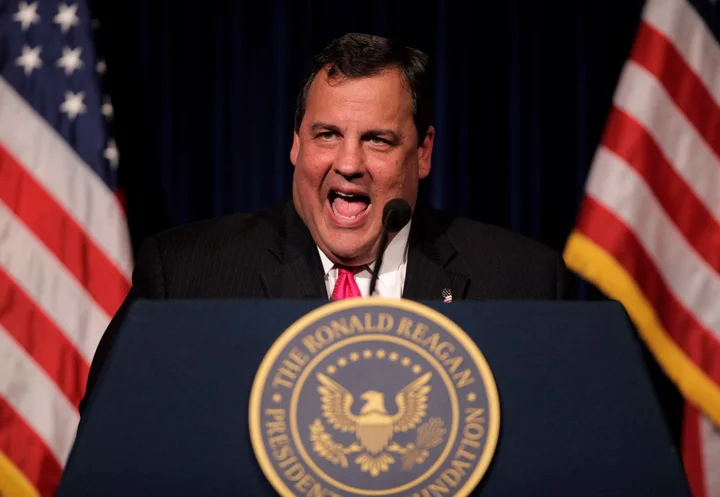
I know I'm supposed to be writing a breathless article about whether New Jersey Governor Chris Christie is thinking about jumping in the Republican presidential primary today, but since so many other fine commentators are addressing this burning issue, I thought I'd skip it. The man keeps saying "No," and the media keep hearing "Maybe," so I'm just going to leave it at that for now.
Instead I'd like to talk about the back-room struggling within the Republican Party this week which is a lot more interesting and will likely be a lot more germane to the race -- the question of who goes first (or, more to the point, who goes fifth) in the Republican primary calendar.
The Republican National Committee has valiantly tried to lay down the law for the Republican primary season. Their plan will (one way or another) be somewhat of a radical change for the party. The RNC envisions a three-phase schedule -- early states, a free-for-all, and then wrapping things up in dignified fashion.
The first phase will consist of the "traditional" first-voting states. This used to just be Iowa (first caucus) and New Hampshire (first primary), but has expanded to include South Carolina and Nevada in recent times. This was a change for the better, since it allows the voices of a state in the South and a state in the West, both of which have very different demographics from Iowa and New Hampshire. The RNC's plan gives these four states the months of January and February to vote in, without the distraction of other states muscling their way in.
The first two phases are actually where the radical change will happen. For both the first-voting states and any states which wish to hold primaries or caucuses in March, the selection of delegates to the national convention will be on some form of proportional apportionment, rather than the traditional Republican "winner takes all" scheme. This is borrowing a page from the Democrats, it bears noting. The new RNC requirement for proportionality is rather vague, and leaves it up to each state to determine how to dole out the delegates (based on voting in the whole state, or district by district, for instance). But it will certainly shake up the contest from the way Republicans have nominated their candidates in the past. Previously, the Republican field has been narrowed very quickly, due to the winner-take-all nature of piling up delegates. John McCain essentially had a lock on the Republican nomination by the beginning of March four years ago, while Hillary Clinton didn't concede the race until July on the Democratic side. Republicans watched the Clinton/Obama race take over the headlines for months, while news about McCain dropped off the public's radar. This time around, they're planning for a more drawn-out contest, which could both make for a more exciting race and give whoever emerges as the nominee a lot more seasoning for the general election campaign. That's the thinking, at any rate.
But, being conservative in nature, the Republican Party doesn't want to let things remain undecided for too long, so the third phase of their plan will revert to the old winner-take-all rules. Any state which schedules its primary for April or later will award its delegates as a bloc, in other words. Even if the primary race goes on this long, one candidate or the other should be able to wrap it up without drawing the whole thing out until midsummer, as Hillary and Barack did last time around.
That's the master plan. On paper, at any rate. Four states get two months to schedule their votes, and then a period of voting happens which allows proportional apportionment of delegates, and then things wrap up with the traditional winner-take-all system. The problem is, the Republican National Committee cannot really literally "lay down the law." They are not in charge of any statehouse, they are a national political party. The politicians in each state are actually in charge of setting their state's schedule, and they are under no legal compulsion to follow the RNC's rules.
This has already led to intense jockeying for position among states which want to vote earlier than the RNC proposes. Florida, Michigan, Colorado, Missouri, Georgia, and Arizona have been making noises about jumping to the front of the line -- or, more accurately, jumping to fifth place in line. The RNC has leverage to make sure this does not happen, but it may turn out to be an empty bluff. Any state which holds their primary or caucus before March 6 (this year's "Super Tuesday") will be penalized at the national convention to the tune of half their delegates. The RNC may not make any laws, but it is the entity which runs the convention. Meaning it can set whatever rules it wishes for seating delegates.
The states may decide to call the RNC's bluff, though. States which vote earlier than allowed will challenge the RNC to seat all their delegates, or else face a backlash among the party's voters in that state. This played out on the Democratic side last time around, with Florida and Michigan jumping the gun -- which led to a huge and ugly fight among the Clinton supporters and Obama supporters when it came time to set the convention rules. If the margin of victory is close enough that the denied half of any state's delegates could swing the race, this could become a monumental headache for the party later on -- which is exactly what states like Florida are counting on (Florida is reportedly now even considering announcing their primary date as early as January, although this could be a bluff on their part).
This is a wonky subject, to be sure. The reason it is important now is that the states have until this Saturday to report to the RNC what their primary or caucus dates will be. So look for a lot of backroom dealing in the next few days.
Florida seems the most inclined not to back down, at this point. Florida has a strong case to make for being fifth (at least, as far as Florida Republicans are concerned). Florida's demographics are closer to the national makeup than any of the first four states, and they have a lot of very committed voters. In other words, Florida would like to be the true bellwether state in the race. In the primaries, Florida could be the tiebreaker between Perry and Romney, if they split the first four states (a scenario which seems more and more likely as time goes on). Plus, in the general election, Florida may indeed be the swing state that decides the presidential race. With a whopping number of Electoral College votes, it could be the center battleground in the 2012 race -- much more so that any of the other states vying for fifth place (again, in Floridian eyes).
This is their gamble. They are defying the RNC to cut their convention delegates in half, in essence saying: "You wouldn't dare do so, because you don't want to risk annoying Florida Republicans in the general election, where they could be crucial to defeating Barack Obama."
This shoving match for fifth place in the line is becoming all but inevitable, in every presidential election cycle (in both parties, to be fair). Until someone comes up with a truly national scheme to set primary calendars -- one that is adopted by all states -- it looks like we're going to have this high-stakes bluffing match every single time. While this weekend's deadline is also an artificial construct of the RNC (meaning the argument could go on a long time after this Saturday), it's going to be an interesting end to the week for election-watchers.
More interesting than hearing Chris Christie say "No" in yet another amusing way, at the very least.
Chris Weigant blogs at:
Follow Chris on Twitter: @ChrisWeigant
Become a fan of Chris on The Huffington Post