Rich Nations Boycott UN Economic SummitG20 Leaders to Global South: "Stimulate This!"
This blog is written by my colleague economic development policy advisor James B. Quilligan. who has just emerged from the UN Economic Summit, and feels like the core messages vital to global economic transition are not being communicated in the popular media. HuffPo being ever a unsparing communication vessel seems an appropriate vehicle, so I offered my blog space as an opportunity for an op-ed.
This article will be followed by an interview and Q&A with the author, so leave comments with whatever questions you have. This is the beginning of a series where I will interview and feature colleagues whom I feel are doing crucial and under-reported global transition work.
Click HERE to read the Outcome Document from the UN Conference last week.
June 27, 2009 - United Nations
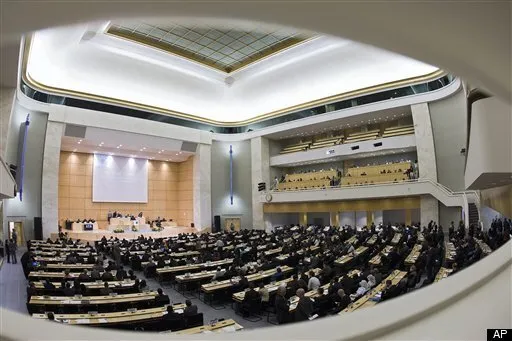
The centuries-old dream of representatives from every nation in the world assembling to discuss their common economic issues was realized -- or at least attempted -- at a United Nations summit last week in New York. Representatives from three-quarters of UN member states attended a Conference on the World Financial and Economic Crisis and its Impact on Development, where they discussed emergency and long-term measures to combat the worst global economic downturn since the Great Depression. It was the first high-level summit on international financial reform in history.
UN Secretary-General Ban Ki-moon opened the conference, noting that "the global economic crisis shows why we need a renewed multilateralism". Since recession has gripped many of the world's industrialized nations during the past year, nearly $18000 billion has been raised or pledged to prop up global banks, financial institutions and corporations. Yet global investment in anti-poverty programs and development has sharply declined. "Surely if the world can mobilize more than $18 trillion to keep the financial sector afloat," Ki-Moon observed, "it can find more than $18 billion to keep its commitments to Africa."
Although the financial crisis began in the developed nations, the world's poor and vulnerable populations have borne the heaviest burden of the global economic meltdown. Commodity prices have fallen, global exports have slumped, foreign direct investment has declined, domestic incomes have dropped, food and energy costs have risen, debt has mounted, credit has become more expensive and aid flows and remittances have flattened.
Financing for the UN Millennium Development Goals targeted for 2015 is also falling dramatically as capital flows from rich to poor nations continue to plunge. The World Bank predicted last week that private capital flows to poor nations will decrease from a high of $1.2 trillion in 2007 to less than $363 billion this year. At the same time, economic growth in developing nations is expected to fall from 8.3% GDP in 2007 to 1.6% in 2009. Without coordinated efforts by developed nations to help the world's poorest nations, 100 million people may fall into extreme poverty each year for the foreseeable future, with women and children suffering the brunt of food insecurity, decreasing access to health care and education and deteriorating social protection. The effects of climate change have also intensified as a result of the economic crisis.
The summit was conceived last November in Doha at a UN conference on financing for development. It was shaped with input from a group of former economic policy-makers, academics and private sector representatives chaired by former World Bank Chief Economist and Nobel Laureate Joseph Stiglitz. The summit's proposals include new measures for external financing, debt relief, increased aid, sovereign debt restructuring, a global reserve currency, and systemic reforms for creating sustainable development and restoring global economic growth.
The creation of a new international economic system is hardly a new idea. During the past half-century, many leaders and activists have called for a global emergency stimulus for poor nations to enable them to become equal trading partners with developed nations, thereby raising demand for goods and services, expanding global trade and investment and reducing world unemployment. Designing a broadly representative framework to address the deep systemic flaws in the international system and provide new financing for poor nations was a central topic of the Non-Aligned Movement and the Group of 77 (1960s); the campaign at the United Nations for a New International Economic Order (70s); the international development commissions of Willy Brandt and Julius Nyerere (80s); the Commission on Global Governance (90s); and the Monterrey Conference on Financing for Development (this decade). It is sometimes forgotten that the Group of Seven -- now called the G8 -- was created in 1975 for the express purpose of countermanding any proposals of this sort that would change the structure of the global economic system and give poor nations a voice in how global development funding is organized.
Those fault lines were evident in the negotiations leading up to last week's global summit. Developed nations wanted to focus on development issues that could be ameliorated through free market policy decisions and discretionary aid and loans by the G8, the G20, the IMF and World Bank, while developing nations preferred to examine the deeper causes of the global crisis in order to overhaul the international financial system. During the past year, as many of the G20 nations generated huge domestic stimulus packages to mitigate the effects of recession, their relief efforts for developing countries have stagnated. At the same time, the world's indebted nations lack the resources to create their own stimulus plans, not only because of the current financial and economic crises but also because of IMF conditionalities on loans.
While the Group of Twenty includes both the G8 nations as well as many former 'developing' countries -- such as China, India, Indonesia, South Korea, Brazil, Mexico, Saudi Arabia and Turkey -- the world's poorest nations are increasingly recognizing that these newly emergent industrial and oil powers no longer speak for them. The international press has also blurred the distinction between developing and emerging economies, making little mention that the G20 nations have become part of the global financial oligarchy in recent years, even though their views may not be fully in sync with the Western-based G8. With the onset of the global recession, the G20 has been anointed the new center of global economic decision-making by the International Monetary Fund, the World Bank, the World Trade Organization, the international press and the public in the world's wealthiest nations. Yet in spite of their recent promises to tackle the current economic crisis through effective global regulation, most G20 nations are still pursuing policies of financial and capital market liberalization, deregulation and trade protectionism.
The UN Economic and Social Council, which United Nations founders in 1945 envisioned as a leading determiner of international economic policy, has only been given authority over UN development policy. Meanwhile, the IMF and World Bank, which are technically United Nations institutions, have always made autonomous decisions based on input from the world's richest nations. Hence, during the post-war period, voting power and representation at the IMF and World Bank have been granted only to nations with the strongest economies, and developing nations are rarely given an opportunity to address their meetings or those of the G8 and G20.
Some analysts believe that the IMF and World Bank should be abolished, or at least marginalized, and that decisions on the management of the global economy should be transferred to the UN General Assembly -- the only universal body of sovereign states, the only body with global political legitimacy, and the only body with the capacity to analyze global financial crises and their impact on development. Last week's summit marked the first time that all UN member nations -- the G192 -- had been invited to offer a coordinated response on the world's financial and economic conditions.
But the historic significance of inclusive global decision-making is not appreciated by everyone. It's no secret that G20 nations are not interested in addressing the structural causes of poverty or their impact on development and human rights, and have worked behind the scenes to undermine the creation of a broad economic decision-making framework. At its last summit in April in London, the G20 declared that the UN's role was merely to "monitor the impact of the crisis on the poorest and most vulnerable", not to address the long-term restructuring of the international monetary and financial architecture to restore global economic stability.
Unsurprisingly, the planning process before the UN summit was contentious, including a whisper campaign of political pressure to dampen conference participation. As a consequence, only 10 presidents and prime ministers attended, mainly from small Caribbean nations. G20 leaders either boycotted the meeting altogether or sent low-level representatives. Of the 142 delegations present, nearly half were comprised of UN ambassadors. Nor did the G20 news media cover the event in much breadth, although numerous articles discrediting General Assembly President Miguel d'Escoto Brockmann as a former leftist Nicaraguan foreign minister were peppered throughout the Western press during the weeks leading up to the summit. Pundits expressed relief that D'Escoto's term as head of the General Assembly is slated to end in September, perhaps also ending the UN's quest for international economic coordination.
As the G8 meets in Italy next month and the G20 assembles in Pittsburgh this September, many issues remain unresolved. How long will these self-appointed clubs go on wielding the authority and legitimacy of an international free market agenda over the world's 6.7 billion people? Was the UN summit on the world economic crisis a wasted opportunity or a historic step toward global economic governance? Can the UN overcome its bureaucracy and inefficiency and establish a permanent working group to carry out a plan of action for transforming the world's financial architecture?
How these concerns will be addressed is uncertain. What is clear is that in shoring up the world's financial institutions through a short-term stimulus for private capital, banks and corporations, effectively ignoring the long-term stimulus of human and social development through the eradication of poverty, the G20 seems to be engineering another 'lost decade of development' for poor nations. The world's impoverished people will continue to suffer the results of a systemic global crisis they did not create but must pay for nonetheless. James Quilligan, Economic development policy advisor and writer for many international politicians and leaders, including Pierre Trudeau, François Mitterand, Jimmy Carter, Edward Heath, Olof Palme, Tony Blair, and His Royal Highness Prince El Hassan bin Talal and worked with the Brandt and Nyerere commissions in the 1980s. www.global-negotiations.org.