
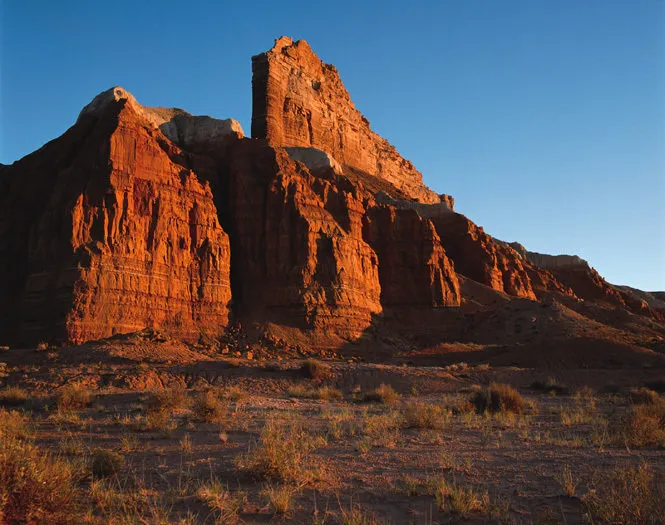
The Chapel of the Holy Cross rises from a 250-foot abutment in Sedona's ferric sandstone, a sort of redundant decoration in this part of Arizona where I-17 and the Red Rock Scenic Byway seem to follow God's own early steps across the Earth. Out here in the desert, among the great open tables of a vast, imposing communion, the idea of sacral man-made space registers in the viscerally absurd, feels essentially and obviously offensive. From the road, the innate need our species has to seek the holy seems corrupted by the building's hubris, its imperial theology, by the categories and catechisms that value the work of fervent human hands above the sublime, enduring witness of 300-million years. As my friend Jeremy and I park our rental car below the chapel's massive cross, so meager in this scheme of things, we confess our doubts.
We'd set out on a slow course from Phoenix after breakfast. As I-17 wended north and east through desert, brush, and forest, we marveled at the physical reality of everything we see in relation to the mountains we know so well back home in Pennsylvania, the trees that cover them, the interloping cities and still-interloping suburbs that never suggest this expanse of material, the planet's bones, an endless stretch of at-rest atoms testifying for the universe. At home there are no resources unturned; limestone and slate and iron-ore are subdued and spent, the mountains are worn-down by glaciers, time, and strip-mines. I know next to nothing about the natural or industrial history of Arizona, but from the highway I am happy to believe that the stones and dirt and desert floor lie just as they rose from dry seas and tectonics. From the highway, that so much matter rests within my sightline reassures me: reality is big, our theologies are small, we must go about sincerely rendered spiritual pursuits with a humility that mimics in its depth the vastness of creation. We have a truly cosmic space in which to seek and find the holy.
Our first views of the Chapel are from the distance after three hours of roadside spiritual formation. We decide before we ever see it that we'll have missed nothing if we don't. We snake through the Red Rock Scenic Byway towards the Chapel's foot fomenting reservations. Out of the car, where the rocks can hear us, we say we don't know why people do this and that then again we do. We ascend the looping road to the Chapel's entrance, hoping to recover the better reasons humans build religious things: from the need to offer, from the need to commemorate the places they encounter God. Still, the red rocks, the desert mountains and Arizona forests, the dirt and stone and binding heat aren't going anywhere; the massive dome we're under can't be soon forgotten. But we move toward the redundant space, moved perhaps by our investment in tradition, by a certain empathy for what William Faulkner's Mr. Compson calls "that aptitude and eagerness ... for complete mystical acceptance of immolated sticks and stones." In this temple of the open air, we move to see what, if anything, might move us in a church.
From the outside foyer-summit, the vistas are impressive, just as they are from any point for miles. Inside, the central cross doubles as the altar's focal point through the Chapel's glass facade. I am struck by the sanctuary's stark simplicity: the space is small, the stone walls are unadorned save two crafted rugs each depicting a nondescript apostle. The Stations of the Cross are Roman numerals formed from crucifixion-style nails (they look like railroad spikes); the altar's ornaments are modern lines and shapes, all unassuming. Though the chapel's founder, Marguerite Bruswig Staude, meant for its contemporary 1950s design to contextualize the liturgy of building in "a monument to faith...a spiritual fortress so charged with God, that it spurs man's spirit godward," I am struck by how underwhelming it is in its setting.
From outside, the Chapel of the Holy Cross is vain decoration, but in the sanctuary I am confronted by the futility that the simple space suggests. The immolated sticks and stones remain as meaningless as ever, but they enshrine in Sedona a natural counterpoint to the majesty that dwarfs them. The Chapel is an iconography of resignation, yes, but not of a surrender to despair. The spare walls and rough metal of the church confirm the higher teaching of geology: in the bare face of cosmic bigness, we might celebrate the room our smallness gives to seek. We might be moved by the fleeting crudeness of our best gifts to consider how deep and wide the holy, how ancient our environs, how vast and long the trek of matter into meaning. How blessed we are in smallness, how godward might we move.