The Week's Top Stories in Foreign Affairs:
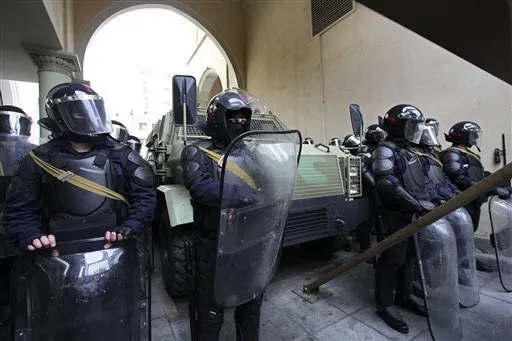
Turning East - Turning West: Brewing Revolutions and Breakaway ProvincesFacts: Up to 100,000 protesters have taken to the street of Tblisi hoping to unseat the government of Mikhail Saakashvili, in an unprecedented uniting of Georgia's opposition and student movements. Uprising is also suspected in the (potentially pro-Russian breakaway) provinces of Anjara and Samtskhe-Javakheti in the southern part of the country. Also, Moldova saw unprecedented riots this week after the Communist Party won what were apparently rigged elections, drawing a distinct line between the general populace and the breakaway pro-Russian province of Transnistria. Though nothing of note took place this week in Kiev, Russophile politicians have been duking it out with their Western-minded foes in Ukraine over the past few years, prompting many to regularly predict government collapse or a non-democratic leadership change there.SI Analysis: Are we seeing a backlash to the Orange and Rose Revolutions? And the founding of new revolutions elsewhere? Last summer's war between Russia and Georgia, exacerbated by the global financial crisis, has put Western leaning NATO candidates Georgia and Ukraine on the defensive with regards to their dissatisfied populaces. At the same time, certain groups in Moldova (and even Azerbaijan, where Baku is concerned about its breakaway province of Nagorno-Karabakh) are tiring of authoritarian rule and isolation and are turning their (traditionally Soviet-allied) sights westward, courting NATO members (Moldova's neighbor Romania is one of NATO's newest members). The role and influence of Russia and the West in these countries' domestic politics is on trial in Eastern Europe (though one should note that none of the opposition parties protesting in Georgia are specifically pro-Russian). But so is the authoritarian pseudo-democratic rule of the Western leaning leaders. Revolution may be too strong a word. But it is certain that both the governments and the people in Europe's eastern flank are trying to assess the new political realities of a re-emergent Russia, a conciliatory Germany and a consensus-minded US. What is apparent is the demographic and cultural disparity and the real division within these countries revealing their intrinsic tendency towards instability despite recent political reform. To be continued...
Turkey, the New Fulcrum of GeopoliticsFacts: US President Obama courted both the Turkish people and the Islamic world during his trip to Ankara early in the week. He also bolstered US ties with its new favorite Middle East ally by championing its EU candidacy, obtaining key positions for Ankara in NATO's leadership (after securing Denmark's prime minister, Anders Fogh Rasmussen, as the alliance's next secretary-general), reaching out to the Muslim world and even encouraging improved relations with Armenia.SI Analysis: Turkey matters. It matters politically as the US' closest 'Islamic ally.' It matters militarily as a member of NATO. It matters diplomatically as an arbiter between Syria and Israel, Syria and the US, Iran and the US, and between parties in Lebanon. It matters geostrategically as a potential alternative to Russian energy in Europe, possibly providing an alternative route for Central Asian gas to reach Europe. It matters geographically as a bridge between Central Asia, the Middle East and Europe (and as Iraq's northern neighbor). Turkey matters and US President Obama understands this.
Israeli-US Relations on the Fritz?Facts: In Turkey, US President Obama clearly stated that he was in support of a two state solution and even cited the Annapolis peace process as his framework for achieving it. He said, "Let me be clear: the United States strongly supports the goal of two states, Israel and Palestine, living side by side in peace and security... That is a goal that the parties agreed to in the road map and at Annapolis. That is a goal that I will actively pursue as president." However Israeli Foreign Minister Avigdor Lieberman clearly stated that the current peace efforts "held no validity". The peace process is not the only issue that Israel and the US do not see eye to eye on. They are also divided on how to deal with Iran. Thought leaders in Israel have expressed concern over the new US policy of engagement with Iran and some in both the US and Israel have suggested that Israel could launch a preemptive attack on Iran in response.SI Analysis: After bold statements from the new Israeli leadership, many speculate that US-Israeli relations are headed on a crash course to bitterness and a definitive rift. Many contend that pro-Israeli forces, who were instrumental in ousting the nomination of Chas Freeman as Chairman of the US National Intelligence Council, will make life difficult for President Obama... but said forces are not powerful enough to completely uproot Obama's new foreign policy to the Middle East. However hawkish and belligerent FM Lieberman may appear, it is PM Netanyahu who really holds the peace dossier. Netanyahu is a pragmatist and is familiar will the political realities facing Israel. He has said he will announce a peace policy soon and promised to work closely with the US on this issue. We expect more constructive engagement between the US and Israel to develop soon.
New US Defense PrioritiesFacts: US Secretary of Defense Robert Gates released his proposals for a new US Defense budget and received ire from both Democrats and Republicans. Essentially, Secretary Gates calls for:
- A recalibration of military resources -- in light of present realities and recent experience in both Iraq and Afghanistan -- to reflect its strategic imperative to fight insurgencies and terrorism in addition to traditional wars.
- An overhaul of Pentagon procurement, acquisition and contracting policies, expanding the Pentagon's number of full-time employees and cutting some major star projects.
- An institutional engagement to better support the all-Volunteer American military corps, by integrating health care and pensions into the regular budget while increasing the Army and Marine Corps and halting planned reductions in the Navy and the Air Force.
SI Analysis: The most controversial items that Gates' proposes to cut are the Air Force's most expensive fighter, the F-22 Raptor, and some spending on the Missile Defense Program. The budget clearly shows that realists are back in charge of the White House and the Pentagon, attempting to align spending with actual needs and security imperatives. Sadly, many expect political bickering to hamper the implementation of the proposed reforms and reduced spending.
Speculation of the Week: Plausible Denialability in PakistanFacts: US Special Envoy to Afghanistan and Pakistan Richard Holbrooke with US Joint Chiefs of Staff, Admiral Mike Mullen met with Pakistani Foreign Minister Shah Mahmood Qureshi in Islamabad to discuss tactics in creating stability and combating insurgency. Pakistan raised the issue of US drones conducting cross-border raids in Pakistan. President Zardari says that Pakistan is fighting terrorism for its survival. Senior Pakistani Taliban commander Baitullah Mehsud says that his group will perform 2 suicide attacks per week in the country unless Pakistani troops withdraw from the Afghan border region and the US stops cross border raids. Holbrooke continued his trip to India and emphasized the need for New Delhi and Islamabad to work together to confront the common threat of Islamist terror.SI Speculation: Key issues here include how to deal with the rising Taliban insurgency, how to engage with some "moderate Taliban", increasing aid to Pakistan and debating the reliability of the Pakistani Intelligence Service. Pakistan is in a state of failing failure and the US is doing its best to bolster its surviving institutions and push elements to really crack down on foreign and extreme Islamist militants. Pakistan is working with the US to find the best strategies to ensure its survival. What is most important though is that Zardari and Qureshi were able to express publically and loudly disdain for American cross-border raids. Pakistan will certainly continue to coordinate with the US, share intelligence and at least tacitly sanction these attacks, but publicly it can decry the raids and maintain a level of plausible denialability with regards to a excitable Pakistani public.
Hodge-Podge and Under the Radar:
Visit of the Week: Obama in Iraq SI Analysis: US President Barack Obama traveled to Iraq Tuesday. He told US troops it is time for Iraqis to take control of their future and received rousing support from US military members and some Iraqi citizens. Obama's surprise trip reminded the world that the Iraq is still of strategic importance to American foreign policy. And though security has improved greatly in recent months, there are signs that Iraqi stability remains fragile.
Streak of the Week: Somalia PiratesSI Analysis: Good weather brought the Somali pirates back to the forefront of media attention. Six ships were taken in the past week. One, a freighter with 21 American crewmen on board, was able to regain control of the vessel from the pirates after capture, but not before the American captain was taken hostage. There is no end sight for this present menace on the high seas. And, sadly for US interests in and around the Gulf of Aden, the most practical hope for calm is if Somalian Islamists gain effective control of the coast.
Olive Branch of the Week: Chavez to the US SI Analysis: Tempestuous Venezuelan President Hugo Chavez, after calling US President Obama an "ignoramus" last month, said he hoped to "reset relations between the United States and Venezuela" at the upcoming Summit of the Americas in Trinidad and Tobago.
Election to Watch: AlgeriaSI Analysis: Algerian President Abdelaziz Bouteflika is poised to be re-elected for a third term. After a referendum eliminating term limits passed last year, pundits said that chances for opposition candidates to have a fair chance is greatly dwindled. Though many decry the coronation of Africa's next president-cum-dictator, others say that Algerian stability and control of Islamist extremists is best supported by Bouteflika's continued rule.
For more Simple Intelligence, visit here.