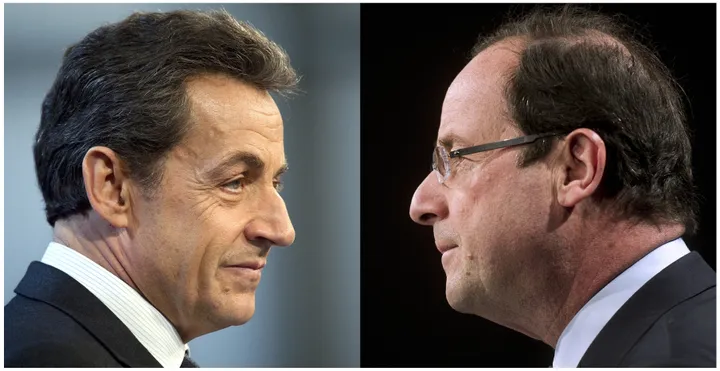
Nicolas Sarkozy came to power five years ago heralded as France's New Man who would bind the country to global capitalism by separating it from its social model. He jogged and he paddled New Hampshire canoes without his shirt. I thought then that it would turn out badly, and it has. This is because national wealth and growth depend on having a strong social model, and Sarkozy's steady downgrading of public infrastructure helped the French economy continue its decline.
The new Socialist president François Hollande campaigned as what Sarkozy had promised to be, the president of prosperity and growth. Hollande has many allies among mainstream economists in opposing the destructive politics of austerity -- not only Americans like Paul Krugman but even some traditional business conservatives like the Financial Times columnist Martin Wolf, who has described Hollande as Europe's "last chance of bringing needed change." But how is Hollande the Socialist going to bring growth and prosperity in a Europe devoted to austerity and to the anti-Socialist financial interests lying behind it?
Wolf's column makes the contradiction clear: Hollande must reject further fiscal tightening, and talk Germany out of its support for that. And yet Germany will only take Hollande seriously, Wolf writes, "if Hollande forgets almost all of his domestic promises." Wolf's idea is that if Hollande sacrifices his program of social rebuilding he could then convince Germany to make a series of policy adjustments: to reduce its trade surplus with those countries that need to sell things to Germany in order to recover, to allow higher Eurozone inflation to reduce other countries' debt, and so on. Wolf is effectively saying that if Hollande abandons his own growth plan for France, Germany may support more growth in the weaker economies of Europe.
This is a foolish political bargain, since Hollande will lose his French political base in exchange for only modest and merely potential improvements in German austerity policy. But Wolf's proposal is also bad economics -- bad because it sacrifices socialist insights into what makes modern economies work.
Hollande needs a Socialist Hypothesis (apologies to Alain Badiou). The Socialist Hypothesis is quite simply that economic value comes from society as a whole rather than exclusively from capitalist enterprise. Socialists do not try to eliminate private property or nationalize crucial sectors by replacing company shareholders with the state. But they frankly oppose the view that a 1% of heroic entrepreneurs creates the society's wealth and that the 99% are passive beneficiaries. Socialism says that economic value comes from the labor, intelligence, ingenuity, and continuous innovation of the 99%. It holds that all wealth flowing from Ayn Randian fountainheads like Steve Jobs or Warren Buffett is as real as the Wizard of Oz.
The Socialist Hypothesis leads directly to massive investment in the general level of knowledge and skill in the overall population -- education, health care, and other public goods that conservative policies generally keep in an impaired and ineffective condition. Recent world history has not offered a single working experiment of what happens when socialist economics is put in place. But we have plenty of evidence of what happens when anti-socialist policies are implemented in a medium-sized country like France that has to live by its wits.
The outgoing president Nicolas Sarkozy presided over the piecemeal degradation of two of the cornerstones of France's economy and society, its rigorous, high-quality public schools and its affordable, high-quality health care system. Frances's educational attainment has slipped to barely the OECD average, and is well below average in science, a traditional strength in France.
More generally, five years of Sarkozyian austerity for the public sector, embodied in his policy of replacing only one in two government workers (which include all teachers, doctors, nurses, et al) has meant that France lacks the infrastructure to develop the small and medium-sized companies that support the healthier economy of Germany, so that France's exports continue to slip, and its public deficit is bigger than ever. Public programs could have brought the brilliance of ordinary French people into the economy via small business grants, expanded higher education, better apprenticeships, more democratic access to capital. The Sarkozy alternative was to prop up a mediocre business aristocracy whose big multinational firms created a net negative number of jobs during his mandate.
During his campaign, François Hollande rejected Sarkozy's wedge politics, which set up a dangerous, Islamic underclass against wealth-giving elites unjustly burdened with taxes. His victory speech stressed reunification and the reorientation of policy around justice and the fate of the young, those who now face dismal prospects for a normal entry into society. He said that France needs to redevelop its economy, strengthen schools, and protect a social model that supports human development while reducing the deficit. Hollande promised to reject austerity while rebuilding the country's teaching force, increase banking regulation, and reduce the deficit by raising taxes on the wealthy and on big corporations that create no jobs (see #15 and #17 of Hollande's "60 Commitments").
But unless Hollande can articulate a Socialist Hypothesis lying behind this collection of neo-Keynesian reforms, all of these useful reforms will be in vain.
Socialist governance must start by explaining how strong economies depend on strong societies, meaning that a strong society is built on mass benefits of policies and on equitable returns for everybody's work. Hollande will then have to come up with major programs that will actually move the needle, and say clearly how he will pay for them. Here are three:A massive reinvestment in education, research, and, universities. Hollande would set a goal for his administration, like getting French students above 510 in all OCED categories, analyzing what this will take, and then funding that, up to, for example, 30% annual budget increases in the first couple of years. The relation between great educational levels and economic health is well established, and Hollande needs to build on his proposal for 60,000 new teaching posts (#36) and rebuild French intellectual capital in a big way.•Transformation of banking into a utility. Bank-dominated and financialized economies are not competitive with those that spend more of their money on investment in public infrastructure and production. Hollande already called for putting banks at the service of the economy but his concrete measures are weak (#7-8) He needs to make France a leader in putting lending and other capital activities in the service of social development by implementing a "Tobin tax" on financial transactions, defining speculative activities that public funds will not support and fully defunding these, and shifting bank boards towards public partnerships in which stakeholders have direct input into bank decision-making. •Explicit racial egalitarianism. Like nearly all societies, France is actively underdeveloping its racial and religious minority populations via second-rate education, housing, health services, you name it. This policy is in open contradiction with French republican values of equality and solidarity, but the passivity of the Left has allowed the Right to have a free hand with racial wedge politics. Hollande should set as a goal equality of outcome for all racial and religious groups, and give his administration five years to make major progress -- say reducing educational outcomes by 50%.
Hollande has a simple choice. There's the way down, Sarkozy-style, with anti-socialist politics that deny the value-creating powers of the whole society. There's the way up, through a modern Socialist Hypothesis that brings the whole of society into the building process, and that will bring Hollande major popular support.