
After BP's financial travails -- falling stock, mounting claims -- financial analysts everywhere are uttering the dreaded B word. Incredibly, it seems that an energy company recently valued at $200 billion could go bankrupt.
As BP executives reiterate pledges to pick up the tab for stained beaches and soiled pelicans, another messy industrial cleanup is unfolding a thousand miles to the north, in the Midwest's auto-manufacturing belt. General Motors and Chrysler are the chief culprits there. The automakers own hundreds of contaminated properties where they once made cars and car parts.
Like so many oil-stained communities along the Gulf, former auto towns throughout the Midwest are waiting for a thorough going environmental cleanup. And like the Gulf communities, they hope that cleanup will help bring about a full economic recovery. Some have been waiting for years, even decades, for GM and Chrysler to finish the job.
Will the communities of the Gulf Coast ultimately fall into a similar state of limbo? Right now, the daily stress and uncertainty demands their energy, but in the months ahead, many may learn a lesson that Midwesterners have known for a long time: The difficulty of making a big corporation pay for its mess increases exponentially once it declares bankruptcy.
Herein lies a cautionary tale for Congress, environmentalists, and the people of the Gulf Coast. As much as they want BP to pay through the nose, they should beware a bankrupt BP, which could use bankruptcy laws to shed its responsibility to pay for environmental cleanup.
"If GM doesn't pay, there's a real danger that the cleanup costs will fall back on the taxpayer." That's Kevin Smith speaking. He's the former mayor of Anderson, Indiana, a city of 50,000 that made millions of starting motors, horns, and headlamps for GM. Smith worked closely with GM to clean up nearly a dozen former plants, but work stopped when GM went bankrupt. Now, the city is seeking $9.2 million from the automaker to finish the job. The court handling GM's bankruptcy may award the funds; it may not. Either way, someone has to clean up the polluted 90-acre field where that headlamp plant once stood.
A former auto plant does not look much like a white-sand beach, but the net effect is the same: An asset converted to a costly albatross. An oily albatross, if you want to mix metaphors.
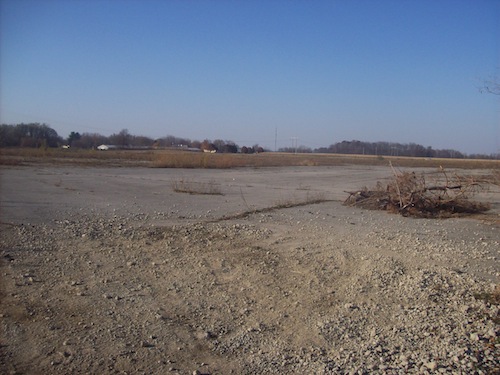
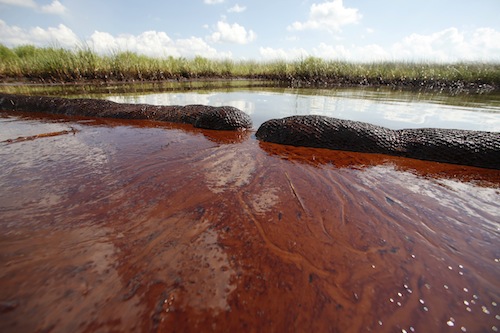
Unlikely Pairing: A bankrupt BP might delay or seek to avoid paying for environmental cleanup along the Gulf Coast (below, AP), just as General Motors has left this contaminated factory site in Anderson, Indiana, untouched (above).
"When companies leave huge environmental pollution from their operations, local governments suffer the brunt of the problems," says Matt Ward. He's the policy director for the Mayors Automotive Coalition, a group of 50 municipalities that have banded together to rebuild communities devastated by plant closures.
"Local communities have to deal with the contaminated property as well as lost jobs, lost tax revenue, increasing foreclosures, demands for social and poverty services, and the stigma that drives away future economic development."
When the companies responsible go bankrupt, cleanup efforts are often put on hold, prolonging the crisis. "When the company has no resources, it is bad news for communities," Ward concludes.
BP is plenty different than the American automakers, of course. For one thing, it has no problem making a profit. And unlike GM and Chrysler, it never owned the waters and beaches its crude has fouled.
But when it comes to the all-important question of who pays, a bankrupt BP may quickly start to resemble GM and Chrysler, which have been widely criticized for insufficiently funding their cleanup obligations.
"We're still trying to calculate the environmental cleanup costs that GM and Chrysler have left to be borne by the public," notes Jackie Gardina, an attorney, professor at Vermont Law School, and authority on the environmental consequences of bankruptcy.
If BP declares bankruptcy, its oft-repeated promise to "pay all reasonable claims" goes out the window.
"If BP were to file for bankruptcy, the government will be unable to hold the company fully accountable for the as-yet-unknown costs of this unprecedented environmental catastrophe," Gardina says. "Bankruptcy courts struggle to find a balance between the 'polluter pays' principle of our environmental laws versus the bankruptcy."
Gardina says that only Congress, not the courts, can truly make corporate polluters accountable. It can arrange liens on BP's assets or revise the bankruptcy code to provide less wiggle room for corporate polluters. Moreover, she notes that the Obama administration can request a "security interest" in BP's property to guarantee the costs associated with the spill.
Bottom line, Congress and President Obama must close the loophole that makes bankruptcy so useful for BP and other corporate polluters.
Otherwise, we may one day speak of the Gulf Coast as the new Rust Belt -- the Tar Belt, if you will.