I've come to Rome on Easter Sunday on the trail of an international scientific conspiracy. No, not a plot to obliterate the Vatican. The Pope and his handlers are doing that all on their own. The plot I'm in search of is the global warming conspiracy. You know, the one that thousands of scientists from countries around the world are perpetrating at Al Gore's command. That's for real. We know it is, because no less an authority than
, cofounder of the Weather Channel, tells us so. And, hey, he's a weatherman, so he oughta know.
But these scientists are subtle rascals. It's been 24 hours, and I have yet to catch a whiff of conspiracy. They're gathering in Italy from all four corners of the world to confer on
, and if ever there were a topic that would draw global warming cultists, this is it. These guys aren't drilling for oil, you know. They are trying to get a read on the climatic history of the South Pole with a view to understanding present-day ... you guessed it: climate change. So, I'm hanging with four of them: Dave Harwood from the US, Richard Levy from New Zealand, Fabio Florindo from Italy, and Chris Fielding from the UK and Australia. Now, these guys have been working together for more than a decade, so you'd think that conspiracy would come easy. But nada, nulla, not a thing. To my intense frustration, all these guys want to talk about is questions. When I confront Harwood about this, he says, "A good question is better than any answer." This, he explains, is because easy answers are bound to be wrong, while good questions lead you closer to the truth.
Hmmm. Sounds suspiciously plausible. But I can't deter them. They plunge on day and night raising doubts about data sets, spotting conflicting evidence, framing new questions, outlining differing interpretations of core sections -- and that's when they're not talking football. This being an international gathering, they naturally have two kinds of football to talk. And then there's the joking and joshing. These guys actually have a sense of humor.
You've heard about the two chocolate Easter bunnies? Nevermind...
I'm starting to wonder if these are real scientists. Everyone knows that real scientists are humorless nerds outfitted in lab coats and thick glasses, right?
Uh, not exactly. These guys are ice-trucker tough -- they've lived and worked on the coldest continent in the world and can curse in at least three languages. They are also damn smart and highly inquisitive. Listen to John Coleman, and you might expect them to whip out Chairman Al's Little Red Book of Global Warming and recite chapter and verse.
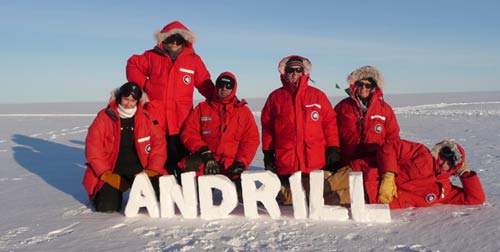
But, dammit, these guys refuse to conform to stereotype. Rather than just declare that global warming is a scientific fact, they are working their way inch by inch through miles of data. The data are in two mile-deep Antarctic cores they have drilled, recovered, and examined over the past four years. Clues abound in the samples, but it takes researchers of many different specialties to spot them.
To me, the ANDRILL cores look like tubes of mud and cement. But these scientists have developed myriad methods of deducing the presence or absence of ice from the record.
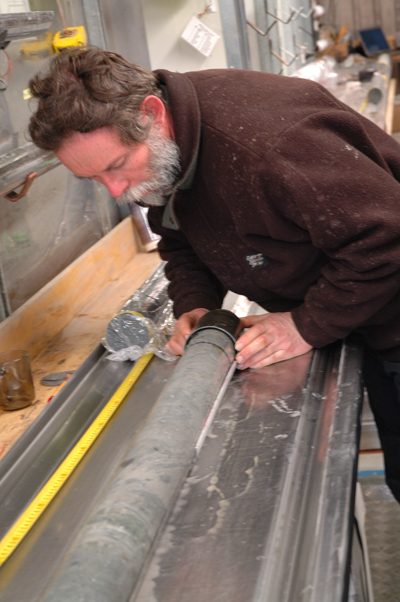
A few examples: they measure the grain size of sediment in each sample. Water moves sand. Ice shifts rocks. So, if you've got all sand in your sample, you can infer that it was probably warm. If you've got a lotta rocks, it was cold. That's just one indicator. They also look for pollen. That tells you if there were plants flowering nearby. They examine the diatoms in the sample. That helps them date the sample, but it also tells them something about the water temperature. They log magnetic mineral content. They check for the presence of organic molecules left over from ancient microorganisms whose presence or absence, again, tells them about temperature. They compare all this with measurements of oxygen isotopes that other scientists have retrieved from microfossils. The relative amounts light and heavy oxygen tells about how much was locked up in ice, and so constitute yet another temperature indicator.
If this is a hoax, scientists are going to ridiculous lengths to establish it. Not only are they weaving together many different lines of evidence, they are actually looking for gaps, knots, and mismatches in the tapestry -- places where the evidence is missing, clashes, or fails to meet expectations. And there are some. That's what makes it so easy for global-warming deniers to pounce. But these scientists seem oddly uninterested in formulating propaganda. Instead, they are struggling to filter out noise, to spot authentic signals, and to test their interpretations against one another before putting together a coherent story.
They aim to tell the climate history of Antarctic over the past 20 million years and explain what it may mean for the world today. This matters, because the world's largest ice sheets lie atop the southernmost continent. They are more than a mile thick. There is more fresh water locked up in the Antarctic ice sheets than in all of the Great Lakes put together. Enough that, if they were to melt, the global sea level would rise by as much as 200 feet (60 meters).
It had been thought that, because they sit on dry land, the Antarctic ice sheets were fairly stable. But NASA satellite images show that they are losing hundred of billions of tons of ice a year. So how likely is it that the ice sheets will collapse?
Over the next few days, ANDRILL scientists hope to weave together the many threads of evidence about the past. This won't necessarily tell us what's going to happen in the next few centuries. It certainly won't answer every question about global warming. But it will give us a higher resolution climate history. And better yet, it will furnish climate scientists with more questions.
Think about that. Global warming deniers have no questions. None at all. They have nothing but smug certainties. But in the hands of inquisitive scientists, a few good questions could outweigh a ton of coal, man.
Full Disclosure: My basic travel expenses are being paid by the ANDRILL project so that I can cover the conference.
Our 2024 Coverage Needs You
It's Another Trump-Biden Showdown — And We Need Your Help
The Future Of Democracy Is At Stake
Our 2024 Coverage Needs You
Your Loyalty Means The World To Us
As Americans head to the polls in 2024, the very future of our country is at stake. At HuffPost, we believe that a free press is critical to creating well-informed voters. That's why our journalism is free for everyone, even though other newsrooms retreat behind expensive paywalls.
Our journalists will continue to cover the twists and turns during this historic presidential election. With your help, we'll bring you hard-hitting investigations, well-researched analysis and timely takes you can't find elsewhere. Reporting in this current political climate is a responsibility we do not take lightly, and we thank you for your support.
Contribute as little as $2 to keep our news free for all.
Can't afford to donate? Support HuffPost by creating a free account and log in while you read.
The 2024 election is heating up, and women's rights, health care, voting rights, and the very future of democracy are all at stake. Donald Trump will face Joe Biden in the most consequential vote of our time. And HuffPost will be there, covering every twist and turn. America's future hangs in the balance. Would you consider contributing to support our journalism and keep it free for all during this critical season?
HuffPost believes news should be accessible to everyone, regardless of their ability to pay for it. We rely on readers like you to help fund our work. Any contribution you can make — even as little as $2 — goes directly toward supporting the impactful journalism that we will continue to produce this year. Thank you for being part of our story.
Can't afford to donate? Support HuffPost by creating a free account and log in while you read.
It's official: Donald Trump will face Joe Biden this fall in the presidential election. As we face the most consequential presidential election of our time, HuffPost is committed to bringing you up-to-date, accurate news about the 2024 race. While other outlets have retreated behind paywalls, you can trust our news will stay free.
But we can't do it without your help. Reader funding is one of the key ways we support our newsroom. Would you consider making a donation to help fund our news during this critical time? Your contributions are vital to supporting a free press.
Contribute as little as $2 to keep our journalism free and accessible to all.
Can't afford to donate? Support HuffPost by creating a free account and log in while you read.
As Americans head to the polls in 2024, the very future of our country is at stake. At HuffPost, we believe that a free press is critical to creating well-informed voters. That's why our journalism is free for everyone, even though other newsrooms retreat behind expensive paywalls.
Our journalists will continue to cover the twists and turns during this historic presidential election. With your help, we'll bring you hard-hitting investigations, well-researched analysis and timely takes you can't find elsewhere. Reporting in this current political climate is a responsibility we do not take lightly, and we thank you for your support.
Contribute as little as $2 to keep our news free for all.
Can't afford to donate? Support HuffPost by creating a free account and log in while you read.
Dear HuffPost Reader
Thank you for your past contribution to HuffPost. We are sincerely grateful for readers like you who help us ensure that we can keep our journalism free for everyone.
The stakes are high this year, and our 2024 coverage could use continued support. Would you consider becoming a regular HuffPost contributor?
Dear HuffPost Reader
Thank you for your past contribution to HuffPost. We are sincerely grateful for readers like you who help us ensure that we can keep our journalism free for everyone.
The stakes are high this year, and our 2024 coverage could use continued support. If circumstances have changed since you last contributed, we hope you'll consider contributing to HuffPost once more.
Already contributed? Log in to hide these messages.
