iPhone app iPad app Android phone app Android tablet app More

Featuring fresh takes and real-time analysis from HuffPost's signature lineup of contributors
Cleo Paskal

GET UPDATES FROM Cleo Paskal

Why Indian Corruption Is a Global Security Concern

Posted: 08/25/11 03:03 PM ET

India is in the throes of what some are calling a "second freedom struggle." Across the country, citizens are on the streets, in the courts and on the internet, fighting to break corruption's chokehold on the nation. It is a critically important battle, not only for the future of India, but for global security -- corruption in India enables some of the world's most dangerous terrorist networks.

The reason is, illegal money needs illegal methods to move it around. And the amount of corruption-generated money flowing through India is vast. According to Interpol: "In South Asia, the 'black' or parallel economy is 30 percent-50 percent of the 'white' or documented economy."

In terms of Indian political corruption, the 2011 2G-spectrum scandal alone is estimated to have lost Indian taxpayers close to $40 billion. And, as soon as the money needs to cross borders, say to get to a Swiss bank account where it can be washed clean, an Indian politician on the take goes from being a national security concern to a global security concern.

Hawala Networks

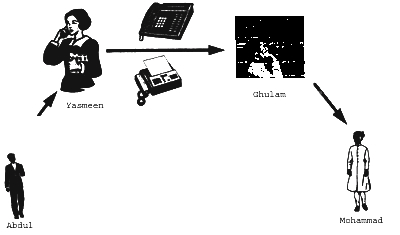
That is because a preferred method of transferring illegal money is called hawala. A very simplified version of how the hawala system works is shown below in a graphic from INTERPOL. Say Abdul in New York wants to transfer $5000 to his brother Mohammed in Pakistan. Abdul would go to a local New York hawala trader and give her $5000 cash. The New York trader would then call her colleague in Pakistan and instruct him to pay $5000 cash (in local currency) to Mohammad. And that's it.
2011-08-19-HawalaINTERPOL.jpg

The Pakistan trader might get the money back from the New York trader through money transfers the other way, by doctoring invoices using participating import/export companies or other methods. In the meantime, Abdul sent the to money to Mohammad in hours and there is no official trace of the transaction.

From a criminal perspective the advantages of hawala are:

  • No paper trail.
  • No taxation.
  • No customs declarations.
  • Often preferential exchange rates.
  • Money laundering.
  • Due to the illegal nature of the process, the people transferring money (in this example Abdul and Mohammad) are now open to blackmail, giving the hawala traders and their associates leverage over their clients if needed.


For hawala to work, there has to be a high level of what Interpol calls 'trust' between the hawala traders. With hawala, that 'trust' is often guaranteed by brutal enforcement. If the money disappears en route, the hawala trader involved is likely to be 'disappeared' as a result, possibly along with his or her family.

The need for this high level of enforced 'trust' is why many hawala networks are controlled by terrorist and related criminal groups. The terrorists are not only willing to be brutal, but also require the quiet transfer of large amounts of untraceable cash. In a coordinated attack, in Mumbai on July 11, 2006, terrorist bombings on trains killed over 200 people. $10,000 that was used to carry out the attacks came from Saudi Arabia to India via halawa networks. The material recovered from Abbottabad shows Osama Bin Laden spent much of his time going through the "corporate" account books, tracking money generation (often through decidedly unspiritual means such as drug dealing) and cash flows.

Like a criminal Western Union, terrorism financiers use vast international hawala networks to move money around the world quickly and quietly. Due to their effectiveness, those same hawala channels also attract cash flows from other illegal sources, including arms traders, prostitution, narco-traffickers and human traffickers.

The problem is compounded when these same networks are used by those whose job it is to shut down criminal networks, such as (corrupt) politicians and law enforcement.

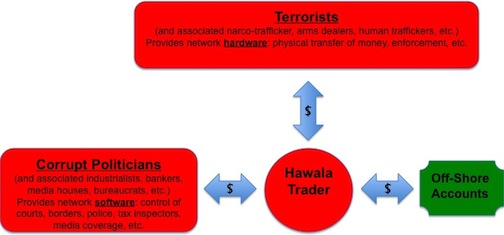
As all these money streams combine and flow through the same channels, each participant, from terrorist to politician, needs to protect the whole system in order to protect their own money flow. Very broadly, those common interests result in a division of labour.

The terrorists and associated criminal groups provide the system 'hardware,' such as physical money transfer, enforcement, etc.

Meanwhile the corrupt politicians and associated 'legitimate' groups such as (compromised) police, bureaucrats, media, etc., provide the system 'software' by keeping cases out of court, losing files, ensuring no coverage of embarrassing incidents, etc.
2011-08-19-HawalaMoneyFlowForHuffPo.jpg

Recently J. Dey, one of Mumbai's top investigative journalists was shot dead. On the list of suspects are politicians, terrorists, gangsters, industrialists and policemen. It pretty much sums up what has happened to India. As dirty money flows between politics, extremist groups, narco-traffickers, business, media houses, and police, it mixes together forming a torrent of intermingled corruption that is drowning the security of the nation, and pouring over the border, carrying terror and crime with it.

Hassan Ali Khan Case

Those dynamics have been on display in the case of Hassan Ali Khan. Khan is sitting in jail in India awaiting trial on charges of running a massive, high value hawala network for an astoundingly varied cast of top-level players, from narcotics dealers to industrialists to politicians. Even Saudi arms broker Adnan Khashoggi's name has come up.

In the case of Hassan Ali Khan and his associates, the sums were too large to be moved around invisibly like Abdul's $5000. As a result vast amounts, sometimes up to $8 billion, periodically popped up in tax haven bank accounts, creating a brazen paper and e-trail.

For example, according to investigators, when millions were transferred to a Khan-linked bank account for the purchase of a hotel in Switzerland, it came with an unusual note attached.

According to the letter rogatory from the Indian government to the government of Singapore on criminal case no. ECIR/MZO/02/2006-07 (the case involving Khan):

Deal for purchase of property i.e. Chateu Gutsch [sic] in Lucerne was finalized and during payment, USB [bank] informed that USD 300,000,000 the fund have arrived tagged with comment "Funds from Weapon Sales.

The note shows just how sure Khan and others involved were that they were protected from prosecution. And, until now, people like Khan had good reason to feel safe.

Among Khan's known associates were three Indian Chief Ministers and a top member of the ruling Congress Party. To protect themselves, they have to protect him, and the system he represents. And so, the case against Khan languished. Interrogations were cursory, files were sloppy, deadlines were missed.

But then, in an echo of what is happening all over India, someone said "enough is enough." In the case of Khan, it was the Supreme Court of India. In a remarkable order issued on July 4, 2011, the court explained why vast flows of illegal money are a national security concern:

the issue of unaccounted monies held by nationals, and other legal entities, in foreign banks, is of primordial importance to the welfare of the citizens. The quantum of such monies may be rough indicators of the weakness of the State, in terms of both crime prevention, and also of tax collection. Depending on the volume of such monies, and the number of incidents through which such monies are generated and secreted away, it may very well reveal the degree of 'softness of the State.' [...] If the State is soft to a large extent, especially in terms of the unholy nexus between the law makers, the law keepers, and the law breakers, the moral authority, and also the moral incentives, to exercise suitable control over the economy and the society would vanish. Large unaccounted monies are generally an indication of that.

The court instructed: "Follow the money." It ordered that the Khan case be taken out of the hands of existing (failing) investigative units, and be given to a special investigate team composed of top officials comprising, among others, two former Supreme Court Justices and the Director of the Research and Analysis Wing.

If properly investigated, the case has the potential not only to bring down governments, but it could also be a huge blow to global terror, drugs, child prostitution, and human trafficking networks.

Anti-Corruption Campaigns

Needless to say, those networks are fighting back. At midnight on June 5th, tens of thousands of fasting, sleeping anti-corruption demonstrators were stormed by the police and cleared from their demonstration site in central Delhi. Reportedly orders for the action came from the very top. But the anti-corruption elements of the system are standing firm. The Supreme Court has ordered the Government to explain its actions on the night of June 5th. Point, counter-point.

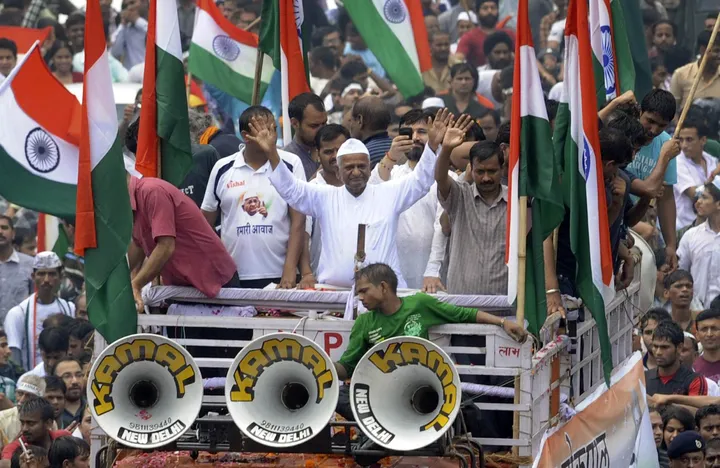
Similarly, this week, anti-corruption demonstrator Anna Hazare and hundreds of his supporters were arrested. Subsequently, tens of thousands took to the street to protest the arrests. India is not new to demonstrations, but this fight back mood is different. It will not go away. And it's spreading. Sympathy protests have taken place in the U.S., Singapore and Hong Kong. And there are more to come.

It is fitting that the protests are going global. Political corruption in India, facilitated by hawala networks, has not only undermined India, it has compromised global security. For years some, like journalist and strategist M.D. Nalapat, have been warning about the deepening and spreading security vulnerabilities resulting from Indian corruption. Now, the Cassandras are being proved right.

Luckily for those around the world concerned about terror, drugs, human trafficking and other multinational criminal organization, the Indian people, from the streets to the courts, are working hard to make India, and by extension the world, a more secure place. This fight concerns us all.


Follow Cleo Paskal on Twitter: www.twitter.com/cleopaskal


  • Comments
  • 20
  • Pending Comments
  • 0
  • View FAQ
Comments are closed for this entry
View All
Favorites
Bloggers
Recency  | 
Popularity
01:45 PM on 10/02/2011
The language of the article best exemplifies the problem we're facing right now. No one in the public domain, including the writer of this article is courageous enough to spell out names of the "three Indian Chief Ministers and a top member of the ruling Congress Party", which gives these corrupt people impetus to continue to move their illegal money around.

Wikileaks was supposed to come out with a list of high profile names, I don't see what happened with that. Then the way the Indian media was silenced after Ramdev was brutally attacked in June, shows media complicity. There is something bigger that is taking place, and we will need a lot of courage from our reporters to unearth the mess to its source. Great attempt to start things off!!
10:43 AM on 10/03/2011
Very Well said.Media is biased to either Left or Right.In most of the cases Media is Over-awed. Indeed the mass uprising is a great thing,it has attracted a lot of Rural People to the forefront who were previously being suppressed by haughty politicians(By Degrading the quality of education).
08:45 AM on 09/12/2011
As an aside US government is strong enough to take one simple unilateral action. They can ban all transfers of funds to and from countries having secrecy laws like Swiss Banks. The rest of the world will soon have to follow suit since US is the biggest economy and the US$ the only currency large enough to support world trade.

But then the US law makers or rather their political financiers / supporters are the biggest scam runners so nothing of the sort is likely to happen.
08:39 AM on 09/12/2011
Actually the hawala transaction has its origins in safe money transfers in the days when there were no trains and the main mode of transport / communication between cities/towns was animal drawn vehicles. Journey ties were long and chances of being robbed were extremely high. The practice of hawala involved making payment at one place and collecting at another. But in reality the money receiver and payer at the 2 ends were the same entity and it was a perfectly legitimate. It was more like a on demand promissory note. It DID leave a paper trail. One simply did not have to carry bundles of currency for trade purposes. Even today such transaction are popular as they are cheaper than the bank charges for similar amounts. The literal meaning of the word " hawala" plural of singular word "hawalo" having its origin in Gujarati is "journal entry" in standard double entry book keeping.
04:39 PM on 08/30/2011
THE GENESIS OF CORRUPTION AND ANNA'S AGITATATION :

It is not at all advisable to kill the system ,no matter how corrupt it has turned into; the whole nation through the parliament of our country is appealing ANNA to give up his fast and he is adamant. This seems being fool-hardy ,you wear your spectacles and others their, you claim to raise the participatory democracy but with a vision all the rest get through your specs ; now this is certainly not democratic .
At the root of decline in social values and rise in corruption is our electoral process which calls for huge amounts needed in election after election by political parties ,where from they will get it but from illegal cuts and bribes by favors to corporates and brokers. Another fact is ,we have lot many laws , but not the will to implement them .Our system requires over-hauling and to begin with ,let the state fund election expenses, reduce the size of constituencies to be effectively manageable and two rounds of voting ,the winner and the runner of 1st round will contest the second and the final round to be true representative of people from that constituency . IT GOES WITHOUT SAYING THAT ALL POLITICAL PARTIES MUST BE MADE TO FULLY IMPLEMENT DEMOCRATIC FUNCTIONING WITHIN THE PARTY AND CANDIDATES FOR ANY ELECTION ARE DECLARED CONTESTANTS ONLY AFTER THEY GET ELECTED WITHIN THEIR PARTY .IT SURE WILL HAPPEN ,SOONER THE BETTER; PEACEFULLY - BETTER .
photo
HUFFPOST SUPER USER
psnyder325
Yep, I'm a Socialist. Deal.
11:53 PM on 08/28/2011
How about American corruption, which is at least as widespread. THAT is a very REAL global security concern, or should be. The fact that virtually ALL of our politicians are owned by the bankers (Gnomes) and the mega-corporations should be a major concern to every citizen on the face of the Earth. We have hundreds of times the nuclear capability of India, and have shown ourselves all too willing to go to war at the drop of a hat to suit the banking and corporate Masters of the politicians.
photo
HUFFPOST SUPER USER
Shaas
04:34 PM on 08/28/2011
Apropos your assumption that "It is fitting that the protests are going global." As far I know, in India itself, the protests are boycotted or ignored by the muslim section of society. Is there some connection to the problem described in your article?
photo
HUFFPOST BLOGGER
Cleo Paskal
05:25 PM on 08/28/2011
The Imam of Delhi’s Jama Masjid mosque did publicly call for "all Muslims to stay far away from Anna Hazare, because he has done nothing for Muslims". However the vast majority of Muslim groups in India rejected that call, including the All India Milli Council, Federation of Minority NGOs, All India Muslim Women Personal Law Board, and many others. Allama Bunai Hasani, general secretary of the All India Ulema Board, said "We must remember that this fight goes beyond religion and boundaries and all Indians must unite." Anna Hazare broke his fast by drinking a cup of coconut water with honey given to him by two eight year old girls, one Dalit, the other Muslim.

For more: http://www.indianexpress.com/news/muslim-leaders-back-anna-in-fight-against-corruption/836710/
photo
HUFFPOST SUPER USER
Shaas
06:54 PM on 08/30/2011
Yes, fortunately, you're right! 4 days ago when I checked the Indian Internet sources, the resistance from Muslim section was much stronger. So, now, the turn of support is really encouraging.
Although in Kolkata, acc. to IANS, a top Muslim cleric of West Bengal was slamming the activist's demand for a stronger anti-corruption bill, as well.
photo
ArchbishopBenevolent
Pre-Approved Saint, Beatific but not Canonical
09:50 AM on 08/27/2011
Another source of Indian corruption is China. Chinese military and intelligence officials have been actively buying out the leadership of India's communist party to extend Chinese influence in India's decisions.
05:15 AM on 08/27/2011
Excellent. India becoming an administrative basket case has been my concern.

But please ask Prashant Bhushan & Kiran Bedi why they did/do not have the honesty & moral courage to acknowledge and support this ?

http://sathyagraha.blogspot.com/2011/05/hand-clap-that-triggered-avalanche_19.html
12:17 AM on 08/27/2011
thanks for the knowledge
This user has chosen to opt out of the Badges program
11:13 PM on 08/26/2011
US govt and wikileaks should make all the Swiss account holders name public! It' would be great to see name of Sonia Gandhi (aka Sonia Antonio Maino) and Rahul Gandhi (aka Raul Vinci) . They merely stole Mahatma Gandhi's surname to fool 50% of illiterate Indian people!
photo
HUFFPOST SUPER USER
allwarisbad
01:53 AM on 09/03/2011
"US govt and wikileaks" - these entities are oppose each other btw ...
photo
HUFFPOST SUPER USER
mangafreak2128
Atheist, progressive activist, democrat socialist
07:04 PM on 08/26/2011
I wish my people the best of success and also hope the the American people take their protests as something to inspire from.
photo
HUFFPOST SUPER USER
FabulousTahoe
Opinions from Lake Tahoe
10:56 PM on 08/25/2011
I wish the US government would take the problem of corruption HALF as seriously at home as we do abroad. There's plenty of crooked officials we could get rid of for our own security.
06:08 PM on 08/25/2011
None of the current versions of the bill are effective but the government agreeing to finally debate it will hopefully lead to a more effective final draft. I also believe that greater deregulation of the economy is the single most important thing that needs to be done to stem corruption but at the same time there is nobody currently in government or civil society willing to bell this cat. Without putting some fear into the hearts of the bureaucracy and civil service they have no incentive to deregulate...it has become a vicious circle.

Perhaps, something almost as draconian and UN-democratic as parts of the JanLokpal is required for a decade or so to jolt us back on the right path.

I just hope it does not end up creating a more powerful and corrupt monster than the one it intended to kill…http://www.vaishwords.com/2011/02/open-letter-to-india.html
edvince
amstel
03:03 PM on 08/25/2011
.......a special investigate team composed of top officials comprising, among others, two former Supreme Court Justices and the Director of the Research and Analysis Wing.

They don't get it. The (retired) special investigative team chosen also maneouvered in the same throngs of the corrupt system, so what are they going to do better except con't the back to business gam.
photo
HUFFPOST BLOGGER
Eric Ehrmann
Blogs on sports and politcs from Brazil
02:43 PM on 08/25/2011
A helpful tool that can take this discussion beyond Hawala networks and personal corruption is the corruption perception index from Transparency International http://www.transparency.org/policy_research/surveys_indices/cpi/2010/in_detail

While the index does have its critics, who focus on methodology, it does succeed at tagging institutional corruption that is enabled by US and other global companies, who enable the corrupt practices with their outsourcing arrangements and reliance on the human capital model. Corruption is often a cultural phenonmenon that is looked at by members of the resident culture as not being corruption at all. One can look at the TI index and find India up at the top among the BRICS nations. But that corruption is driven by globalist interests who often promote it and tolerate it as a trade-off fo benefits of the low wage service industry labor they promote through outsourcing and the human capital model.
05:49 PM on 08/26/2011
>But that corruption is driven by globalist interests who often promote it
>and tolerate it as a trade-off fo benefits of the low wage service industry
>labor they promote through outsourcin­g and the human capital model.

What you say here is only true for the previous 10-20 years. Corruption has been a cancer in India for far longer than that - ever since the first Prime Minister Nehru and his Marxists-Socialist buddies took over the country and implemented their license-quota-raj. It is in fact the opening up of the economy in the early 90's and allowing FDI from "globalist interests" and increasing competition that has at least reduced some corruption in some areas.