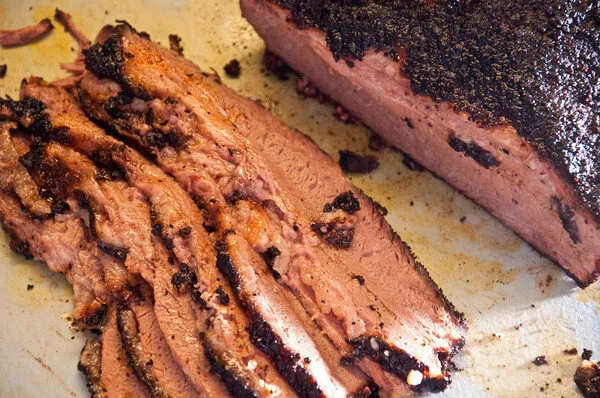

The Stall. The Zone. The Plateau. It has many names and it has freaked out many a barbecue cook. I know because they email me right in the middle of their cook. Panicky.
You get a big hunk-o-meat, like a pork shoulder for pulled pork or a beef brisket, two of the best meats for low and slow smoke roasting, and you put it on the smoker with dreams of succulent meat dancing in your head. You insert your fancy new digital thermometer probe, stabilize the cooker at about 225°F and go cut the lawn. Then you take a nap.
The temp rises steadily for a couple of hours and then, to your chagrin, it stops. It sticks. It stalls for four or more hours and barely rises a notch. Sometimes it even drops a few degrees. You check the batteries in your meat thermometer. You tap on the smoker thermometer like Jack Lemon in the China Syndrome. Meanwhile the guests are arriving, and the meat is nowhere near the 190°F mark at which these two cuts are most tender and luscious. Your mate is tapping her foot and you're pulling your hair out.
Sterling Ball of BigPoppaSmokers.com, a major retailer of grills and smokers and a successful competition cook says that "no matter what I tell customers, when the stall hits them, they are horrified. It seems to last forever. They crank up the heat. They bring the meat indoors and put it in the oven. They call me at all hours."
What the heck is happening?
Many pitmasters have long believed that the stall was caused by a protein in the meat called collagen combining with water and converting to flavorful and slippery textured gelatin. Called a "phase change" the conversion of collagen starts happening at about 160°F. Others have speculated that the stall was the fat rendering, the process of lipids turning liquid. Still others thought it was caused by protein denaturing, the process of the long chain molecules breaking apart (for more about these processes see my article on meat science).
But it is none of these things. It is much simpler, and there is a cure if you want it.
Dr. Blonder to the rescue
Dr. Greg Blonder, is a physicist, entrepreneur, and former Chief Technical Advisor at AT&T's legendary Bell Labs. He is also an avid cook, a barbecue lover, and the resident myth-buster at AmazingRibs.com. He set out to figure out what causes the stall. His answer: "The stall is evaporative cooling."
It's that simple. The meat is sweating, and the moisture evaporates and cools the meat just like sweat cools you after cutting the lawn. Here's how he proved it.
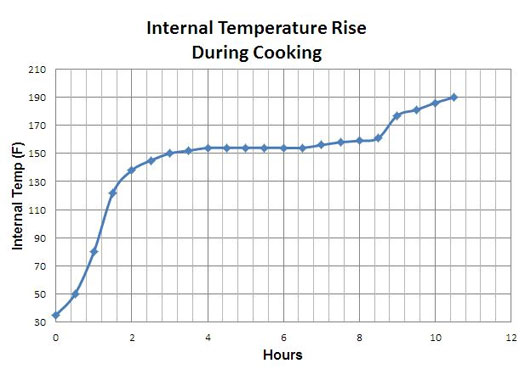
He charted a cook of a brisket on a thermostatically controlled smoker. In his test (see the chart to the right) you can see the stall starts after about 2 to 3 hours of cooking at about 150°F and then lasts about 6 hours before the temp begins rising again. Your graph may vary depending on the type of meat, its size, and your cooker, but the curve should be similar.
Next he did some calculations and determined that the amount of energy required to melt the collagen would be far less that that consumed during the stall. A pork shoulder is about 65% water, 18% protein, 15% fat, and 2% sugars and minerals. About 1/4 of the protein, about 4% of the meat, is collagen.
Here's the logic: The fuel in your cooker (oxygen plus charcoal, gas, or pellets) burns and produces energy which enters the cooking chamber in the form of heat. Some of it escapes through the metal sides and some goes out the vents, but some is absorbed by the cold meat. When it heats, some of the energy is used up raising the temp of the entire hunk, some of it is used in changing the chemistry and physical structure of the molecules in the meat, and some is used to melt fat and evaporate moisture. Pork shoulders and brisket have relatively high connective tissue content. These connective tissues form a sheath around muscle cells that connect them to each other, it sheaths bunches of muscles into fibers, it encases fibers into whole muscles, and it connects muscles to bone in the form of tendons and ligaments. Some are made of really tough stuff called elastin. But some are made of collagen. But the math didn't add up. There's just not enough collagen to suck up all the energy necessary to prevent the meat from increasing in temp. So it had to be something else, and his final test proved it.
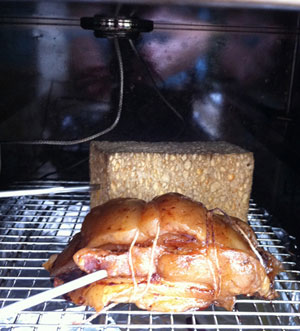 Hypothesizing that the stall might be evaporative cooling, but still wondering if it may be fat melting, Blonder took a lump of pure beef fat from the fridge, inserted a thermometer probe, and placed it in a thermostatically controlled smoker. He also soaked a large cellulose sponge in water, shook it out, inserted a probe and placed it next to the fat. Then he set the smoker for 225°F.
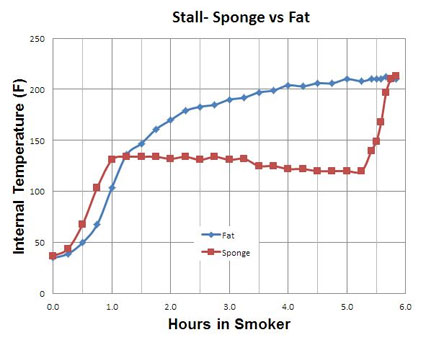
The results are pretty clear. The sponge is the red line and the fat is the blue line. The fat did not have a stall at all. It slowly and steadily heated on a nice gradual curve. But brother, did the sponge ever stall. It climbed at about the same rate as the fat for the first hour to about 140°F, and then it put on the breaks. In fact, it even went down in temp! When it dried out after more than 4 hours, it took off again.
The conclusion was inescapable: "Since there was a deep, glistening pool of melted fat in the smoker, the rendering fat hypothesis is busted. The barbecue stall is a simple consequence of evaporative cooling by the meat's own moisture slowly released over hours from within it's pores and cells. As the temperature of cold meat rises, the evaporation rate increases until the cooling effect balances the heat input. Then it stalls, until the last drop of available moisture is gone."
Blonder points out that the size, shape, and surface texture of the meat can influence the stall by influencing how much moisture is available for evaporation, not to mention airflow and humidity in the cooker. He also has done experiments that prove that the more airflow in the oven the lower the stall temp so the amount of draft in your smoker will impact the process. For example, pellet smokers, which have a fan in them, create a convection environment and that speeds the evaporation, so the stall can be shorter. I might add that ambient temp and wind and other environmental factors also come into play.
The process seems to take all the moisture out from the surface and just below it, and this is clearly part of the formation of the crusty, jerky like, spice laden "bark" on the surface that contributes to the textural and flavor profile. Why doesn't the meat just stay in the stall until it is all dried out? "Much of the moisture in meat is tied up and bound to other molecules like the collagen, fat, and protein. The supply of moisture that can evaporate is limited. Once the meat's ability to supply moisture peaks, it gradually starts to heat up."
Anyone who cooks large cuts knows that it is common for them to lose as much as 25% of their weight during cooking. Well if you've ever collected the drippings, you know that the melting fat is nowhere near 25%. The loss is mostly moisture. Considering that meats are 60 to 70% water, that means there is still plenty of water left behind after breaking out of the stall.
Will basting the meat or putting a water pan in the smoker impact the stall? "There is no question extra humidity will slow down the cooking process, whether it comes from a water pan or wet mop." When we baste, whether by mopping, brushing, or spritzing, we cool the meat just by the fact that the liquid is cool. It then sits on the surface and evaporates prolonging the stall. When we put a water pan in the cooker, the moisture evaporates from the surface and raises the humidity in the cooker, slowing the evaporation from the meat, and slowing the cooking. "In low and slow cooking this allows the meat's interior to catch up with the surface temperature" explains Blonder.
Until now I had always believed that water pans were important to keep the cooking chamber high humidity and thereby reduce moisture loss from the meat. Apparently it does this somewhat, but they also cause the cooking to take longer. But this is no reason to stop using water pans because the moisture in the atmosphere inside the cooking chamber mixes with the smoke, influences flavor, and lets the meat's interior catch up with the exterior so it cooks more uniformly. Water pans also help stabilize the temp in a charcoal fire because it heats and cools slowly and this tends to even out spikes and valleys in a cooker.
Apparently the stall is not unique to barbecue. Blonder has proven it can happen in baked goods. He points out that when we put ice cubes in a pan and turn on the heat, the ice remains 32°F and the water from the melting ice remains close to 32°F until all the ice is melted. This is a form of stall. Then the water in the pan rises to 212°F, the boiling point, and stalls there until the water is all gone, regardless of how much energy you apply to the pan. Same phenomenon.
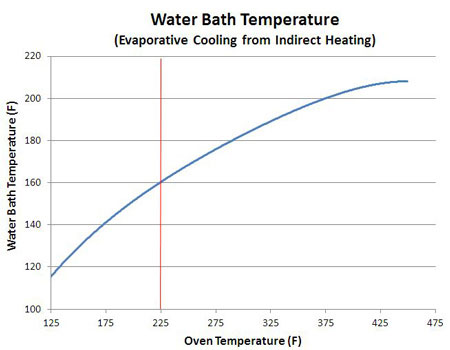 Interestingly, meat won't stall at high temps. Stalling is primarily a phenomenon of low temp cooking. Blonder discovered this by putting a bowl of water in an oven and set the thermostat for 125°F. The water stalled at about 115°F. Then he put another bowl in at 175°F. It stalled at 140°F. He repeated the experiment in 50°F intervals. With each step, the stall temp rose until it slowly approached the boiling point, 212°F, with the oven just over 425°F. The bowl of water he cooked at 225°F stalled at 160°F. Well 225°F is the same temp of the oven in his other experiments, not to mention the temp favored by most barbecue cooks, and 160°F is pretty close to the stall temp for meat. That's the red line in the chart at right.
When I showed this research to Ball he roared "I love it. It debunks the urban legend that it is the collagen or fat melting. And it makes great sense. This explains a lot! I can use this info!"
How to beat the stall and retain more moisture
How can we use this info? As you can see from the last chart, one way to beat the stall and retain more moisture would be to cook at a higher temp, and the fact is that more and more competition cooks are doing just that. They figured it out by trial and error. Many now roast pork shoulder in the 250°F range, and others are baking brisket north of 300°F.
There is a better way to prevent the stall, speed up cooking, and retain moisture. For years, competition cooks have employed a trick called the Texas Crutch. The crutch is a method of wrapping the meat with aluminum foil and adding a splash of liquid like apple juice or beer. The conventional wisdom was that the moisture created a bit of steam that tenderized the meat, and since steam conducts heat faster than air, it speeds cooking. Typically they do the wrapping when the meat hit 170°F or so, deep into the stall.
Blonder says that there is no steaming action inside the foil at 225°F. Foil prevents evaporative cooling and over a period of hours the temperature inside the foil slowly approaches a low simmer. Any moisture that comes out of the meat just pools in the foil along with the liquid the cook adds. "It's like running a marathon in a rain coat. You'll sweat, but it won't cool you off." There is a slight fog inside the foil, but no steam, so there is no steam cooking. But there is a form of braising! Braising is a wet method of cooking similar to stewing or poaching but the food is usually not submerged as they are in those methods. It is more like what happens in a slow cooker.
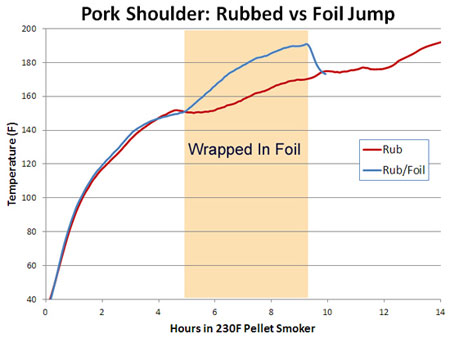 For his final test, Blonder took a 6 pound pork butt and divided it in two removing the bone. He rubbed them both with a standard pork rub and put them into a 230°F cooker until the stall began. Then he wrapped one in foil and added 1 tablespoon of water. In the chart at right, it is the blue line, labeled "Rub/foil".
The other he left alone, naked except the rub, the red line labeled "Rub". As you can see the wrapped pork climbed to 180°F in about half the time, about 6 hours. He let it go to 190°F, a target I recommend, removed the foil and put it back on to firm up the bark. As you can see, the temp dropped immediately after unwrapping as the moisture evaporated and cooled the meat. After 4 hours the unwrapped butt had still not passed 180°F. The lines end when he got hungry and when the foiled/unfoiled butt hit the same temp as the never foiled butt. He called the foiled butt "Really juicy and nearly perfect." But "When the other hit 180°F the meat was still slightly tough. It needed another hour or so to finish cooking in kitchen oven."
At right are photos of the two pieces of pork. Pretty comparable.
If the stall was caused by conversion of collagen to gelatin, since the transition happens within the foil and there is no stall, the phase change of collagen cannot be the cause. The fact that collagen melts at about the same temp as the stall is a coincidence, not the cause of the stall.
Based on Blonder's data, I now recommend that you wrap pork shoulders and beef briskets at about 150°F, after about 2 hours in the smoke. By then it has absorbed as much smoke as is needed. If you wrap it then, the meat powers right through the stall on a steady curve and takes much less time. It also retains more juice.
Ball says that he is now following a similar protocol in competition. He won't say what temp he cooks at on his MAK pellet smoker, but he is now foiling when his bark is the deep mahogany color he wants, usually somewhere between 140 and 150°F. He leaves it in the foil all the way up to the end, takes it out of the cooker, lets it come down in temp to about 175°F so it stops cooking, and then wraps it in a towel and puts it in an insulated holding box called a cambro for an hour or two to rest (see my article on how you can rig a faux cambro).
There is a problem with this approach for some cooks: The meat does not have a hard chewy bark on the exterior. Ball says that a hard bark is emblematic of overcooked meat. He wants a dark, flavorful, tender bark. But if you want a hard bark, the solution is to pull the meat out of the foil when it hits 180°F or so, and hit it with higher heat to dry the exterior and darken the rub. Or just skip the foil altogether, do things the old fashioned tried and true way, and just be patient. Either way, the results are superb.
If you change the way you cook based on Blonder's work, let us know how you liked the outcome. Click here to go to Blonder's website for more details on his experiments with the stall.
All text and the photo of the brisket are Copyright (c) 2011 By Meathead, and all rights are reserved. Graphs and pork photo are (c) 2011 by Greg Blonder.
For more of Meathead's writing, photos, recipes, and barbecue info please visit his website AmazingRibs.com and subscribe to his email newsletter, Smoke Signals.