iPhone app iPad app Android phone app Android tablet app More

Featuring fresh takes and real-time analysis from HuffPost's signature lineup of contributors
Meathead

GET UPDATES FROM Meathead
 

When Buying a Grill, Understanding the Thermodynamics of Cooking is Crucial

Posted: 04/23/10 03:24 PM ET

An outdoor grill may seem simple, but it is actually a complex cooking tool, and understanding how it works is crucial to making great food outdoors, and a necessity before handing your credit card to the clerk.

You may have thought you left physics and chemistry behind when you left school, but if you want to eat well, you need to understand that cooking is all about physics and chemistry, with a little magic mixed in. Here are some broad concepts every outdoor cook needs to know.

What is cooking?

Cooking defined. Most foods are composed mainly of water, fat, protein, and carbohydrates. Cooking is the process of transferring energy from an energy source to the food long enough to change its chemistry until you achieve safety and digestibility, as well as the desired flavor, texture, tenderness, juiciness, appearance, and nutrition.

The four ways heat cooks food. Food gets hot when molecules vibrate so fast that their temperature rises. Heat is transferred to food by means of conduction, convection, radiation, excitation, and induction.

The processes can be described this way: Conduction is when your lover's body is pressed against yours. Convection is when your lover blows in your ear. Radiation is when you feel the heat of your lover's body under the covers without touching. Excitation is when she talks dirty to you on the phone. And induction is when she gives you electric socks.

Let's be a bit more precise:

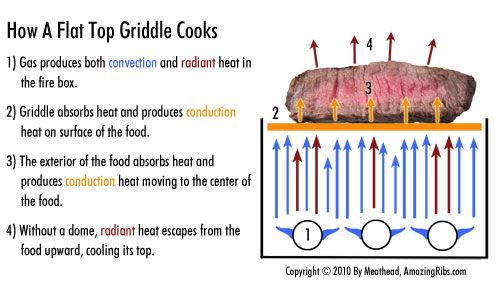
Conduction is when heat is transferred to the food by contact with the heat source. Cooking a hot dog in a frying pan is conduction. As the surface of meat gets hotter than the interior and the heat transfers to the center through the moisture and fats, that's also conduction.
2010-04-23-thermodynamics_griddle.jpg

Convection is when heat is carried to the food by a fluid such as air, water, or oil. Cooking hot dog in your kitchen oven where it is surrounded by hot air or deep frying it is convection. The interior of the meat, however, is cooked by conduction as the heat travels through it.

Radiation is the transfer of heat by direct exposure to a source or energy. Grilling a hot dog directly over hot coals is radiation with the exception of the parts touching the hot grates. They cook by conduction.

Excitation is how microwave ovens work. Microwaves are radio waves that penetrate the food and vibrate the all the molecules inside the hot dog at once until it gets hot without heating the air around it.

Induction is the latest technique for stove tops. An copper coil is placed under a smooth cooktop and an alternating current is sent through the coil creating a rapidly changing electromagnetic field. Electrons in conductive steel or cast iron pots placed above the electromagnet are jostled by the rapidly changing magnetism, but they resist and get hot. The pot then conducts the heat to the hot dog without the cooktop or the air around it getting hot. Induction is very responsive to the control knob and is extremely energy efficient, but it does not work with aluminum, glass, or copper pots.

The different types of grill

Want to start a new business? I'll tell you one to avoid: Manufacturing grills. Man, there are a lot of choices out there. But that's good for us. Prices are competitive. You can get a cheapo disposable grill for the beach for under $20 or a state of the art rig with everything including the kitchen sink for $20,000. What does it say about our love of grilling when my neighborhood hardware store has an aircraft carrier sized gas grill on display with a sign: "Financing available"?

Let's start with the different fuels: Charcoal, gas, wood pellets, or electric.

Charcoal

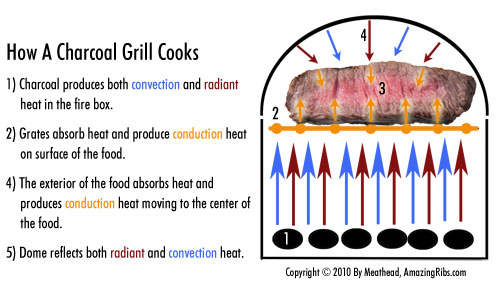
2010-04-23-charcoal_types.jpgMostly carbon, charcoal has been used as cooking fuel since prehistoric times. If you don't muck it up with solvent when you start it, it burns cleanly, hot, and pretty close to flavorless. The smoke is mostly from food drippings. There are two major types, hardwood lump and briquets. Hardwood charcoal is pretty much the way charcoal has been made for centuries. Hardwoods are set to smoldering in a closed environment with very little oxygen until it turns to lightweight carbon. Briquets are hardwood charcoal ground up and mixed with binders and additives to help it form a briquet. Controlling the temperature on charcoal grills can be tricky, and you cannot be a good cook if you cannot control the temperature. I can't take the space to get into the details and advantages or disadvantages now, but you can read more in my article The Zen of Charcoal.

Likewise, I won't get into the long religious discourse over which is better, charcoal or gas, but I will send a few of you hurling off the deep end by saying that flavorwise, the taste differences are negligible between charcoal and a really hot gas grill, especially on quickly cooked foods like burgers or steaks. For the charcoal devotees, ask yourself this: Remember the best steak you ever had? At a steakhouse, right? What fuel do they use at almost all the great steakhouses? For more about the topic, and especially before you start calling me an idiot, read my article Charcoal vs. Gas Grill Throwdown. If you are shopping for a charcoal grill, read my article Reviews of Charcoal Grills.
2010-04-23-thermodynamics_charcoal.jpg

Gas

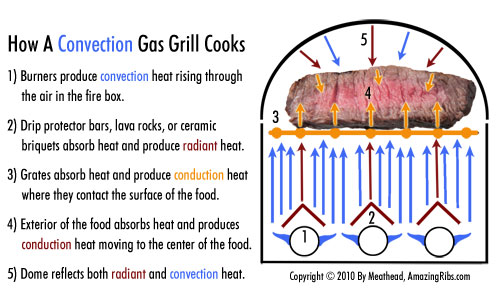
Liquid propane, which comes in tanks, and natural gas, which comes in pipes, work pretty much the same. The advantage of gas grills is that ignition is push button, they heat up quickly, and there is no ash to clean up and discard. The disadvantage is that gas grills are more expensive than charcoal. Gas grills can be divided into two categories, convection and infrared. Convection grills are the standard system of burners, usually tubes with holes, that sit below the grates upon which food sits. Between the burners and the grates are upside down V shaped drip deflectors, lava rocks, or ceramic briquets.

2010-04-24-convection.jpg

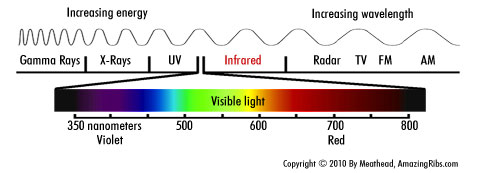
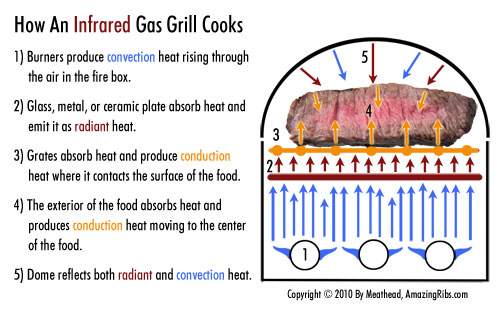
In the past few years a number of gas grills have been touting their superiority because they use "infrared" cooking. What the marketing guys really meant when they called their newfangled cooking systems infrared, was radiant heat because there is a radiant surface, a plate of glass, ceramics, or metal, between the burners and the cooking grates. The radiant surface absorbs the heat from the flame and radiates it to the food.
2010-04-23-spectrum.jpg

The advantage of radiant heat is that it is more efficient than convection, it gets hotter than convection, often in the 500 to 700F range, there is less dry air motion, and less moisture is lost. Also, the radiant surface is usually very close to the food so dripping juices or marinades incinerate and go right back up into the meat, adding flavor without flareups. The results are indistinguishable from charcoal. Worth it? Yup. Especially if you want good browning. And you do, because browning creates flavor.
2010-04-23-thermodynamics_infrared.jpg

If your grill doesn't have infrared, you can add it with a new commercial product called GrillGrates. They replace the manufacturer's grates or sit on top of them and act like infrared generators. Read more about GrillGrates here.

If you are shopping for a gas grill, read my article Reviews of Gas Grills.

Wood Pellets

2010-04-23-pellets.jpgWood pellets look like rabbit food. About the thickness of a pencil, and less than 1" long, they are made entirely of compressed sawdust with no glues or binders. They are fed by an electric motor driven Archimedes screw into a small combustion chamber where they are ignited with a heating element. The combustion chamber is about the size of a beer can ripped in half and it sits in the center of a radiant heat plate. By increasing the rate of feed and the fan you can increase the temp. At temps under 400F they generate a lot of smoke and make incredible smoked foods. At higher temps there is less smoke. Newer models are thermostat controlled, just like your indoor oven, and the flavor is fabulous, if you like smokey foods. Pellet grills are not cheap. If you are shopping for a pellet burner, read my Review of Pellet Grills and Smokers.

Electric Grills

Electric grills usually cook by conduction and radiation. The work with an electric element under a heavy metal surface that usually has ridges. They don't get as hot as gas or charcoal, and the flavor is not as interesting.

Shopping for a grill or smoker

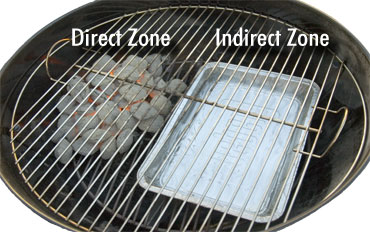
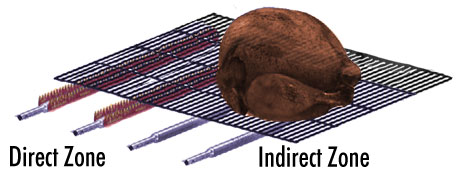
Temperature control. The key to successful cooking indoor or out is temperature control. A good grill must have (1) a lid so food can cook on all sides and (2) allow you to setup multizone lid down roasting with at least two zones. One zone for high heat cooking, another for slower, lower heat cooking. For more on this important concept, read my article on 2-Zone and Indirect Cooking.

2010-04-23-2_zone_setup.jpg

Charcoal grills should allow you to bank the coals on one side and leave the other side without coals. They need tight lids and dampers that can be opened or closed to control oxygen to the fire and thus control the heat. Some have the ability to raise and lower the coals. This is a very good thing because heat dissipates according to the inverse square law which states that the energy delivered to the meat is inversely proportional to the square of the distance from the source of the energy. In plain English, this means that means that if the charcoal is 2" from the meat there is 4 times as much energy delivered to the meat than when the coals are 4" away, not double.
2010-04-23-indirect_gas.jpg

For gas grills, you want at least two burners so one can be on and one off. But the more the better. With three or four burners you can have hot, medium, and low zones. You also need a lid that closes fairly tight for smoking. Alas, very few gassers seal tightly. You also want even heat across the cooking surface. Watch out for hot spots over the burners.

Other important features. When shopping for a grill, in addition to price, you want to consider size of the cooking surface, size of the grill's footprint, space under the hood, the maximum heat, minimum heat, quality of construction and materials, what the grates are made of, rotisserie capability, thermometer, side shelves, side burners, ease of cleaning, ease of assembly, safety, warranty and support, and accessories. For more on what to look for when shopping for a grill, read my article How to Buy a Grill.

Tell me about your grill and what you like or hate about it.

----------------------------

All text and photos are Copyright (c) 2010 By Meathead, and all rights are reserved. For more of his writing, photos, and recipes, please visit him at AmazingRibs.com.


Follow HuffPost Food on Twitter and Facebook!


Follow Meathead on Twitter: www.twitter.com/ribguy

An outdoor grill may seem simple, but it is actually a complex cooking tool, and understanding how it works is crucial to making great food outdoors, and a necessity before handing your credit card to...
 
 
  • Comments
  • 101
  • Pending Comments
  • 0
  • View FAQ
Comments are closed for this entry
View All
Favorites
Recency  | 
Popularity
Page: 1 2 3  Next ›  Last »  (3 total)
04:32 AM on 04/28/2010
I've found that a Weber grill with lump charcoal that's NOT started with starter fluid (electric starter, starter sticks, anything that doesn't make it stink.) works best. Lump charcoal burns cleaner with a LOT less ashes to clean. Nice and hot for steaks and you can adjust the heat with the lid and exhaust port for cooking killer bbq ribs and chicken. I've read in the past that propane burns resulting in the release of water molecules while charcoal doesn't... resulting in a better steak.
01:43 PM on 04/27/2010
MEAT IS MURDER and grills are like nazi crematoriums!! LOL...only kidding, Craig. Just had to give you a little sh*t after your last article... ;)
This user has chosen to opt out of the Badges program
photo
06:18 PM on 04/26/2010
to say there's no difference in taste between charcoal and gas tells me that the author must be eating crappy meat or really doesn't know how to grill.

being from texas, where REAL bbq is done in smokers with wood, and having lived in argentina for the last 15 years, i can tell you that there's no comparison.

in argentina, they have the best natural beef in the world (grass fed, not this corn-fed hormone crap you find in the states), and it's all cooked over hardwood coals in some form or another, whether hardwoods are burned down to coals or charcoal is bought in the store.

argentines know their beef, consuming about 4-5 times as much as americans per year on average. 95% of the restaurants use real wood charcoal over open grills. anyone who's ever been down here and tasted the meat knows there's absolutely a difference.
photo
HUFFPOST BLOGGER
Meathead
I am a Barbecue Whisperer and Hedonism Evangelist.
09:22 AM on 04/27/2010
Wood is not the same as charcoal. Huge difference in flavor. Wood has scores of compounds that are removed in the process of making charcoal.

I'm really getting tired of telling people who haven't read the article or the comments below, or followed the links, that it is all about the heat and how it changes the flavor of the fats, not the fuel, and the big diff between charcoal and gas is that charcoal is usually hotter. But new infrared grills close the gap.
03:08 PM on 04/26/2010
Though I'm pining for an egg...most specifically the literal works of art that are Kamodo Kamados (green egg my patootie: http://www.komodokamado.com/new2/ ), I must say I cannot imagine a more comprehensive, flexible cooker than the Weber Summit 470 I got last fall.

Great for low & slow...with/without great smoke from the dedicated smoke box/burner...the Sear Zone burner on the 470/670 give you the super-hot you want for steaks & chops. Great build quality, and what's so great about Weber is you know you'll ALWAYS be able to get parts easily for decades to come. That's how I justified spending that much...I KNOW I'll be using it in 15-20 years, as I'm giving my old Genesis to my mom-in-law that I got about 18 years ago at the ole' annual Weber Factory Sale in Palatine (man, I miss those!!!)

Genesis are great too, but go with the stainless steel grates & flavorizer bars. Porcelain-on-steel is OK for cookboxes & lids, but not for the 'guts' inside...you WILL need to replace heat-diffusers & grates every 3 or so years (but again, you can buy parts in either material).
12:03 PM on 04/26/2010
This is a great post, Craig. My husband and I (well, mostly my husband) grill about 4 to 5 times a week. We make all our holiday dinners on the grill, even when it snows. And when the power goes out due to a storm, we're lucky to have our reliable Weber. But one point about any method of cooking is that the better the product, the better the taste. So, regardless of whether you use gas/propane, charcoal/hardwood, or even an oven, cheap meat is pretty mediocre once you've tasted grass-fed farm-raised beef, or truly free-range chickens.

Thanks for a great post -- I look forward to reading more of them.
photo
HUFFPOST BLOGGER
Meathead
I am a Barbecue Whisperer and Hedonism Evangelist.
09:23 AM on 04/27/2010
AMEN!
This user has chosen to opt out of the Badges program
photo
01:15 PM on 05/16/2010
How's the artery blockage?
12:16 AM on 04/26/2010
A great article, but I feel like I need to disagree on one point. I don't feel that your science is totally accurate. Heat is not "created" in foods. As a form of energy, heat can neither be created nor destroyed. It is simply transfered to foods from one source to another. The energy causes the food molecules to move faster. This is actually what temperature is: a measurement of the average speed of a group of molecules.
Also, you claim that there are five methods of heat transfer. Excitation is not a separate form of heat transfer, but just a specific example of radiation. To see this, think of microwave cooking as "radiant energy transfer." The microwave radiation transfers energy to the food. The food begins to heat up, and as it does, the heat conductively transfers throughout the whole body. I have never heard of induction as its own method of heat transfer, but I also do not know enough about it to talk confidently.
Sorry, but as a chemical engineering student with an interest in food science, these types of things bother me.
photo
HUFFPOST BLOGGER
Meathead
I am a Barbecue Whisperer and Hedonism Evangelist.
09:22 AM on 04/26/2010
Of course you are correct that heat is not created, it is transferred. I will change "Heat is created when molecules vibrate so fast that their temperature rises. Heat is transferred to food by means of conduction, convection, radiation, excitation, and induction." It now reads "Food gets hot when molecules vibrate so fast that their temperature rises. Heat is transferred to food by means of conduction, convection, radiation, excitation, and induction."

Technically ALL cooking methods are excitation, but I am discussing METHODS of excitation used in cooking.
07:15 AM on 04/28/2010
If you're interested in food science, check out Harold McGee's "On Food & Cooking" - total science geek out for the foodie.
photo
mlaiuppa
Pres. Sarcasm Society. Like we need your approval.
05:27 PM on 04/25/2010
My Dad uses propane.

I use lump charcoal.

I think my steaks are better.

What I really want is a big green egg. Really.
07:28 PM on 04/25/2010
Your steaks are better because propane doesn't get as hot as lump charcoal. Qing steaks is all about high heat, don't 'cha know!!
photo
HUFFPOST BLOGGER
Meathead
I am a Barbecue Whisperer and Hedonism Evangelist.
07:45 PM on 04/25/2010
Spike is right. Most propane grills don't get hot enough. Infrared grills do. Read this, one of the links above, comparing charcoal to propane:

http://amazingribs.com/BBQ_buyers_guide/grills/charcoal_grills_vs_gas_grills.html
04:31 PM on 04/25/2010
OK, bottom line time:
Which cookers DO you recommend in the various categories? I would like to see a list of rankings.
photo
HUFFPOST BLOGGER
Meathead
I am a Barbecue Whisperer and Hedonism Evangelist.
07:47 PM on 04/25/2010
Waaaay too many to consider and waaay to much to discuss here. But there are links in the article above to my review of dozens of grills and smokers.
04:11 AM on 04/25/2010
Ya know, it's not often I'm impressed with a HP blogger's post, but you covered a lot of material in this one, and I didn't find a single error in all of it. Well done.
12:44 AM on 04/25/2010
I am really impressed with depth of discussion on this subject. I am more impressed with your dilligent follow-up on the postings Craig.

Big fan here.
photo
HUFFPOST BLOGGER
Meathead
I am a Barbecue Whisperer and Hedonism Evangelist.
10:08 AM on 04/25/2010
Thanks! When time permits, I try to interact with commenters. Especially when I know that my articles can't possibly cover the entire subject. And as a HuffPo devotee I love a good fight like most of our readers!
01:54 PM on 04/24/2010
Textbook stuff Craig! Love the charts and detail! Fun to see the trouble you stir up too. I'm smoking and grilling just quite well on my old charbroil using GrillGrates and BBQR's Delight All-natural wood pellets.
photo
HUFFPOST BLOGGER
Meathead
I am a Barbecue Whisperer and Hedonism Evangelist.
02:10 PM on 04/24/2010
Full disclosure: Brad is the inventor of GrillGrates, but they are really really impressive. Made with aircraft aluminm, they have wide rails that make the best grill marks, and their base converts any grill into a radiant infrared grill. They can take an old convection grill and get the temp up to steakhouse temps. The back side can be used as a griddle. I use them on both my gas grill and my charcoal grill.

GrillGrates with pellets, sawdust, or chips is the best thing to happen to outdoor cooking since salt and pepper. Read more here: http://amazingribs.com/BBQ_buyers_guide/barbecue_accessories.html

Full disclosure. My review on that page contains a link to Amazon which pays me a small referral fee. But my respect for GrillGrates is honest unbiased awe.
08:22 AM on 04/25/2010
Craig is the one who turned me onto BBQR's Delight natural wood smoking pellets- called us Peanut Butter and Jelly. They really work in my gas grill, in fact I use half the suggested amount to avoid too smoky a flavor that overpowers the meat. I've learned a lot from Craig and appreciate his technical approach and passion for great grilling.
11:22 AM on 04/24/2010
As usual, Craig, you've given a tremendous amount of information -not to mention experienced observation - in this article. I love it when people offer their criticisms without 1/100th of the experience and research that you have devoted to this subject. Truly, ignorance is not only bliss, it's arrogant!
10:00 AM on 04/24/2010
Another urban myth.
HUFFPOST COMMUNITY MODERATOR
jeb50
Retired.
09:39 AM on 04/24/2010
I only grill with wood and not that rabbit pellet wood. Mainly hard Maple and cherry. Your only kidding yourself if you think gas or charcoal will give the food the same flavor.
photo
HUFFPOST BLOGGER
Meathead
I am a Barbecue Whisperer and Hedonism Evangelist.
10:24 AM on 04/24/2010
Charcoal is like religion. Facts just don't apply. And reading skills are useless.
photo
HUFFPOST SUPER USER
donaldinks
and so it goes...
09:28 AM on 04/24/2010
Thank you, Craig...
for the very insightful article and information.

I've been an "outdoor griller" for over 38 years now,
and have grilled on everything from the cheapest charcoal grill, to a "split-in-two" 55 gallon steel drum...
to this kinda mediocre "but does the job" Char-Broil.

I grill outside probably 3 to 4 times a week, year round (...and in Michigan...that's a fun time!).

When this grill dies, I"ll move up to a Weber.
Now that I'm retired...
I want one that will last longer than me.
;-)

Thanks again, for the great Information!